Some trees emit potentially toxic vapours that could increase urban ozone pollution, according to a new study that could change the way green spaces are designed in cities.
While the green cover in cities can absorb gaseous pollutants and cool urban neighbourhoods, some trees also emit potentially toxic volatile compounds that can contribute to ozone pollution at the ground level.
These volatile compounds are similar to those found in solvents, paints, cleaning products, and fuel vapours, say researchers from Jinan University in China.
As the global climate warms, there is an increased need to understand the significance of these overlooked emissions from trees, scientists say.
In the latest study, researchers set up a direct emissions monitoring system on a 102m (335ft) platform, high on Beijing's meteorological tower, as well as in a laboratory at the building’s base.
Scientists tracked chemical signals in the atmosphere several times per second, capturing the city's chemical "breath" in real time.
Researchers specifically quantified volatile organic compound (VOC) emissions and traced them to sources like trees, traffic, chemical products, cooking and household activities.
The chemical isoprene, which is found in natural rubber, was found to be one of the key reactive compounds detected, and most of it came from trees, the study found.
Hot weather also seemed to amplify VOC emissions in cities.
Between 20C and 35C, the chemical reactivity of the volatile compounds emitted by city trees increased seven to eightfold, scientists found.
Isoprene emissions in Beijing were the highest among the cities observed, approaching levels found in temperate forests, the study found.
This was mainly due to the tree species planted in Beijing, researchers say.
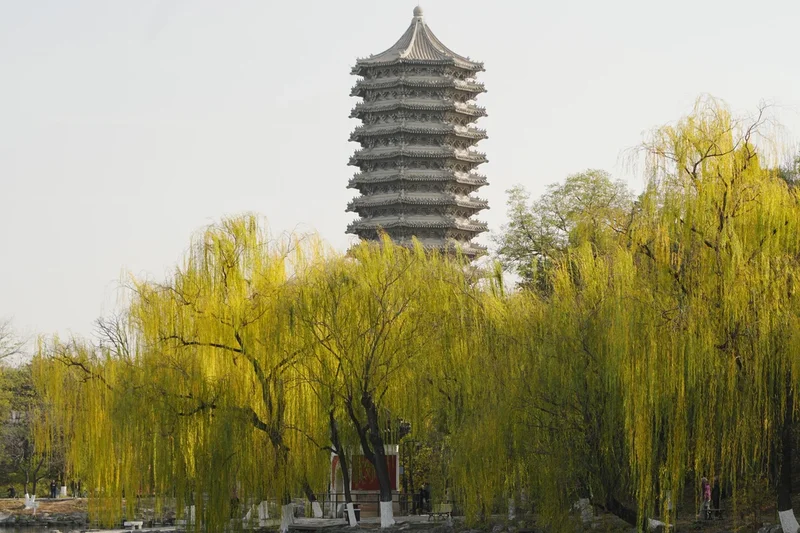
Large proportions of native trees in Beijing are known as isoprene emitters, including the weeping willow (Salix babylonica) and the Chinese white poplar (Populus tomentosa).
“This finding may apply to other cities in northern China as reflected by similar or even larger average emission potential estimated for Harbin and Changchun as these cities have extensively planted willow and poplar trees over the past decades,” scientists wrote.
Many other cities in Asia and Oceania may also face comparable air-quality pressures from tree emissions, they say.
"In European cities, we find considerably fewer tree species that release isoprene. Native tree species often emit monoterpenes, which are also ozone-forming, but are released in smaller amounts than isoprene," said Thomas Karl, another author of the study.
However, scientists caution that the findings do not call for less urban greening or the removal of mature trees.
Instead, they call for selecting trees with lower volatile compound emission potential.
Taking the example of Beijing, researchers say the city officials could replace high VOC-emitting trees in one-tenth of the total city tree population with low-emitting species to reduce isoprene emissions by at least 29 per cent.
“Our findings underscore the critical need for selective urban planning in greening programs to counteract a warming climate,” they wrote.