Britain's most politically correct broadcasting station, BBC Radio 4, is currently transmitting a series arguing that we're all wrong and that crime is, in fact, going down.
Really? Well, so they say. A lot. Noisy trailers blare the foghorn voice of Mark Easton, who sums up his own message on anti-social media as: 'If we're serious about cutting crime, we need to accept it's fallen and work out why.'
He's not alone. This 'crime is falling' theory is widely believed among the great and the good, which might explain why our criminal justice system has become so feeble. Large numbers of politicians, Labour and Tory, have proclaimed that crime has been going down for many years now.
We, the public, have apparently got it all wrong and are having a moral panic, fuelled by delusions.
Mr Easton, after decades at the BBC, has now definitively joined the think-tank world in which such exalted beliefs guide our nation. He is a senior fellow at something high-minded called the National Centre for Social Research. He is also a fellow of the Academy of Social Sciences and a governor of the National Institute of Economic and Social Research.
How shall I put this? I think it would be unfair to call any of these bodies fiercely conservative.
This 'crime is falling' theory is widely believed among the great and the good, which might explain why our criminal justice system has become so feeble, writes Peter Hitchens
Large numbers of politicians have proclaimed that crime has been going down for many years now. We, the public, have apparently got it all wrong and are having a moral panic
What is really going on here? How can we tell? From 1898, the old Home Office collected classic crime figures – actual crimes committed, and acted upon by proper police officers. However, that long line ended in 2002. The figures you see now are gathered in a different way and cannot be compared with the old ones.
As with so many things in modern Britain, the beginning of the Blair era in 1997 signals a break in almost everything government does or says.
A new National Crime Recording Standard was introduced. And what we see now are figures of 'recorded crime'.
Dr Rodger Patrick, who completed 30 years of police service as a Chief Inspector for West Midlands Constabulary, is now an academic specialising in such things.
He is filled with doubt about the figures we now see.
He says scathingly: 'They have been fiddling the figures for years and [they] are as reliable as an elastic ruler. Making sense of them is like reading tea leaves.'
Back in 2013, Parliament's Public Administration Committee examined the reliability of modern police crime statistics. Its report was entitled Caught Red-Handed and said there was 'strong evidence of under-recording, which was exaggerating the rate of decrease in crime'.
The Daily Mail at the time reported: 'Crime figures are routinely massaged by police desperate to show that they are making the streets safer, it was claimed yesterday. Serious offences including rape, child sex abuse, robberies and burglary are disappearing in a 'puff of smoke'. Police are accused of downgrading crimes to less serious offences and even erasing them altogether by labelling them as accidents or errors.'
One police analyst claimed that hundreds of burglaries 'disappeared' in a matter of weeks at the Metropolitan Police after managers intervened. Police forces throughout England and Wales were found to have an 'utterly unacceptable' rate of accurately recording crime.
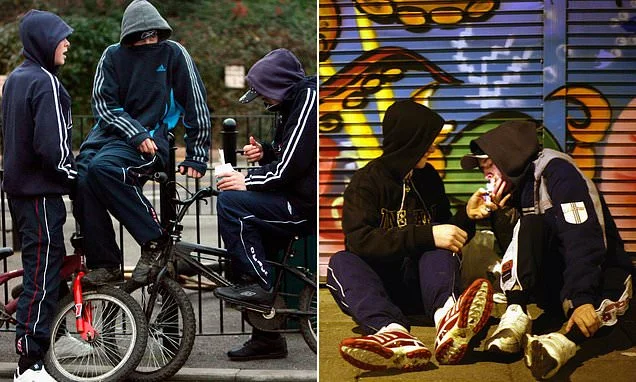
'Anti-social behaviour', the loutish menace in the streets faced by so many, alters lives for the worse but is hard to quantify (Pictured: youngsters on a housing estate in Bristol)
You could nowadays use a Smellometer, if such a thing existed, to detect the widespread use and possession of marijuana, a crime that is officially punishable by up to five years in prison
The then HM Inspectorate of Constabulary (HMIC) estimated that almost one in five crimes were not being recorded, though how anyone can know how many crimes go unrecorded is hard to say.
The rebuke was so severe that recorded crime figures rose sharply in each of the following four years.
Actual crime probably just carried on rising as before, but how can we be sure? Years later, all is still not perfect, even in the official view.
Almost a year ago, HMIC's successor, HM Inspectorate of Constabulary and Fire & Rescue Services (HMICFRS), said 'the percentage of overall crime the police have recorded has risen from 80.5 per cent in 2014 to 94.8 per cent in 2025' – an assertion some might possibly doubt. How can it know?
It said: 'Although the standard of crime recording has improved, there is still more to do. There is still too much difference between forces in how well they record crime.
'Some forces have set and achieve high standards; others haven't made as much progress as we would have liked. Violent crimes – such as minor assaults, harassment, stalking and controlling or coercive behaviour – still aren't being recorded well enough.'
Dr Patrick would go much further. He says the picture is being badly blurred by a new standard for recording crime, introduced in April last year.
He gives this example – a woman has her phone stolen from her bag on a train but does not see the theft. She tries to report it when she discovers it's gone, but cannot prove the phone has been stolen.
Officers, under pressure from bosses to cut crime figures, classify it as a 'loss' – and refuse to record it as a crime. Thus does crime fall, or appears to do so, in modern England.
There is another element in this. The Crime Survey for England and Wales (CSEW) is heavily relied on by many analysts when discussing crime in this country.
But again it is full of flaws. Dr Patrick describes it as 'a survey of nice people living in Niceville – the survey group is selective and the offences covered are limited'.
For instance, it does not survey shoplifting, an alarming, dispiriting and often frightening activity which many burglars have switched to, in the near-certainty that they will not be caught or punished and because of the ease with which it can be done.
The CSEW is also poor at giving full impact to 'anti-social behaviour', the loutish menace in the streets faced by so many, which alters lives for the worse but is hard to quantify. And it has trouble noticing huge and growing crimes, such as the possession of illegal drugs.
You could nowadays use a Smellometer, if such a thing existed, to detect the widespread use and possession of marijuana, a crime that is officially punishable by up to five years in prison but almost unprosecuted.
The sad truth – and it applies nowadays to exam results, unemployment and inflation figures – is that almost all politically significant statistics are fiddled or massaged in one way or another.
This has especially affected crime since the Blairites claimed to be tough on it, back in the 1997 election.
So I can't prove the ebullient Mark Easton wrong when he incessantly proclaims his happy-clappy message of falling crime. I'd need a whole government machine and several years to do that.
However, to all those who, confronted with such claims, mutter that it doesn't feel that way round where they live, I would say that there is a good chance the optimists may in fact be wrong, and your eyes and ears may be right.