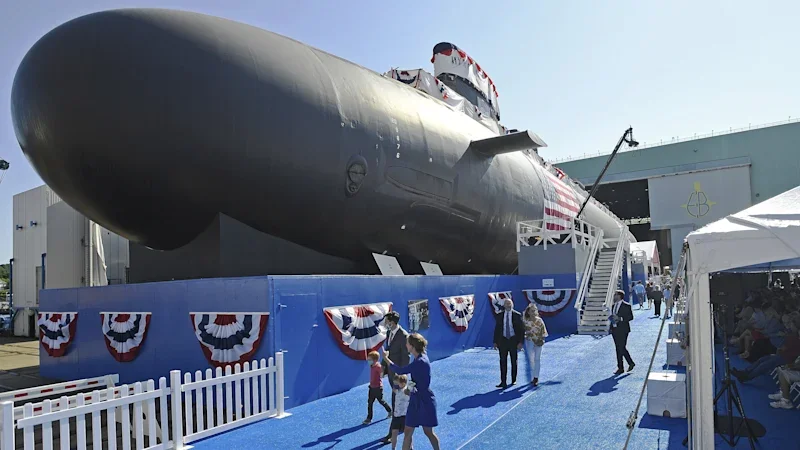
Washington: Billions of dollars of additional funding for the US defence industrial base have not improved the production rate of Virginia-class submarines, a top Pentagon official says, casting further doubt on whether Australia will receive its AUKUS subs on schedule.
Austin Dahmer, a senior policy official at the US Department of Defence, told a hearing on Capitol Hill that while undersea forces were the decisive instrument in denying Chinese domination of the Pacific, they were also the forces the US was the least able to produce.
“Virginia-class boats have been delivering at roughly 1.1 to 1.2 a year since 2022, against a requirement of two to 2.33, counting AUKUS pillar one,” he said.
“Two per year is not now expected until roughly 2032 … The strategy is sound. Production capacity is the point of failure.”
The US Congress has approved billions in additional funding to build submarines, while Australia has tipped in at least $US2 billion ($2.84 billion) with another $US1 billion to come. But Dahmer said the extra money had not helped.
“I would underline that Congress has already appropriated [funds] substantially, and the rate has not moved,” he said. “Any recommendations that consist of more money without a mechanism to materially compress those timelines will not change the outlook.”
Dahmer is a deputy to Elbridge Colby, the undersecretary of defence for policy who has in the past expressed scepticism about AUKUS. He made the comments to the National Commission on the Future of the Navy on Wednesday (US time) during a hearing on ways to improve US sea power.
Afterwards, he told this masthead the navy was working hard to improve delivery of the Virginia-class submarines so that a future administration would be in the best possible position when it decides whether to transfer a vessel to Australia.
“We’re full steam ahead … It’s incumbent on all parties – us and the Australians and the British as well – to ensure that we’re meeting those conditions on the timelines agreed upon,” he said.
“It’s a conditions-based agreement; it’s not a time-based agreement. So we have time to improve – we’re just being clear well ahead of time that we’re not there yet.”
The comments underscore the practical hurdles facing AUKUS despite the political commitment from all three countries, and come as Australian Labor Party members prepare for a possibly fiery debate about the pact at their national conference in Adelaide.
Under the $368 billion-plus agreement, Australia is due to receive at least three nuclear-powered submarines from the US starting in 2032, before building a new class of the vessel, the SSN-AUKUS, with the UK.
The US has now clarified all three of the submarines it proposes to sell to Australia will already be in service, rather than new. But the president of the day must approve the transfer and be satisfied it does not degrade US war-fighting capability.
Arthur “Trip” Barber, a retired 40-year veteran of the US Navy and the Pentagon, who now sits on the National Commission on the Future of the Navy, said the fundamental problem was shipyard wages, and their inability to retain workers.
“We need to pay shipyard workers a compelling amount of money so they stay on the job,” he told this masthead.
Barber said Australia made the correct decision to acquire nuclear-powered submarines. “Everything about the decision was right until you get to the point of, ‘well, can we actually make them?’ That’s a struggle.
“Can we sell submarines that are in service and take the inventory dip? The plan was that we would be building new ones. Well, that’s not working out real well. I have no idea how that’s going to end.”
AUKUS sceptics in Australia are currently holding an independent public inquiry into the defence pact, which has heard from figures including former Liberal defence minister Christopher Pyne.
A staunch AUKUS supporter who is now a defence lobbyist, Pyne told the inquiry he did not believe the project would be delivered on time nor on budget, but “they’ll give it a good go”.
Deputy Prime Minister and Defence Minister Richard Marles was contacted for comment. His office referred inquiries to the government’s Australian Submarine Agency.
“All three AUKUS partners are investing significantly in our respective industrial bases to ensure the success of AUKUS, to meet respective requirements and timelines, including the delivery of three Virginia class submarines to Australia by the US,” an ASA spokesperson said.
“The Australian government is satisfied that it has the appropriate bilateral and trilateral agreements and arrangements, and governance structures.”