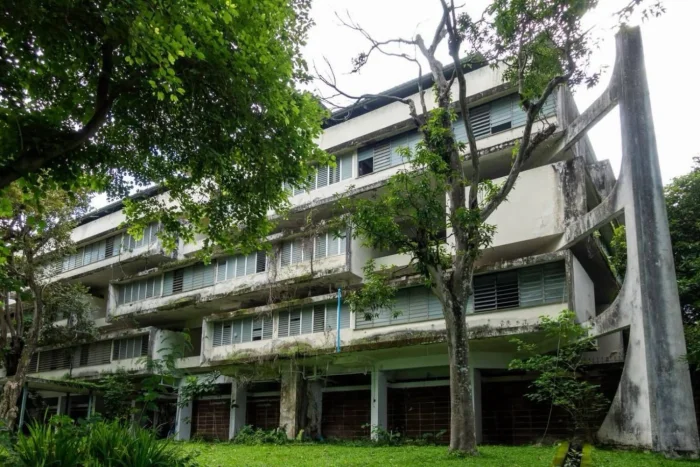
Thai architects have called on Chiang Mai University to reconsider the demolition of the Ang Kaew Dormitory, considered a prime example of a bold, progressive milestone in the country’s architectural history.
The building was one of the early projects by the legendary self-taught architect Amorn Srivongse, whose visionary work continues to inspire generations of architects.
The main engineer for the project was the late Arun Chaiseri, considered the father of modern structural engineering in Thailand and known for landmarks like the Baiyoke Tower II and the Elephant Building in Bangkok.
Over six decades ago when Thailand was transitioning towards an industrial economy, technocrats were pushing to expand higher education into the provinces to increase the number of graduates, leading to the establishment of Chiang Mai University (CMU) as the country’s first regional university.
The Ang Kaew women’s dormitory, which opened in 1964, was regarded as a symbol of the university’s boldness in breaking away from the central government’s applied Thai architectural framework and embracing progressive, international modern architecture.
According to the influential design and decor publication Baanlaesuan (House & Garden), the building is distinguished by its open courtyard plan, which allows ventilation from the area around the Ang Kaew reservoir.
The rooms are arranged in groups of four, staggered like bricks, with spaces between them creating wide balconies that allow airflow throughout the day. Inside, the ceilings are set at two different levels, while teakwood louvres filter sunlight and allow natural ventilation.
The building also features diagonal cantilevered beams connected to supporting columns at its four corners, adding visual depth and giving the structure a dignified presence beside the water, wrote Baanlaesuan.
The design makes room units appear to float independently from the main structure of the building.
Amorn, who died in 2012 at the age of 84, is best known for his modernist and brutalist works. He designed many buildings in Thai universities, including the “Tuek Klom” lecture hall at Mahidol University and the “Pumpkin Building” of Prince of Songkla University.
The Ang Kaew dormitory had been unused for several years and maintenance was no longer being done, before news of the demolition emerged this week.
The news has saddened academics and members of the public, who feared they were getting a last glimpse of another valuable example of Thai architecture.
Bidding documents from CMU indicate that the Ang Kaew dorm is among other structures slated for demolition. It specifies a value of 209,587 baht associated with the building, based on demolition costs referenced from two other dorms that had previously been demolished and replaced with new buildings on the same site.
Adaptive reuse proposed
On Wednesday, the Association of Siamese Architects Under Royal Patronage (ASA) submitted a letter to the university management, expressing its opposition to the demolition.
“Ang Kaew Dormitory is not merely an old building; rather, it is a physical testament to the founding of Chiang Mai University, the first regional university in Thailand, and an important part of the history of modern architecture in Thai higher education,” the ASA said.
The association said that preserving a historical building does not mean halting development but safeguarding the values of the past as an integral part of future development.
It asked the university to reconsider the proposed demolition and to explore conservation options or adaptive reuse strategies before making a final decision.
The ASA said it was also willing to support any approach to conservation.
Pinai Sirikiatikul, an associate professor of architecture at Silpakorn University, strongly criticised what he described as a short-sighted and unimaginative approach to the old building.
“It is sad that, in an era when access to knowledge is vastly easier than before, those responsible can still be so narrow-minded that they see a deteriorating building and immediately decide to demolish it,” said Mr Pinai, author of the e-book Unpacking the Archives: Amorn Srivongse.
He added that this could be an opportunity that allows the university to demonstrate expertise and vision as a conservation-minded institution.