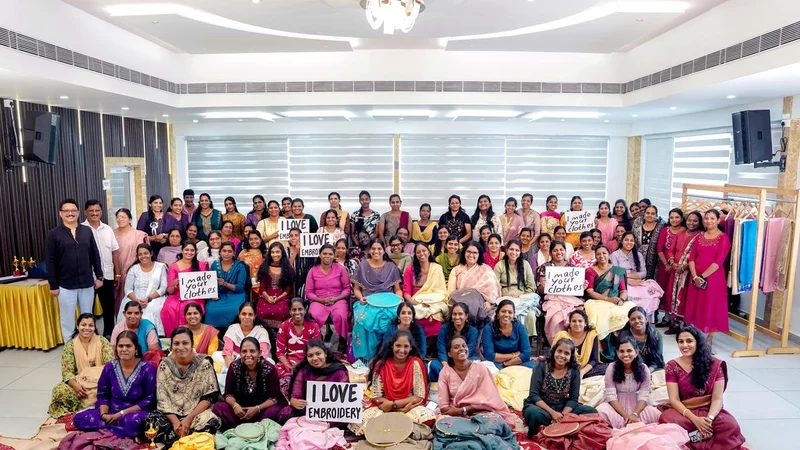
You cannot expect a hall with around 100 people to be quiet by any measure. But the one I walked into on a Saturday morning was relatively quiet, except for a buzz. A group, all of them women, sat there engrossed in embroidery, some on the floor and others on chairs. They were busy creating intricate designs on the fabric attached to the hoop they were holding. That was an event by Thiruvananthapuram-based hand embroidery e-commerce brand Alika to celebrate its artisans.
Alika boasts a legacy dating back to the 1930s, when Sophie Sathyasandhan, a homemaker from Thalassery, learnt embroidery from the visiting Christian missionaries. She passed on the knowledge to her daughter Ramola Francis and daughter-in-law Pearly Manohar. Sophie opened Sathya Thayyal Centre in Thalassery in 1958, and went on to train many women. Pearly carried forward that tradition, which she passed on to her daughter, Deepthi Jewel S.
Once Deepthi moved to Thiruvananthapuram post-marriage, Pearly too came along. That was when, in 2013, they introduced hand embroidered clothing in the capital city through an exhibition. The brand, christened Alika, meaning noble, named after Deepthi’s daughter, is now managed by Deepthi’s husband, Sarath Kiran, while she divides her time between the brand and her corporate career.
Alika has a huge customer base spread across India and abroad for its hand embroidery done on pure linen, cotton and silk fabric. “With 120 artisans, all of them women, working for Alika in Thiruvananthapuram alone, we decided to bring them together and acknowledge their work. Among them are divorcees, widows, survivors of domestic abuse, and those who are economically backward. We have been able to change their lives for the better and felt that their stories needed to be told,” says Sarath.
Deepthi adds, “We have built this workforce in the last eight months. We shared a WhatsApp story, saying embroidery would be taught, and we stressed that it is to give them jobs and not as a hobby. One batch had 15 trainees, and more women joined when those who trained under us spread the word about what we were doing. That was when we thought about building a community. In fact, most of them were meeting each other for the first time. Post-pandemic, they have been working from their homes once they collect the fabric from our store at Mudavanmugal. Besides the 120 here, around 25 women work for us at Thalassery, Kozhikode and Kochi.”
While the women in Thalassery specialise in ribbon work and applique, the ones at other places concentrate on cut work, she adds.
Among those whom we met at the gathering was Ancy ML from Vilappilsala, the first hand that Alika recruited, who is also among the three women trainers with the brand. “I joined in 2016, and I have trained more than 100 women over the years. I have become self-reliant, confident and feel that I am more valued by my family. And it is overwhelming to hear that the saris I worked on have travelled to countries such as the US and New Zealand,” says Ancy.
While Bindu M is proud that she no longer has to ask her husband for money, Anila Raj is thrilled that she has finally got the opportunity to showcase her embroidery skills. Then there were newcomers like Princy S from Kattakkada, who were excited to have picked up the art. “It is a time-consuming job, which requires immense concentration. At the same time, it helps you to forget your worries,” Ancy adds.
Deepthi explains that different patterns under convent-style embroidery are done on the fabric, such as bullion, cast-on, shadow work, knots, and satin stitch, among others. “Of late, we have been working with pure fabric. That is, if it is a sari, we buy the material, dye it as per the order, convert into sari and then do the embroidery,” she adds. A sari takes at least six weeks to be ready.
Alika’s product range has embroidered saris, kurtis, salwar sets, frocks and Onam special kavani collection. The products are primarily sold through its website. And each product comes with the name of the artisan who did the embroidery, Sarath says. Alika also conducts exhibitions in the city during the festival season.
Deepthi mentions that her 68-year-old mother continues to be the backbone of the brand. “She is in Thalassery, where she trains around a dozen women; but she is always around to help us with suggestions and guidance,” Deepthi says.
Sarath adds, “We want this community to grow in order to conserve this art form that is getting lost. While we celebrate several other embroidery styles in North India, our embroidery also needs to be promoted and preserved. We hope to do that through this community.”
Details on www.alika.in
Published - August 20, 2026 02:32 pm IST