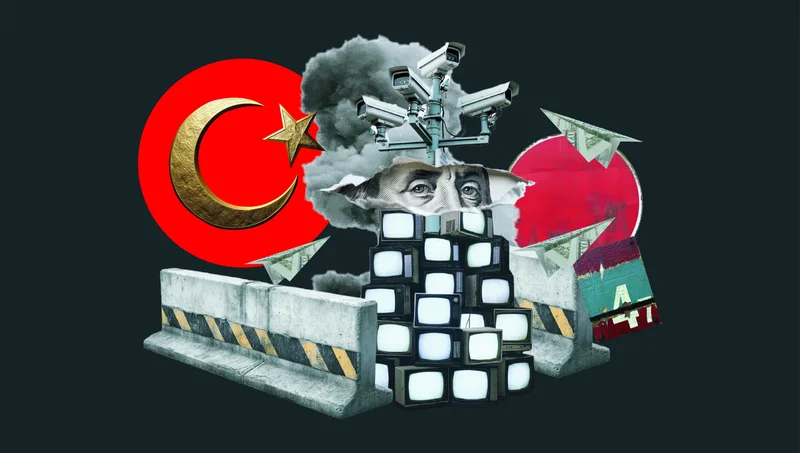
The international order is undergoing its deepest transformation since the end of the Cold War. The old system has not disappeared, yet the new one has not fully emerged. We are living through a prolonged period of uncertainty in which geopolitical rivalry, technological competition and civilizational narratives increasingly overlap.
Recent shocks, from the Russia-Ukraine war to the catastrophe in Gaza and the wider confrontation involving Iran, Israel and the United States, have accelerated this transition. These are not isolated crises. They are symptoms of a broader restructuring of global power.
The most important feature of the emerging era is the centrality of technology, especially artificial intelligence (AI). AI is no longer merely a consumer technology. It is becoming a determinant of military capability, economic productivity and strategic influence.
Recent debates in the U.S. reveal a significant shift: major technology companies are increasingly viewed as national security assets rather than purely commercial actors. Engineers, data systems, defense institutions and society itself are being integrated into a broader strategic framework. Technological superiority is being treated as a prerequisite for geopolitical power.
This is the essence of what might be called techno-militarism: the fusion of AI, defense planning and state capacity. Algorithms, cloud infrastructure and data ecosystems now carry strategic value comparable to industrial capacity in the 20th century.
For Türkiye, this development has a clear implication: technological dependency is becoming a vulnerability. Strategic autonomy cannot be achieved solely through diplomacy or military capability. It increasingly depends on the ability to produce technology, control critical data and develop domestic innovation ecosystems.
The transformation is also visible within the West itself. The U.S. and Europe no longer function as a completely unified strategic bloc. Differences over security priorities, economic policy, technology regulation and geopolitical risk are becoming more pronounced.
Europe seeks strategic autonomy, yet it remains heavily dependent on American security guarantees. Domestic political fragmentation and the rise of populist forces further complicate Europe’s ability to articulate a coherent global strategy.
This does not mean that the West is weak. It remains economically and technologically powerful. But it is increasingly plural rather than singular. For Türkiye, this creates more room for issue-based diplomacy with different Western actors.
China remains Washington’s principal long-term strategic competitor. Beijing has moved beyond the low-profile posture associated with earlier decades and now pursues a more visible global role. Yet China is not offering a universally accepted alternative order. It is advancing a state-centered model of modernization and influence.
Russia continues to challenge Western power, particularly in European security. Its relationship with China is best understood as pragmatic convergence rather than a formal alliance. Cooperation is significant, but its long-term trajectory remains uncertain.
In such an environment, rigid bloc politics becomes less useful. Flexible and adaptive strategies become more valuable.
This is the context in which Türkiye’s foreign policy should be understood. Over the past decade, and especially since 2016, Ankara has pursued a strategy aimed at strengthening strategic autonomy while maintaining engagement with multiple centers of power.
The objective is not isolation. It is flexibility: preserving alliances where beneficial, avoiding excessive dependency where risky, and expanding national capacity in defense, diplomacy, energy and technology.
Türkiye’s positions on regional crises reflect this approach. Its calls for a more balanced international order, its stance on Gaza, and its efforts to avoid direct involvement in great-power confrontations all point to an attempt to maintain room for independent action. Ankara increasingly emphasizes that sustainable stability in the Middle East must involve regional actors themselves rather than relying exclusively on external powers.
The same logic applies to technological sovereignty. For Türkiye, the new age has led to a growing emphasis on cybersecurity, infrastructure protection and digital resilience. Türkiye sees that states must develop the capacity to produce technology, protect strategic data, shape information flows and maintain public trust in an environment saturated with manipulated content. The deeper issue is digital sovereignty: who controls data, who governs platforms and who sets the rules of the digital age.
If the emerging era is defined by techno-geopolitics, Türkiye’s strategic agenda should focus on three interconnected priorities.
First, AI must be treated as national strategic infrastructure, not merely as an innovation sector. Investment in sovereign cloud capacity, large-scale data ecosystems and advanced human capital is becoming essential.
Second, defense modernization must increasingly integrate AI and autonomous systems. Türkiye’s existing strengths in unmanned technologies provide a valuable foundation, but they need to be embedded in a broader AI-enabled defense architecture.
Third, digital sovereignty requires greater control over critical infrastructure, including data centers, communication networks and cloud services, while maintaining openness to international cooperation.
These priorities reinforce one another. AI capacity strengthens defense modernization. Defense modernization creates demand for domestic technological ecosystems. Digital sovereignty protects the strategic value generated by both.
The emerging world is a contested environment in which technology, security, economics and culture are increasingly interconnected. AI is becoming a core instrument of power. Great powers are reorganizing around technological competition. Middle powers are gaining greater room for maneuver, but only if they build sufficient capacity and strategic coherence.
For Türkiye, the central challenge is not choosing a single geopolitical camp. It is strengthening its own capabilities while operating across multiple power centers.
In the age of techno-geopolitics, autonomy depends less on rhetoric and more on real capacity. The states that can combine technological strength with strategic independence will be the ones that help define the next international order.