Listen to this essay
41 minute listen
‘A nasty one, the dolphin,’ Derode grumbled when he returned home, trading the humid heat of an Amazonian afternoon for the cool, sheltered interior. Inside, his wife Rosa and I shot hungry looks at his empty hands. Once again, the Caquetá River surrendered no fish. I was only two weeks into my fieldwork with the Andoque people in southern Colombia, and my eyes zigzagged in confusion between the two septuagenarian spouses. What did a dolphin have to do with anything? Rosa explained: ‘Derode had left baits by the river, and it seems a dolphin had stolen the fish that had gotten hooked in them.’
Derode nodded.
The fishing had been poor ever since my arrival, and as Rosa cooked lunch from the rice and lentils I had brought from the city – the ‘White People’s Food’ – she reminisced with her husband about times when the river had been generous. She recalled how her grandfather had once hauled in an almost legendary catch by throwing poisonous plants into the shallow stream and asphyxiating the fish in great numbers. Among this enormous catch was a dolphin. Of course, she added, as if it needed no explanation, her grandfather did not eat it.
‘Why not eat the dolphin?’ I asked. The Andoque were accomplished hunters and fishermen, and there was almost no walking, swimming, crawling or flying creature that they wouldn’t relish, if they could catch it.
‘Because dolphins are people,’ Rosa said, matter-of-factly. ‘Besides, their meat smells terrible.’
Dolphins were not simply people, she went on, they were bad people, shapeshifters. Her father had once warned her never to accept the advances of unknown men while bathing at the river. As handsome as they may seem, he had said, they may be dolphins in disguise. Those reckless enough to fall for their charms would soon grow feverish, drift into madness and hallucinations, and ultimately die. No cure would save them.
Look what happened upriver, Rosa said. She then told a story about a strikingly handsome man and a stunning woman who walked into a riverside bar in some village one night. Both were impeccably dressed in white clothes, with fancy accessories, such as a belt, a watch and a hat. The man ordered drink after drink, while the woman remained quiet and abstained. The bar owner sensed something strange about them, though he couldn’t say what. The other clients were enchanted: the men drawn to the woman’s grace, the women to the man’s charm. Then, at some point late in the night, the couple disappeared. The last place they were seen was down by the riverbank. At dawn, villagers returned to the spot, and found the visitors’ elegant accessories scattered on the ground. Only now, those items had transformed: the belt had become an electric eel, the watch a crab. Gazing at the stingray that had previously been a hat, the villagers finally understood. It had been needed to cover a blowhole. The visitors were dolphins in human form, on the hunt for unwitting prey.
‘Such are dolphins,’ Rosa concluded.
I tried to lighten the mood. ‘Where I come from,’ I said, ‘dolphins perform tricks in aquatic circuses.’
Rosa was unimpressed.
‘You’re talking about sea dolphins. Those may be different. But river dolphins here are evil.’
When I laughed and, perhaps insensitively, mentioned a newspaper story I’d once read about a woman who had married a dolphin, Rosa’s face twisted in disgust, as if she might be sick. She changed the subject.
What initially drew me to Amazonia was the tendency of its Indigenous inhabitants to consider the forest and river where they lived as a delicate society populated by beings similar, in crucial respects, to humans. An ecology of persons. This is what led me to Andoque territory in 2018, and why I spent more than a year living with families like Rosa’s. I had set out as an anthropologist seeking to study their notions of power, and how this power is bound up with nonhuman persons – like dolphins. For the Andoque, these beings may wear the bodies of trees, plants, animals and insects, but they have wishes, thoughts, fears and cultural customs like humans do. What would power look like in such a world, I wondered. A deeper interest lay hidden within the word ‘power’ – hidden, back then, even from myself. I longed for a first-hand encounter with something truly powerful: the dangerous web of life and death that makes up the forest; the intricate wisdom of a people attuned to it. I wanted to bask in that power. I wanted to admire it, decipher it, crash against it.
But the world of the Andoque had been battered long before I arrived. Far from the postcard ‘isolated tribe’, they place relations with whites at the centre of their culture. ‘Whites’ is a term that, for them, refers not to skin colour but simply to anyone external to the forest and its ways. These outsiders are closely linked in Andoque mythology with the Caquetá river mouth, as it was from there, where the water meets the main Amazon River, that European merchants first arrived as early as the 17th century.
With almost no one speaking their native language, many Andoque sometimes doubt how Indigenous they still are
The Andoque, I was told, traded slaves with whites in exchange for coveted metal tools. By the turn of the 20th century, they began acquiring these tools in exchange for vegetal rubber. But that opportunity turned into a nightmare when the Peruvian Casa Arana company overtook the region. For the sake of a booming automobile industry thirsty for rubber, the Andoque were enslaved, suffering indescribable atrocities and massacres. From around 10,000 people in 1908, they dwindled to a few dozen survivors by the mid-1930s, when they rebuilt their maloca – a large residential and ceremonial house for hosting ritual dances – and healed the wounds of their ancestral territory. In their own words, they became human once more.
They also resumed rubber extraction under more humane conditions and, in the years that followed, took part in each economic boom that swept through the region. They hunted for animal pelts, worked in the commercial fishing industry, and tried gold-mining. Today, their world has become entangled with that of whites. The Andoque live alongside settlers and other outsiders, occasionally travel to Bogotá, and have become vulnerable to price fluctuations caused by wars in countries far, far away. They currently number around 260 individuals, and Colombia recognises their ancestral territory as an Indigenous reserve. However, with almost no one but the elders speaking their native language, many Andoque sometimes doubt how Indigenous they still are.
The word for ‘dolphin’ in the Andoque language – ama̰na̰ – is not Andoque at all. It is a loan from the Tupí-Guaraní language, whose speakers served as middlemen in the slave trade with whites (and, like the Andoque, were sometimes enslaved themselves). Ama̰na̰ appears virtually unchanged across the region’s several language families, which are otherwise markedly different from one another. It attests to the relative recency of the dolphins’ flirtation with the Andoque, who were originally inland hunters and ventured along the main rivers of the Amazon only when trade intensified during the 19th century. In the process, they borrowed a Tupí-Guaraní word to refer to the strange creature they encountered in those rivers: playful and intelligent, resurfacing for air like a human living underwater.
Known to biologists as Inia geoffrensis, these river dolphins have been around for at least 10 million years. They date back to a time when the sea that had once covered the northern part of South America receded and the saltwater dolphins who remained in the rivers adapted to freshwater environments. Today, the pink skin of river dolphins makes them an attraction to tourists. Their large bodies and high food intake, on the other hand, make them especially vulnerable during the increasingly frequent drought periods when fish become scarce as rivers dry out and water temperatures rise.
The men would sit with me for sessions of conversation called mambeadero that stretched from the afternoon deep into the night
I had known practically nothing about river dolphins before starting my research but, a few months into my fieldwork, dolphin talk kept popping up during conversations with the families I lived with. As in Rosa’s stories, they were always evil, but this wickedness was never explained.
My days of fieldwork found their rhythm in hunting, fishing and tending gardens. These were tasks I tried to assist with, though I was often more of a burden to my hosts. I found solace in the preparation of coca powder, a stimulant now referred to as mambe to distinguish it from the illicit version – the white one. You pick the leaves, toast them, pulverise them, add some ashes, and filter the mixture. This fine green powder is believed to carry the spirit of an ancestor and to open channels of communication with the dueños of the forest – the guardian spirits of animals, from whom permission to hunt must be sought to avoid retribution. This almost daily work earned me the trust of the men, who would sit with me for long sessions of conversation called mambeadero that stretched from the afternoon deep into the night, with lighter topics such as gossip and politics gradually giving way to mythology. But when I asked about the enigmatic dolphin during these gatherings, the man presiding the session would frown at me: ‘Dolphins do not enter my mambeadero!’
My curiosity grew stronger. If dolphins did not enter Andoque mambeaderos, I thought, perhaps I needed to enter their domain myself.
Nearly every week, I joined my hosts on boat trips to the nearby settler village to sell local produce. On one of these trips, four months into fieldwork, I was going back home with my friend Miller after his unsuccessful attempt to sell the meat of a wild boar. It was on that late afternoon that my dangerous liaison with the dolphin began.
As the sun sank slowly into the broad-armed Caquetá River, the rainforest alive and infinite on either side, I sensed a strange smell permeating the air. Sweet and sickly, entrancing yet nauseating – it was a scent so overpowering it could make you dizzy. It wasn’t the odour of the dismembered boar, which smelt like an armpit. This was something else entirely, closer to a piece of chocolate candy stashed away in a dirty sock. The odour, a euphoric scent that was at once uplifting and deeply unsettling, turned the sunset utterly foreign.
‘What is this smell?’ I asked Miller, and added – perhaps carelessly – ‘It’s nice.’
‘Nice?’ Miller shot me the most surprised of glances. ‘It’s the smell of dolphins. It’s disgusting!’
‘Right, right,’ I mumbled.
‘You don’t do that,’ his mother admonished me. ‘You don’t mess with dolphins!’
I had learned by then that a dolphin’s human victims were not entirely blameless. The dolphin would take any action that mimicked its behaviour as a sign of affection. Sniffling a runny nose would be frowned upon because it sounds like a dolphin breathing air. Splashing water by the river amounts to a frivolous invitation to play. And here I was, in the middle of the dolphin’s domain, foolishly babbling about how pleasant it smelled.
‘You won’t believe it,’ Miller told his parents as we shared the boar meat with them for dinner. ‘Eliran likes the dolphin’s smell! He said so on the way here.’ They shook their heads.
‘You don’t do that,’ his mother admonished me. ‘You don’t mess with dolphins!’
But Miller, a cheerful man in his mid-30s, only a little older than myself, couldn’t resist teasing me. ‘Tonight, you’ll dream of a pretty girl,’ he said with a grin, ‘and if you slip her your guama’ – the elongated ice-cream bean fruit growing on the tree outside the house – ‘that will be the end of you!’
Word of my taste for dolphins soon spread among Miller’s family. ‘That smell is the dolphin’s breath when it surfaces for air,’ his cousin explained, leaving me all the more unsettled by the unexpected intimacy I had shared with the animal.
That night, the dolphin visited me. While my body lay peacefully in a hammock within its mosquito-net cocoon, my mind was sweating with desire for a guy I knew in my 20s, who then morphed into a high-school classmate of the same name. Two dream lovers. Did that mean double the danger?
Normally, I would tell my hosts what I had dreamt the previous night, tossing one more convoluted narrative into the pot of dreams they would share with each other over breakfast. Every morning, I was amazed anew at how they deciphered dreams as messages from the forest. In their language, dreams are knei: ‘somebody said’. And what this mysterious ‘someone’ says is forever oblique. A person in a dream represents an animal or forest spirit, while an animal stands in for a human. So, if you dream of encountering a wise old man, you should be on guard for deadly anacondas crossing your path. Dreaming of besting someone in a fight or of resisting seduction means it’s time to pick up your rifle and head into the woods because an animal will become your prey. Eating with someone foretells disease – it means you’re joining the domain of animals by breaking bread with them. But dreaming of sex foreshadows a whole different magnitude of disaster.
Any animal, plant, pain or blessing has a mythical origin. But nobody would tell me the dolphin’s story
So, the next morning, I kept my mouth shut. I was embarrassed, but I also wanted to test the Andoque approach to dream interpretation. Would disaster really visit me? At first, this interpretation seemed off the mark: while everyone around me caught malaria during the following weeks, burning and shivering, I remained untouched.
And all the while, I kept cautiously asking for more information about the dolphins of the Caquetá. ‘Everything has its story,’ people would invariably say: any animal, plant, pain or blessing has a mythical origin outlining its essence and how to engage with it. But nobody would tell me the dolphin’s story.
Finally, during one of the late-night mambeadero sessions at the maloca of Dufi, an elder considered the wisest, he declared: ‘I can speak about dolphins without fear because I know their origin. By telling it, it’s as if I say to them – “I know who you are, I know your faults, so be ashamed to come here!”’ As crickets chirped through the dense, wet air outside the house and toads echoed the forest heartbeats with their deep croaks, I pulled out my voice recorder with broad movements. Dufi nodded and began his story.
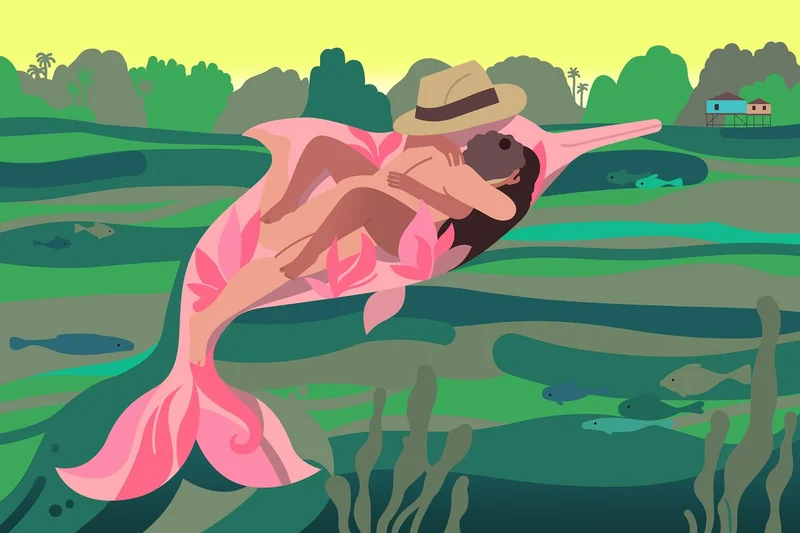
Green Tapir was organising a ceremonial dance at his maloca when he caught his wife by the riverbank, having sex with her own brother. Enraged, he painted his spear in the red dye of annatto seeds and hurled it into the siblings, fusing their bodies together, and threw them into the river, where they transformed into dolphins. The splash of water from their bodies sent a shiver through him – the beginning of a vengeful illness sent by the dolphins. Bound together and still facing each other, the brother and sister swam downstream in the missionary position, which is endorsed by both human and dolphin lovers to this day.
After Dufi finished his story, we remained silent. The fire in the corner of the maloca died out and darkness suffused the house. But I was finally able to see the dolphin’s traits clearly. Its insatiable sexual appetite now appeared interwoven with its incestuous behaviour. In a society where men replace the exchange of hostilities with the reciprocation of marriageable women, as in Claude Lévi-Strauss’s classic alliance theory, coupling with one’s own sister signals a refusal of exchange – and thus a turning away from alliance toward hostility. Above all, the casting of the siblings downriver, the direction from which whites first approached the Andoque territory, marked an unmistakable connection to these outsiders. As the folklorist Candace Slater shows in her book Dance of the Dolphin (1994), this association is especially striking along Brazil’s Amazon River and its main tributaries, where dolphin tales abound among Indigenous groups and communities of mixed ancestry. The pink dolphin, or boto cor-de-rosa, is said to abduct his female victims into magnificent underwater cities, filled with palaces, gold paved streets and luxuries that, for humble Amazonians, must be the everyday fare of any common urbanite. In such riverine communities, whenever unfamiliar foreign men appear at traditional communal dances, women are cautioned to be wary, for the strangers could be dolphins in disguise.
By telling dolphin stories, Amazonians of Indigenous and mixed descent convey the dangers of ‘becoming white’
The stress on the dolphin’s pink hue is no coincidence: these are the adult males who turn pink, partly due to a low concentration of melanin across their larger bodies, and partly from the scars they earn in endless battles over females. The dolphin’s link to aggressive non-Indigenous sexuality then becomes clear: Europeans first entered the Amazon as bands of adventurous men with a taste for violence through the same major rivers where dolphins live. Like the dolphin brother in the Andoque myth, these outsiders showed little regard for reciprocity through marriage. In the Europeans’ case, this disregard was reflected in an imbalance: many more Indigenous women partnered with European men than Indigenous men found wives among European women.
In Indigenous thinking, and in Lévi-Strauss’s theory of reciprocity, a lack of matrimonial reciprocity is tied to violence. Consider that, in another version of the dolphin’s origin story, Dufi explained how the descendants of the incestuous couple returned upriver to avenge their parents’ disgrace and how they were pacified through offerings of coca and tobacco. The Andoque still commemorate this episode in a ceremonial dance to shield themselves from violence of non-Indigenous origin. During the past several decades, it has been celebrated to ensure that they are not caught in the crossfire between the guerrillas and the military.
As I began to connect the dots linking dolphins and whites, I wondered about the deeper meaning of such tales – a meaning that is often implicit for those sharing them. It slowly became evident that, by telling dolphin stories, Amazonians of Indigenous and mixed descent convey the dangers of ‘becoming white’. You leave your community, abandon tradition and cross into the parallel world of non-Indigenous people, forever lost to your family.
Upon hearing Dufi’s stories, I felt as if I, too, could tell the dolphin: ‘I know who you are, I know your faults, so be ashamed to come here!’
But the dolphin visited me again, finding its way one night into a dream – disguised this time as a guy from Bogotá I was dating.
Soon, I began to question my confidence.
A few days later, jaguar footprints appeared along the long path leading to a small harbour on the Caquetá River. For the next week, Dufi’s family expressed concerns about venturing down that path, especially alone, for fear of a jaguar attack. When I mentioned my plan to go there for a phone call, hoping for better reception by the river, one of Dufi’s sons again cautioned me about the jaguar. Dufi, however, quickly reassured me. I had nothing to fear because jaguars dislike the soapy, perfumed scent of white people, which, he added, is precisely the smell that attracts dolphins.
As I reached the Caquetá in the late afternoon, I sensed the dolphin smell again. Odours and attraction, I thought – at least it works both ways.
I called my Bogotá lover, but he didn’t answer.
By then, it was dusk. I stared at the broad river, its waters reddening, and realised that I was near the place where a boat Dufi had told me about had sunk. A ‘Dolphin Boat’ he called it.
What if the Andoque felt vulnerable to dolphin attacks precisely because this animal already sensed something ‘white’ in them?
The story took place at some indeterminate moment before the rubber genocide, in that murky zone where history and myth collapse into one another. Back then, Dufi explained, there existed a clan named after the Cacambra bird. Its members caught vast quantities of fish from the Caquetá River, salted them, and traded them with downriver merchants in exchange for manufactured goods. One day, a new trade boat approached their settlement and the Cacambra people eagerly climbed aboard to marvel at the exotic items. They tried on hats, admired themselves in mirrors, and doused themselves with perfume. Suddenly, the boat pulled away from shore, trapping the Cacambra people onboard. The goods, it turned out, were cursed. The hats brought on fierce headaches, the perfumes made them feverish, and those who gazed into the mirrors went mad. Farther downriver, the boat sank, taking all the Cacambra with it. The merchants, Dufi whispered, were actually dolphins in disguise, avenging the slaughter of fish.
Heading back to Dufi’s maloca, I saw the junk along the path differently. This motley cemetery of products beneath the voraciously fast-growing vegetation – used gasoline barrels, damaged solar panels, plastic shopping bags, empty shampoo bottles – now appeared ominous. What if the Andoque felt vulnerable to dolphin attacks precisely because this animal already sensed something ‘white’ in them – a budding preference for non-Indigenous goods and comforts? Perhaps, I thought, the more dolphin-like you become, the more vulnerable you are to a dolphin’s pull.
But the danger of dolphins goes beyond mere assimilation into non-Indigenous society. It also speaks to the traps of desire itself. The dolphin is in the bad company of other seductive creatures who have nothing to do with whites. My Andoque friends told me how the tapir deceives married women by taking the form of their husbands; how the earthworm climbs into hammocks at night, seeding its victims with slime and causing deadly pregnancies; and how the deer seduces young women in their gardens, appearing as a handsome man.
Men are not spared either. Lone hunters who venture deep into the forest, consumed by thoughts of their lovers, may encounter the fi’du spirit, called madremonte in Spanish. This ‘forest mother’ appears as a beautiful woman with long flowing hair, but to lie down with her is to lose your life. The elders often told of a young man who had met such a fate in the 1940s, while working in a rubber tapping group. Famous for his lewd jokes and boastful tales of the women awaiting him back home, his bravado met its end one afternoon when he was working alone, collecting latex from a rubber tree. A naked woman appeared and offered to help fill his buckets with the milky sap. He gave in to desire. The pleasure was immense, but the cost was, eventually, fatal. He turned ill, raving with fever and visions. Before long, he was dead.
When I jotted these stories into my field diary at night, I often found them hard to believe. How can you mistake a forest spirit for a human? How can you not tell a real person from a mere hallucination? And yet, the terror that registered in my friends’ faces as they shared these stories affected me.
After I left the forest territory of the Andoque in 2019, I spent two weeks in the Colombian city of Leticia with Rosa, who had moved there for her son’s medical treatment. In marathon-long interviews, I recorded her mind-bending stories of people turning into animals, of dolphins and fi’du spirits, of detached human heads that existed as parasites on their lovers’ shoulders, and detached tapir legs that roamed the forest. And then there was her own mother, who Rosa said had contracted the ‘deer disease’ – a kind of wasting sickness that had been slowly gnawing on her ever since she was a young girl who stopped her garden work when her eyes fell on a graceful, unknown man. Restless and without appetite, she grew emaciated and unable to work, wandering to her garden at dusk as if spending her life waiting for that man to return.
I began to fear that the power of the forest, of the Indigenous wisdom so generously shared, was turning against me
All these stories contained more of that thing I had been chasing since I arrived in Amazonia: a kind of power, difficult to define, that seemed bound to the forest and its rivers.
On our last day, I phoned Rosa and asked to cancel the session. We had enough material as it was, I said. But the truth was that I felt drained, my head pounding since the night before, my body slightly feverish, nausea overwhelming me.
I felt that something was wrong. I began to fear that the power of the forest, of the Indigenous wisdom so generously shared, was turning against me.
When I boarded the plane back home, I felt a huge relief. In Paris, where I did my doctoral studies, the power of the dolphin and its shapeshifting cronies waned. They became curiosities I would bring along to dinner parties, like a bottle of red wine. And things stayed that way until, about a year after leaving the Amazon, the power struck me again.
In March 2020, just as the pandemic was gathering force across the globe, I sank into my field diaries, coming across a long-forgotten piece of esoteric gossip, which had been shared with me playfully by several Andoque people. A renowned professor, a specialist of the region, they told me, had been visited by a fi’du spirit.
Once, on an expedition to visit sacred sites in Andoque territory, he spent the night deep in the forest with a small Andoque team. They urged him to hang his hammock near theirs, but he insisted, for reasons of his own, on sleeping a little farther away. In the dead of night, the Andoque leapt at the sound of his scream. The professor, pale and shaken, claimed that a pretty, fair-skinned girl had entered his hammock. His ‘We told you so’ companions shone a flashlight inside, and found a long, blonde hair – a silent memento from the spirit-turned-woman who had just sought intimacy with him. Amazed, the professor took the hair back with him, intending to show it to his students but, upon reaching the university, it had mysteriously vanished.
The world felt apocalyptic when I came across that anecdote. The number of people infected by the new virus was climbing globally. Lockdown was declared. Any stranger’s breath, any contact, was suspicious. You could be next – with as-yet unknown consequences. This story, about a scholar I knew personally, rendered the possibility of intimacy with a different kind of danger unsettlingly real.
Birds called in longing beyond the thin walls, monkeys courted in deep-throated howls, and insects buzzed their desire into the air
Like a magnet hauling metal, the story drew from the depths of my memory an incident from several years earlier. It was a trivial episode I had been ready to forget, but which now assumed ominous proportions. I remembered another seduction, one from long before I ever dreamed of dolphins from the Caquetá disguised as men.
In 2016, shortly before beginning my doctoral studies, I travelled to the Brazilian Amazon in search of an Indigenous community where I could carry out fieldwork. I approached the first community I visited with great excitement. The first day was exhilarating, but by the evening I was so exhausted from the scorching heat and my constant efforts to decipher people’s speech that I expected to collapse the moment I climbed into the hammock. Instead, sleep never came.
That night in a maloca, the chief and his family were all sleeping deeply in their hammocks under the vast, towering roof. In my own hammock, about 30 feet away from them, I listened to the forest alive around me: birds called in longing beyond the thin walls, monkeys courted in deep-throated howls, and insects buzzed their desire into the air. The forest was fertile, vibrant, sensual. I was overtaken by a strange cocktail of emotions – a mix of daytime adrenaline from finally immersing myself in the Indigenous village routine I had yearned to experience, and something more visceral, more banal: I was horny. Drifting into a restless sleep, I was startled awake by the unmistakable sensation of a hand moving down my body. It felt so real I could still sense its warmth on my thighs. Panicked, I grabbed my flashlight and scanned my hammock and its surroundings. There was no one there. And yet, I knew that a hand had touched me. Outside, the forest surged with a deafening uproar of life. I realised I would not sleep soundly until I gave in to my body. I did it discreetly, careful not to disturb the family sleeping nearby. By morning, shame kept me from meeting anyone’s eyes; I was convinced the entire village knew what I had done.
When I later came across my notes about the professor’s spirit encounter, my own incident suddenly crystallised in Andoque terms: the fi’du had touched me, and I had yielded. My memory of this experience became a dubious initiation into Andoque lore. The fi’du, the dolphin, the deer – an obscure bestiary suddenly made sense.
The mysterious and deceitful fi’du embodies the forest’s fertility, its raw vitality – the promise of that which has not been civilised or inhabited. It is the seduction of a million and one possibilities: everything and everyone that lies beyond us, all that is not us – life itself. In my arousal, I had succumbed to its pull, I had given it my semen, my body; I had helped it reproduce. But I realised the aftermath of that fi’du encounter only now, in retrospect. I recalled that the next morning, hitching a ride out of the village to a nearby Brazilian town in an open truck, I caught a cold that lingered for a month, worsened by heartbreak over a romantic relationship that had ended weeks earlier. Feverish in my forest hammock, and later in my city bed, I sank into months of depression, consumed by longing for an ex-boyfriend who had moved on with his life. Letting yourself be pulled outward, I realised, is the fi’du disease – it is the dolphin disease. It is the desire for an Other we yearn to possess, for a life force we can never truly claim as our own.
Amazonians know desire well: desire is what the rainforest is all about. Those who live far from the Amazon tend to see the food chain as its governing metaphor, but, for those who live inside the forest, the boundaries between eating and mating blur. It is no wonder that, for an Andoque hunter, dreaming of a beautiful woman signals an encounter with forest meat, while a dream about sex foretells illness. The Amazon rainforest is, at its core, a sexual space: 2.3 million square miles of desire, where survival depends on consuming others – culinarily or sexually – while living in constant fear of being consumed yourself. For Amazonians, the world is first and foremost a huge pool of potential partners and, by marrying them, an even larger pool of potential in-laws who would become allies. Even animals are drawn into this logic. For many Indigenous groups, sex and predation are two forms through which the same mode of relation materialises. The consummation of ‘marriage’ with animals may therefore take the form either of consuming their meat or of being consumed by them through fatal attacks. As anthropologists like Eduardo Viveiros de Castro and Aparecida Vilaça have shown, within this chaotic tangle of desire and survival, family – the people with whom the urge to consume or mate is deliberately restrained – must be actively created by sharing food, care and knowledge. In the Amazonian worldview, attraction is the rule, isolation the exception.
It was Miller, my companion on that dolphin-perfumed boat trip, who clarified for me why sexual seduction is the most potent weapon of dangerous forest creatures. One day, when I joined him on a hunting expedition, I asked about the sounds he used to attract prey. Many of these calls mimic an animal in heat. Seduction becomes a powerful weapon, drawing in a potential victim and holding them captive in a moment of confusion, just long enough for the fatal blow. In the relentlessly cruel and dangerous jungle, any distraction can be deadly. And sexual distraction, when one expects the highest of pleasures, is also the moment of greatest vulnerability. To be horny in the jungle is to be overtaken by a passion that pulls you toward countless potential connections, each one promising to lure you away from yourself.
Consuming the dazzle and convenience of non-Indigenous goods leads to being consumed by the forest
The Andoque have a word for people and things that do exactly that: yoóka, or ‘diverters’. Yoóka is whoever and whatever pulls you away from yourself – distracting you from your survival, wellbeing and prosperity, and instead turning you into raw material for the forest’s relentless cycle of life and death. It’s also the word they use for harmful goods from the non-Indigenous world – alcohol that stirs brawls, machetes that fall on your foot, rifles involved in shooting accidents and, in bygone days, goods whose arrival also brought epidemics.
Yoóka stand in contrast with bɨ’iá, ‘working tools’, which contribute to people’s prosperity and wellbeing: the very same alcohol can be bɨ’iá if it brings people together; the machete when it helps you open paths in the forest; the rifle when a successful hunt enables you to feed your family; and foreign goods when they sustain rather than undermine life. As the gruesome story of the enchanted boat that lured away the Cacambra clan recounts, deviation by yoóka is where the dolphin merges with the fi’du; where consuming the dazzle and convenience of non-Indigenous goods leads to being consumed by the forest. Living in the unforgiving Amazon, you constantly ward off blood-sucking mosquitoes, carry a machete just to bathe safely lest a venomous snake crosses your path, and witness vines strangling trees whose rotting corpses nourish new growth. Every time you see a shaman or elder ‘healing’ meat through chants before giving it to a child or a woman giving birth, you are reminded of the vengeful intentions of the guardian spirits of animals. In this zero-sum game between humans and nonhumans, it is little wonder that forest dwellers who become ‘white’ expose themselves to the jungle’s predatory forces.
While the Andoque and other Amazonians may seem removed from the global economy, it’s clear that most have been deeply entangled in it long enough to grasp its essence. One of the truths they hold, embodied in the dolphin, is that the vital yet perilous force animating the jungle is also the lifeblood of the commodity economy in which we all live. This economy thrives on our sense of lack. We restlessly yearn to resemble others in their beauty, wit or taste – even, paradoxically, in their uniqueness and authenticity. Beyond the familiar notions that ‘sex sells’, and that we consume goods and services to amplify our attraction, lies a deeper principle articulated by the thinker René Girard: desire is never truly our own. It comes from the outside world, as we yearn for the objects or lifestyles desired or possessed by others. These inevitable dynamics of human sociality – crucial to how we learn, mature and form our sense of self – are amplified exponentially in consumer society, with the reach of social media multiplying our social universe.
Far away from the poor internet connection of the Amazon, I scroll daily through the carefully curated lives of seemingly happy and successful acquaintances, celebrities and influencers, their auras beaming into my eyes just like the dolphin scent tickled my nose along the Caquetá. Uplifting yet unsettling. Their desire infects my own.
For the Andoque, giving into the desire of the dolphin, or of the fi’du, leads to illness. It begins with a restless, gloomy anticipation – eyes wide, scanning for something thrilling, beautiful or exotic from the outside. This yearning pulls its victims away from home, from their very humanity, undermining their groundedness in the immediate world. Stripped of this anchoring, they become vulnerable to whatever snares are lurking in their surroundings. The dolphin’s seductive lure is a recipe, in the long run, for losing ourselves or being consumed.
The Andoque perspective had taken root in my mind, reshaping the world around me
My interest in power had, ironically, resolved itself in the negative: a deep recognition of my own weakness. For the Andoque, oral tradition is a form of protection. It is a body of knowledge that keeps people safe from the forest’s dangers. I have come to appreciate the weapons that Andoque generations have crafted to protect themselves from such pitfalls: tales and rituals, spells and observances. To abandon them is to remain unguarded. Yet I also understand all too well why they fail to take up these weapons as resolutely as they say they should.
The words in the recordings of mythology that my Andoque friends shared with me during long mambeadero sessions, which likely originated decades or even centuries ago, are spoken now with languid and defeated voices. Listening to them is like swimming in an ocean of unfathomable wisdom. But we are swimming against the current.
And all at once, I am gasping for air, drowning. Little did I know when I left the forest, that the Andoque perspective had taken root in my mind, reshaping the world around me, recasting even my own life in its terms.
I check my phone: it’s already time. I stop the recording, silence the voices from the mambeadero, open the dating app, and send a message that I’m on my way. Before I leave, I put on my cap – just in case – to cover the blowhole.
Further reading
The understandings of reality espoused by many Amazonian societies, where nonhumans are endowed with souls and subjectivities comparable with those of humans, have been described by Philippe Descola as ‘animism’. A compelling analysis of animism, alongside its comparison with modern Western ways of relating to nonhumans, can be found in his book Beyond Nature and Culture (2005/2013).
For more about dolphins, Candace Slater’s Dance of the Dolphin: Transformation and Disenchantment in the Amazonian Imagination (1994) remains the most sustained study of Amazonian dolphin folklore, particularly in the Brazilian Amazon.
Eduardo Viveiros de Castro discusses common Amazonian notions regarding dangerous encounters with spirits capable of transforming humans into beings like themselves in his article ‘Immanence and Fear: Stranger-events and Subjects in Amazonia’ (2012). In an animist world, where animals and spirits are understood to possess souls, humans risk becoming overwhelmed by the subjectivity of nonhuman beings and accepting their framing of reality, in which humans may appear merely as prey.
In another text by Viveiros de Castro, Cannibal Metaphysics: For a Post-Structural Anthropology (2014), he discusses a conception widespread in Indigenous Amazonia, though potentially counterintuitive to many readers, in which relations of marital alliance and predation are primary and given, while blood ties must be actively constructed.
Aparecida Vilaça elaborates on this idea in her article ‘Making Kin Out of Others in Amazonia’ (2002), showing how the Wari’ of Brazil actively fashion the bodies of newborn children through feeding practices and dietary restrictions, differentiating them from the worlds of animals and spirits from which they are thought to emerge.