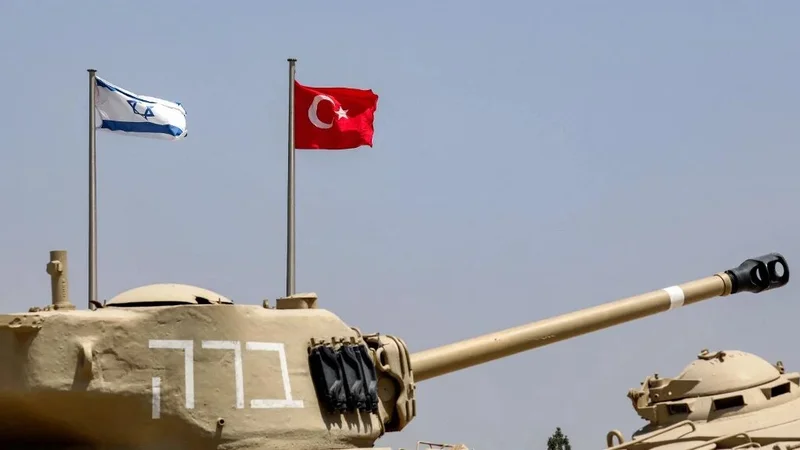
Israel issues veiled threat to Turkey following airbase strikes in Syria
Israel issued a veiled threat against Turkey on Thursday, following Israeli strikes on the Abu al-Duhur military airbase in northern Syria, about 70km from the Turkish border.
“Turkish President Recep Tayyip Erdogan is dragging Turkey into dangerous adventures in Syria,” Israeli Defense Minister Israel Katz said in a social media post.
Katz said Israel would not “allow any entity to threaten its security”. He added that Erdogan would be better off curbing his anti-Israel rhetoric rather than “attempting to test Israel’s resolve to defend itself”.
Israel accused Syria of being on the verge of violating a security “status quo agreed with Israel” by allowing Turkish troops to deploy at the airbase.
Both Turkish and Syrian officials rejected the allegation.
The Turkish defence ministry said in a statement that there was no Turkish military presence at the Abu al-Duhur airbase before or during Israel's "unacceptable" attack.
"It is essential that Israel ceases such reckless attacks," it added.
Syrian officials told Middle East Eye that a Turkish technical team had been tasked with repairing the runway and control tower, but that there was no Turkish military presence at the base.
“The last team tasked with reconstructing the base was there two days beforehand,” one official said.
The officials added that Turkey had been helping the Syrian army build bases across the country, with no specific plans directed against Israel. Ankara, they said, wants to rebuild a robust Syrian military capable of defending the country.
"We will continue to support Syria’s efforts to build its infrastructure and military capabilities within the framework of the 'single army' principle," the Turkish defence ministry statement said.
Syrian Foreign Minister Asaad al-Shaibani said he had made clear to Israel that there were no plans to establish a Turkish military base and that the site was being rehabilitated for use by the Syrian Air Force.
“There was no intention to establish a Turkish base there, nor to establish a permanent Turkish military presence or deploy Turkish forces at the site,” Shaibani said in an interview with Axios on Wednesday.
'They didn't understand the message'
The strikes renewed tensions between Turkey and Israel despite extensive talks last year that led to the establishment of a diplomatic hotline intended to prevent accidents.
Turkish officials told MEE that Israel did not use the hotline, trying to provoke Ankara. Sources in Ankara believe Washington may have notified Turkey of the impending strikes, giving Turkish officials reassurance about why Israeli jets were approaching the Turkish border.
In a statement on Wednesday, the Turkish presidency said Israel’s actions were driven by Prime Minister Benjamin Netanyahu’s campaign ahead of the general election in October.
Netanyahu said Israel had warned Syria before the strike not to allow a Turkish presence at the base.
“Our message was very clear: Don’t. I guess they didn’t quite understand the message,” Netanyahu said on Wednesday.
Shaibani said Israel had no legitimate justification for the bombing.
Tom Barrack, the US special presidential envoy for Syria and Iraq, told Reuters after Tuesday’s strikes that Washington was working to establish a deconfliction mechanism among Israel, Turkey and Syria.
Israeli media quoted a Syrian source close to the government as saying that Israeli strikes on Syria would only deepen Turkey’s involvement in the country.
“We do not want any foreign forces on our land, but Israel must understand that the more it threatens Syria, the more the Syrian government will align itself with Turkey. The Israeli government is getting the opposite result of what it hopes to achieve,” the source said.