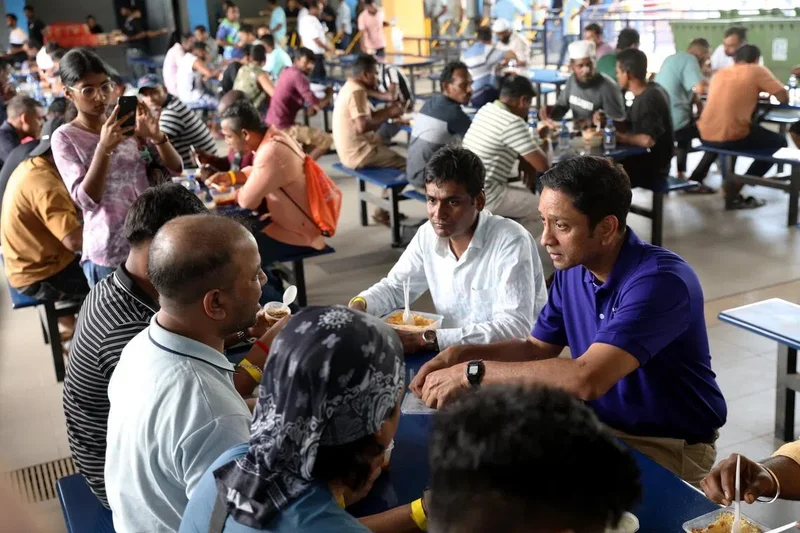
MOM tapping migrant worker network for alerts on issues like salary claims: Dinesh
Ho Yoon Sim
AI generated
SINGAPORE - The Manpower Ministry is looking to plug the information gap on migrant worker issues by tapping an app and a volunteer programme used extensively during the pandemic.
Minister of State for Manpower Dinesh Vasu Dash said migrant workers are being trained under the Friends of ACE volunteer programme to act as volunteers, to make it easier for their fellow workers to raise issues like salary claims.
ACE, or Assurance, Care and Engagement, is a group under the Ministry of Manpower (MOM) that works with stakeholders like employers, dorm operators, non-governmental organisations, to support the well-being of migrant workers.
Dinesh said migrant workers may be unwilling to highlight concerns because they are “loyal to their employers” and want to continue being hired by them.
He added: “I don’t think they aren’t aware of the channels that are available. But they may choose not to indicate through the formal channels or somewhat informal channels.
“We have to pay particular attention to make sure that their voices are heard.”
MOM manages around 1,000 active Friends of ACE volunteers across different nationalities who live in large and medium-sized dormitories, as well as in public and private housing.
It was previously reported that the network of volunteers can reach more than three in four workers living in dorms. There are more than 1,500 worker dorms in Singapore, housing more than 300,000 migrant workers.
Speaking in an episode of the podcast In Your Opinion hosted by senior columnist Tan Dawn Wei, which was first posted on 12 Aug, Dinesh said that many vulnerable workers might be unable to articulate their concerns and the kind of support needed.
“There is a tendency for migrant workers to just suffer in silence and that is exactly what we are hoping to try to unpack with the various channels that we have,” he said, citing other examples including the FWMOMCare mobile app and service centres.
The MOM app helps migrant workers in Singapore manage their well-being, access medical care, request help from officials, and book recreation facilities.
Dinesh said the ministry is also looking to tap the eight recreational centres across Singapore as “non-work environment” and “safe space” for migrant workers to voice concerns.
His comments come in the wake of an episode in June which saw more than 400 migrant workers raise issues, including claims of unpaid wages, against KPA Engineering, SK Industries and VVR Plant Engineering.
The firms were operated by the same business owner.
In a written reply to Parliament in July, Minister for Manpower Tan See Leng said that at different points in 2025, five workers from air-conditioning contractor KPA Engineering had individually approached the Tripartite Alliance for Dispute Management (TADM) regarding unpaid salaries.
Their cases were resolved within a week and the workers received payment from the employer.
He added that claims filed by four other workers from the same company were in the midst of being processed before the first large group of workers turned up at Ministry of Manpower on June 22.
Incidence of salary claims had increased in Singapore from 2021, based on the Employment Standards Report 2025 released by MOM and TADM in July.
The sharpest increase was among foreign employees, which jumped from 2.1 per 1,000 employees in 2021 to 5.16 per 1,000 employees in 2025.
The report also showed that of the salary claims lodged in 2025, 92 per cent of employees fully recovered their wages at TADM or the Employment Claims Tribunal.
In the case of the 400 workers, Dinesh said that the ministry could have expeditiously addressed their issues if the workers had highlighted them early.
That said, a “relatively good outcome” was achieved for the 400 workers, he added.
Among other things, the National Trades Union Congress (NTUC)’s Migrant Workers’ Centre (MWC) assisted with finding new job placement and provided financial aid of $200 to its members.
As at Aug 3, MOM has also rehoused 361 affected workers who required alternative accommodation at the Onboard Centre.
Meanwhile, 392 workers who chose to remain in Singapore have secured new employment with around 135 companies.
The company director, Indian national and Singapore permanent resident Ramu Palani Velu, who has been declared bankrupt, is being investigated by MOM.
Losing jobs
Dr Stephanie Chok, executive director of the Humanitarian Organisation for Migration Economics (HOME) said based on their casework experience, migrant workers are reluctant to report salary issues because they fear losing their jobs and being repatriated.
She added that this fear is heightened when they have yet to recover their recruitment costs, which be as high as $12,000.
“Early reporting will become more realistic only when workers can change employers without requiring their employer’s consent, have access to reliable job matching, are protected against retaliatory feedback and immediate repatriation, and the burden of incurring further recruitment debt,” she said.
Dinesh said there were three learning points from the episode.
First, he said workers need to advocate for themselves. Second, employers have to be responsible and comply with the Employment of Foreign Manpower Act.
He added that the ministry has to also “tighten up areas that may have certain deficiencies” that they have identified once the investigations are over, such as taking action against phantom workers.
MOM controls foreign labour numbers through the dependency ratio ceiling (DRC), by tying foreign work pass limits to local employee headcounts. There have been cases of firms hiring “phantom local workers” to boost their foreign labour count.
“The (DRC) is there for the purpose of making sure that you get a fair share of Singaporeans and migrant workers, and it cannot be migrant workers for migrant workers’ sake.
“It has to be in support of Singaporeans,” he said.
But employers will also need support, he said, adding: “We also have to look out for employers to make sure that it’s sustainable for them.”
Dinesh referred to the Local Qualifying Salary, which sets the minimum salary that local employees must be paid in firms that hire foreign workers.
It was raised from $1,600 to $1,800 starting July.
“Given the business outlook, we have to be cautious about imposing too much on our employers as well,” Dinesh said, adding that when employers are unable to sustain their operations, workers lose their jobs.
“We try not to create a situation where one party benefits at the expense of another party.
“It’s always about trying to reach a comfortable equilibrium across government, across the unions, and across employers,” he added.