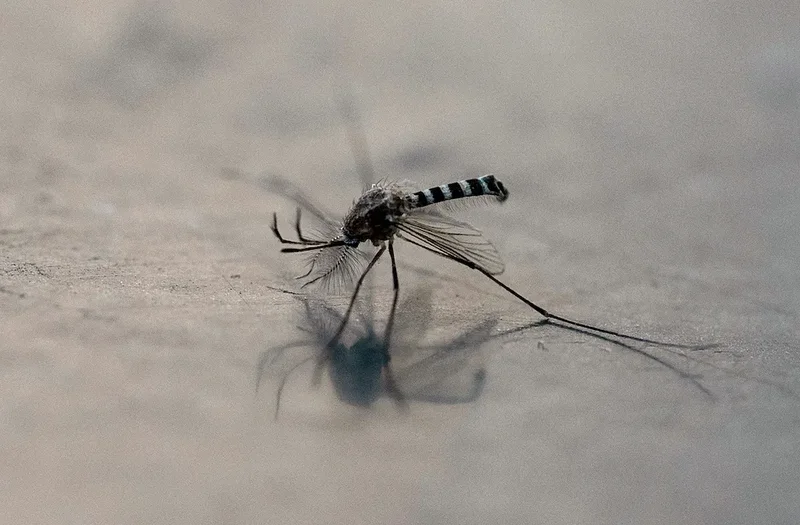
Italy has recorded 226 confirmed cases of West Nile virus and seven deaths since mosquito season started earlier than usual this year, national health institute ISS said in its latest bulletin on August 13th.
That was up sharply from 141 cases a week earlier, a jump of around 60 percent.
READ ALSO: Could summer 2026 be Italy's hottest on record?
The virus has been detected in 55 provinces across 16 of Italy's regions, from Piedmont down to Sicily. Just over 100 of this year’s cases were severe, "neuro-invasive" infections, according to ISS.
West Nile is not new to Italy. The mosquito-borne virus returns every summer and is now considered endemic, with cases reported annually since surveillance began in 2008.
The toll is lower than last year, when 275 cases and 25 deaths had been recorded by this point in 2025, but the recent spike of cases week has caused some concern.
What is the West Nile virus?
West Nile virus is a single-stranded RNA virus that can cause West Nile fever in humans. It belongs to the same Flavivirus family as Zika and dengue.
First identified in 1937 in Uganda’s West Nile district, it is now endemic across Africa, the Middle East, Asia and Australia, and returns to Italy every summer.
The virus is carried by birds and passed to humans by Culex mosquitoes. Human-to-human transmission is possible through blood transfusion and from mother to foetus during pregnancy, but not through everyday contact.
What are the symptoms?
Around 80 percent of infected people show no symptoms at all, according to ISS. Where symptoms appear, they resemble a common flu: fever, headache, nausea and diarrhoea, lasting a few days.
Serious illness occurs in fewer than one percent of cases and mainly affects older people and those with weakened immune systems. All seven of those who died this summer had underlying health conditions, and their average age was 72, ISS said.
Around one in 150 infected people develops severe symptoms including partial vision loss, convulsions or paralysis. In roughly one in 1,000 cases, the virus causes a fatal brain infection: encephalitis or meningitis.
Is there a cure?
There is no vaccine and no specific treatment for West Nile fever. Patients with serious symptoms are admitted to hospital and treated with IV fluids and, where needed, assisted ventilation.
“Vaccines are being studied, but for now prevention mainly means reducing exposure to mosquito bites,” ISS says.
The ISS recommends:
– Using mosquito repellent sprays
– Wearing long-sleeved shirts and trousers outdoors, especially at sunrise and sunset when Culex mosquitoes are most active
– Fitting mosquito nets on windows
– Clearing standing water around the home – flower pots, pet water bowls, inflatable pools – where mosquitoes lay their eggs
How severe is this year’s outbreak?
Italy has more confirmed cases than any other European country this year, but the picture is less alarming than in 2025: both cases and deaths are below where they stood at the same point last summer.
ISS began the 2026 surveillance season early after the virus was detected in mosquitoes in Emilia-Romagna in mid-June, the earliest reading since monitoring began in 2008.
READ ALSO: The bugs that could ruin your summer in Italy and how to deal with them
Lazio and Lombardy are among the worst-affected regions, though cases have now been reported as far south as Sicily and Sardinia.
What are Italian health authorities doing?
Regional authorities in the worst-hit areas are running mosquito control campaigns using larvicides, and monitoring birds, horses and other animals that can host the virus.
Italy’s national blood centre CNS brought back its summer 'blood safety rules' in May, running through the end of November. In provinces where the virus has been detected, every donation must be screened with a Nucleic Acid Test (NAT) before it can be used.
CNS stresses that donations have not been stopped, and that no patient in Italy has ever caught West Nile from a transfusion.
You can find more information on the West Nile virus on the health ministry’s website (in Italian).