- What happened in the early universe,between the Big Bang and the Cosmic Dawn that produced the first stars?
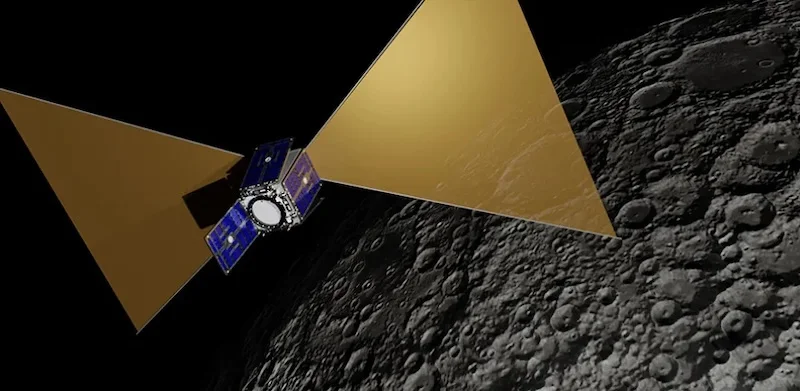
- A new U.K.-developed satellite, called CosmoCube,will orbit the moon and listen for faint whisper signals from this period in our universe’s history.
- CosmoCube will use the the moon as a shieldto block radio and other noise from Earth.
Faint whispers from the early universe
What happened in the cosmic dark ages, before the first stars appeared? A tiny new satellite, about the size of a small suitcase, will try to finally answer that question.
An international team of scientists, led by the University of Cambridge in the U.K., said on August 14, 2026, that the satellite – called CosmoCube – will use the far side of the moon to eavesdrop on whispers from the early universe.
CosmoCube will use the moon as a shield to block out all the noise coming from Earth. The faint whisper it is looking for is something called the 21-centimeter line, also known as the hydrogen line. Hydrogen atoms emitted this whispered wavelength in the period between the Big Bang and the lighting up of the first stars at the Cosmic Dawn.
CosmoCube will also study the role of dark matter in the early universe. Dark matter is a mysterious substance thought to compose about 27% of the makeup of the universe.
The research team published their peer-reviewed results in Nature Astronomy on August 14, 2026.
Using the moon as a shield
The 21-centimeter signal originates from over 13.5 billion years ago. It is extremely difficult to detect using Earth-based telescopes, since all the “noise” from Earth – particularly radio waves – drowns it out. So instead, the researchers will use CosmoCube.
The tiny satellite will orbit the moon. When orbiting over the far side of the moon, it will use the moon as a natural shield to block Earth’s noise for about 40 minutes in each of its two-hour orbits.
Over its expected two-year mission, it will collect about 1,000 hours of data.
Exploring dark matter in the early universe
The early universe isn’t the only thing that CosmoCube will investigate. It will also explore the role of dark matter in the universe. Dark matter is the mysterious, invisible force that holds the galaxies and universe together. As lead author Eloy de Lera Acedo at Cambridge’s Cavendish Laboratory said:
This emission from hydrogen after the Big Bang, but before the first stars, will hopefully allow us to understand the role of dark matter in the early universe, how it worked to pull together hydrogen into the first stars and galaxies.
There’s no other place where you can get the sort of shielding you need to detect such a faint signal, while at the same time looking at the whole of space. The far side of the moon is really the only option: it solves multiple problems at once, opening a clear window to the very early universe.
Listening from lunar orbit
So, how will CosmoCube listen to the early universe? In orbit, it will unfold a long and lightweight radio antenna. The antenna is sensitive enough to detect the 21-centimeter signal from hydrogen atoms in the early universe. And as noted, this can only be done from the far side of the moon, using the moon as a shield to block out all the noise coming from Earth.
CosmoCube will also constantly check and correct its own electronics using a Dicke-switched calibrator. This will flip between the sky and several built-in reference sources, helping to cancel out tiny drifts and noise inside the satellite. Otherwise, those could be false positives masquerading as cosmic signals.
Removing other noise
Radio and electronic noise from Earth isn’t the only noise out there, though. When the data from CosmoCube arrives back on Earth, the researchers will use advanced Bayesian statistical methods to remove other kinds of noise, such as radio emissions from our own galaxy, the Milky Way. As part of this process, they will reconstruct how the antenna responds to different parts of the sky using computer simulations and in-flight measurements. This will let the research team remove any remaining distortions and interference.
CosmoCube is really small, about the size of a suitcase. So the science it can achieve is remarkable. De Lera Acedo said:
Aside from the science, what makes our mission unique is its size: we’re probing the earliest, deepest parts of the dark ages that others don’t reach, but with a compact, relatively low-cost platform.
Co-author Will Grainger at STFC RAL Space added:
CosmoCube is aiming to do some ambitious science from a very small satellite in a challenging environment, and to do that requires some clever design techniques.
And as de Lera Acedo concluded:
This could be a real U.K. success story: the hardware, the software, the implementation and the technology is all being developed here, and it could help us answer one of the most profound questions in the universe.
Bottom line: A tiny U.K. satellite called CosmoCube is to listen for faint signals from the early universe. It will use the moon to block out noise from Earth.