TAMPA, Fla. — Muon Space has raised $250 million to fuel the small satellite specialist’s push into larger, more powerful spacecraft and constellations.
The Mountain View, California-based manufacturer announced the closure of a Series C round Aug. 20 led by Eclipse Capital, which earlier this year co-led defense space startup True Anomaly’s $650 million Series D.
While Muon declined to comment on its valuation, a source said the funding valued it at $1.5 billion, adding to a surge of “space unicorns” crossing the $1 billion post-money threshold this year.
“As more industries rely on space-based intelligence, communications, and compute, this investment allows us to accelerate the next generation of space infrastructure,” Muon cofounder and CEO Jonny Dyer said in a news release announcing the Series C.
The five-year-old startup has deployed 11 satellites to date, including three this year for a low Earth orbit wildfire-monitoring system being developed in partnership with nonprofit Earth Fire Alliance.
Muon says it has more than 50 satellites in development for customers, including 13 booked for launch over the next year.
More than a dozen spacecraft are tied to recently signed commercial and U.S. government customers that have not yet been announced, Muon president Greg Smirin told SpaceNews.
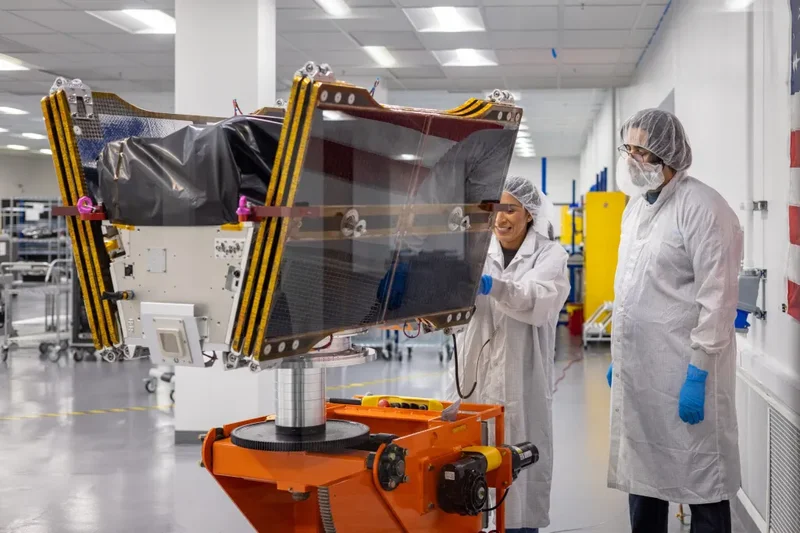
The company recently opened a manufacturing facility in nearby San Jose designed to produce up to 500 satellites a year by 2027, a tenfold increase over its previous capacity.
Satellites deployed so far have centered on platforms in the 200-kilogram class or smaller.
However, next year the company plans to deploy its first 500-kilogram MuSat XL spacecraft for Hubble Network, a Seattle-based venture with plans for a 60-strong constellation to connect up to a billion Bluetooth devices from space worldwide.
In June, Muon unveiled an even larger Starship-class platform called Condor-Ultra, initially offering 20 kilowatts of baseline power and more than 18 square meters of nadir payload area to meet emerging demand for orbital data centers.
Muon aims to debut Condor-Ultra in 2028 after securing undisclosed customers.
The new capital brings Muon’s total equity funding to more than $386 million, supporting investments in vertical integration that included the acquisition of propulsion startup Starlight Engines last year.
According to Muon, it controls 95% of its spacecraft production in-house under its Mission Foundry model, which integrates mission design, spacecraft, payloads, software, operations and data.
California’s satellite manufacturing hub
The funding comes shortly after fellow Californian satellite manufacturing startups Apex Space and K2 raised a combined $700 million in funding rounds valuing them at $2.3 billion and $6.8 billion, respectively.
K2 focused from the outset on large spacecraft, while Apex has also expanded into bigger, more vertically integrated satellite platforms after starting with smaller buses.
But whereas Apex is structured around standardized buses that can be produced at scale and later configured for different missions, Muon says Mission Foundry starts with customer requirements.
“The key difference is that Muon starts with the mission, rather than with a predefined satellite bus that the mission then has to fit around,” Smirin said via email.
“This allows us to optimize the entire system around the customer’s requirements, including orbit, power, processing, pointing, payload and operations.
“We’re seeing other companies that began primarily as satellite bus providers expand toward a broader mission model, which we think validates the approach. But Muon was architected as an integrated, full-stack mission provider from the beginning, with the hardware, software and operational infrastructure designed to work together and scale across multiple high-performance constellations.”
Galvanize, Google, Salesforce Ventures, Wellington Management, I Squared Capital and Woven Capital participated in the Series C, alongside existing investors Radical Ventures, Congruent Ventures, Costanoa Ventures, Activate Capital, ACME Capital, ArcTern Ventures and Overlap Holdings.