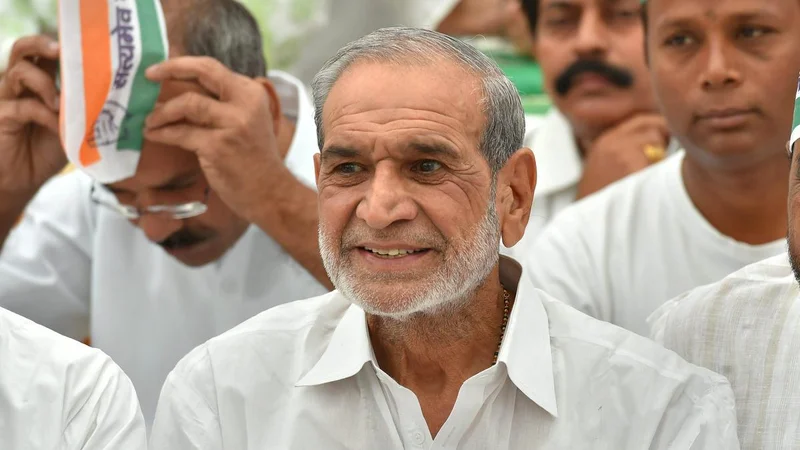
Sajjan Kumar, a three-term Lok Sabha member and once a powerful leader of Delhi Congress, whose political career was eclipsed by his conviction in the 1984 anti-Sikh riots cases, died at Safdarjung Hospital here on Thursday (August 20, 2026).
Mr. Kumar, who was serving a life sentence in Tihar Jail, was taken to hospital after his health deteriorated and was declared brought dead.
He had been in custody since December 2018, when he surrendered following the Delhi High Court’s decision to overturn his acquittal in a case relating to the killing of five members of a Sikh family and the burning of a gurdwara.
His death has left the Congress with a political dilemma, ahead of the Punjab Assembly election. The party has maintained a conspicuous silence on his death, with no immediate condolence from its top leadership.
Pawan Khera, chairman of the Congress’s media and publicity department, was the only prominent party functionary to publicly condole the death, expressing sympathy to Mr. Kumar’s family.
The muted response reflected the political sensitivity surrounding Mr. Kumar’s name, particularly in Punjab, where the memory of the 1984 violence remains a deeply emotive issue.
His death also marks the end of the life of a politician whose career was closely intertwined with the Congress’s organisational dominance in Delhi in the 1970s, 1980s and 1990s.
Born in 1945, Mr. Kumar began his political career through the Congress organisation and was elected a councillor to the Municipal Corporation of Delhi in 1977. He subsequently became general secretary of the Delhi Pradesh Congress Committee and emerged as a powerful organiser in the capital. He was associated with the political network around Sanjay Gandhi.
Mr. Kumar entered the Lok Sabha from Outer Delhi in 1980. He was elected again in 1991 and 2004, making him a three-term MP. His political career, however, came under increasing scrutiny over allegations relating to the 1984 violence. The Congress denied him a ticket for the 2009 Lok Sabha election.
The violence, which erupted after Prime Minister Indira Gandhi was assassinated by her Sikh bodyguards on October 31, 1984, resulted in massacre of Sikhs in retaliatory attacks across the country, with Delhi accounting for the largest number of deaths.
Mr. Kumar was accused of leading and instigating mobs during the violence. A trial court acquitted him in 2013 in a case concerning the killing of five Sikh men and the burning of a gurdwara in Delhi.
The Delhi High Court overturned the acquittal in December 2018 and convicted him of criminal conspiracy, abetment and other offences, sentencing him to imprisonment for the remainder of his natural life.
He resigned from the Congress a day after the High Court verdict and surrendered before the authorities. His appeal against the conviction remained pending before the Supreme Court.
A second conviction followed in February 2025, when a Delhi court sentenced him to life imprisonment for the killing of Jaswant Singh and his son Tarundeep Singh, who were burned alive during the violence in the Saraswati Vihar area. The prosecution had sought the death penalty, but the court cited his age and health while imposing a life sentence.
In January this year, Mr. Kumar was acquitted in a separate case relating to alleged violence in the Janakpuri and Vikaspuri areas. The court held that the prosecution had failed to establish his involvement beyond reasonable doubt. The acquittal did not affect his incarceration because of the other life sentences.
Mr. Kumar’s legal battles were part of the long and uneven pursuit of accountability for the 1984 violence. The cases against him, which remained unresolved for decades, were among those revisited after the Union government constituted a Special Investigation Team in 2015 to examine cases that had been closed or had not resulted in convictions.
His death brings to an end the criminal proceedings against him, but not the political debate surrounding the 1984 riots and the accountability of political leaders accused of involvement in the violence.
Mr. Kumar is survived by his family. Details of his last rites were not immediately available.
Published - August 20, 2026 05:22 pm IST