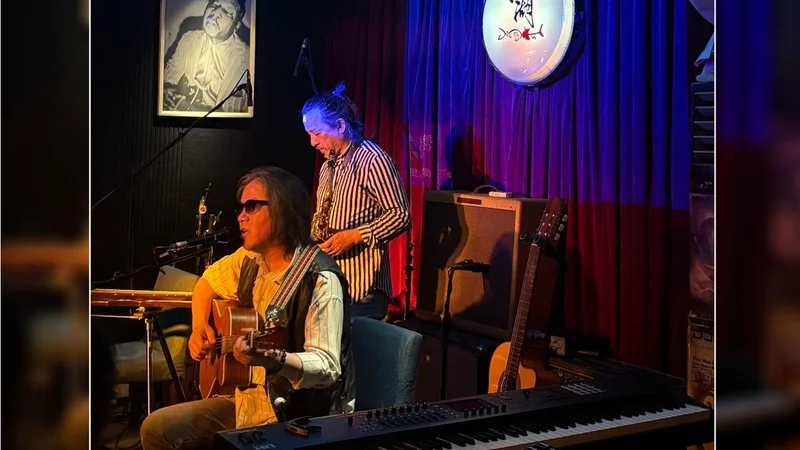
The day after the night before, Jiang Hu, a hole-in-the-wall Beijing bar and live music venue, tucked away inside a hutong alleyway not far from the Forbidden City, is unrecognisable. As I push open the unlocked wooden doors, the bar is entirely empty. The alley outside is silent and still.
The previous evening was anything but. For more than two decades, Jiang Hu has been something of a Beijing institution. As other bars and live houses popped up and faded away, part of the waxing and waning that has been a trademark of cultural life in the Chinese capital, Jiang Hu persevered.
I arrive on a warm evening to find a long queue snaking its way into the hutong. I am half an hour early, but by the time I make my way in, there is barely enough room to stand. A packed crowd waits impatiently, and breaks into applause and hoots as the star of the evening, Zhou Yunpeng, sunglasses on, strides on to the small stage, guitar in hand.
Zhou lost his sight as a child. He taught himself music at university, and in the early 2000s, went on to become one of China’s most well-known folk musicians, following the release of ‘Silent as a Mysterious Breath’ in 2004 and ‘China’s Children’ in 2007.
His music established him as a rare voice unafraid to sing about the real issues in people’s lives, at a time when love and patriotism seemed to be all that anyone sang about. Zhou’s music struck a chord with Chinese who, like him, were born in the 1970s, when the Cultural Revolution was still in full swing, and then grew up in the reform era that brought both prosperity and extraordinarily dislocating social change.
If the crowd outside is testament to how his music still resonates, what strikes me is the number of young Chinese in their 20s and 30s. When we meet the next afternoon, the first thing I ask Zhou is what explains this broad resonance. “I think it’s just the span and scope of my songs,” he reflects. “The themes perhaps cover several generations. Like buying houses...”
From the streets of Beijing
Bought a house, spent over three hundred thousand,
The money all came from the bank,
From today, I can’t take people to dinner,
I can’t drink, I can’t travel…”
— ‘Buying a House’ (2010)
If ‘Buying a House’ captures the economic anxieties of a period of breakneck growth, Zhou himself had no house to live in when he first moved to Beijing. The only place for aspiring artists like him, back in the 1990s, was a cramped artists’ colony outside the city centre near Yuanmingyuan, the historic old Summer Palace that had been looted and destroyed by foreign troops during the second Opium War.
“It was a bit like Greenwich Village in New York,” says Zhou. “I graduated in 1995 and went there [NYC], influenced deeply by that kind of Bohemian life. A lot of my music, the root [also] lies in those days of drifting in Beijing as a wandering musician.”
He began busking on Beijing’s streets — a sight that used to be common when I first moved to the city in 2008 but one that has now become all too rare at a time when order and security are emphasised over street life. The artists’ colony itself no longer exists, having been demolished to build a park. “I was there a few days ago. It’s a beautiful park for sightseeing, with a lake, trees... The artists’ colony only exists in people’s memories now.”
Literature was Zhou’s path to music — a path trodden, he points out, by others whose music has inspired him, such as the legendary Leonard Cohen. If literature was one inspiration, the reality of life in Beijing was another, the stories of ordinary people he would come into contact with while busking.
Reflecting reality
A child who lost his sight at the age of nine,
Spends his life in the cinema for the blind,
Listening to movies from morning to night,
Using his imagination to capture what he cannot see…
— ‘The Blind Man’s Cinema’ (2010)
I ask Zhou what makes Chinese folk music distinctive. It is, he says, both old and new, Western and Eastern, inspired as much by classical Chinese poetry as by the Beat Generation and Bob Dylan. “The earliest tradition of folk music in China is to be connected with reality. One of the earliest examples is The Book of Songs (Shijing), over 2,000 years old. It has a lot about the reality of that time, including criticising that reality. There is one piece that introduced corrupt officials, called ‘Shuo Shu’, meaning giant rats. Large rats, large rats, eat no more of our millet! For three years we have fed you, yet you show no care for us! It was about exploitation.”
Musically, there are Western influences. “It’s still a new, modern thing. Chinese folk music relies on the guitar, and that’s a Western instrument. It’s not played with a guzheng or pipa. So broadly speaking, the melody of folk music, it was only after having the guitar, hearing about Dylan, American country songs, and even Taiwan’s campus folk songs as well, that we obtained this nourishment.”
Increasingly, Chinese folk bands are also drawing on local musical traditions — like the Wutiaoren band that has become widely popular despite singing in a local dialect. Others frequently draw on classical Chinese poets such as Li Bai and Su Dongpo.
**ALSO WATCH ** Watch | Tibet in translation: how the capital city of Lhasa has been reshaped, and rewritten
When you mention Zhou Yunpeng, for many Chinese, the song that comes to mind is ‘Chinese Children’. It probably couldn’t be sung in today’s China. It hauntingly remembers a number of tragedies, including a fire that led to the death of close to 300 schoolchildren and caused outrage following reports that government officials were evacuated before the children. The song established Zhou’s voice as one that sang truth to power.
“That’s what folk music should be about. It should have the courage to expose reality and criticise it,” he says. That also explains his admiration for Dylan. “As a person, I feel he is someone who is forever non-cooperative, he always has a way of making sure people aren’t too comfortable.”
Like Dylan, Zhou resists labels. His view of his country is one of nuance. He has long drawn attention to the daily struggles of ordinary people and the sense of dislocation caused by a rapidly modernising society. At the same time, his years of travelling across China have given him an appreciation of the country’s extraordinary development.
Folk music at its best, in Zhou’s view, has a deep story to tell. “It is easy to write a song if you are writing a romantic lyric — for example, the sky is so blue, the sea is so blue, I love you, you love me. But it is very difficult to turn a realistic story into a song, with a narrative, telling a story about a child being abused, or how difficult life can be,” he says. "As a song, it still needs to be beautiful and music requires melody. Dylan did this so capably. To sing about messy and complex realities, but then put them into the melody of a great song.”
ananth.krishnan@thehindu.co.in
Published - August 20, 2026 05:15 pm IST