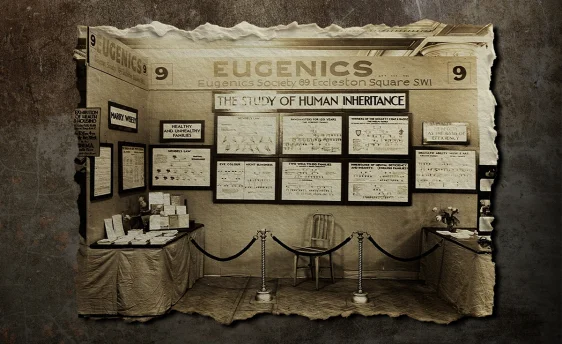
The pseudoscience of eugenics, founded on the mistaken notion that nature envisions some “right” combination of genes, and that selective breeding can improve the human race, is making a comeback. While the heyday of eugenics was a century ago, the idea was never really forgotten.
In the 19th century, the modern science of biology was in its infancy, but took a leap forward with the work of pioneering researchers like Charles Darwin and Alfred Russel Wallace. But other thinkers, like Darwin’s cousin, Francis Galton, took things further by supposing that, just as farmers breed animals to improve or weed out various traits, humans could be guided to make “better” offspring.
When the Nazis came to power in the 1930s, they took eugenicist ideas and ran with them, justifying their hatred of certain groups—Jews, Roma, gay people, the disabled—as supposedly backed by science, anchored to the notion that some races were naturally superior to others. In this distorted way of thinking, violence against the unfit was justified, even noble.
While eugenics largely fell into disrepute in the wake of Nazism, it never disappeared. Nor was it something the Nazis invented: In the early 20th century, most of the literature on eugenics was published in the United States, where it eventually underpinned sterilization campaigns against people with disabilities, fueled racist immigration policies, and, more recently, inspired efforts like the “Repository for Germinal Choice,” which collected and preserved the genetic material of leading thinkers, including Nobel laureates, by storing their sperm.
Read more: “The Misguided History of Racial Medicine”
Most serious scholars have relegated eugenics to the trash heap of science history. But much like its original incarnation from the late 19th century through the aftermath of World War II, its current rise is tangled up in politics, ideology, and an insidious desire to divide rather than unite people. And, as in the old days, on the unfounded notion that biology is the be-all and end-all of a person’s character and worth.
This past March, President Donald Trump told Fox News what he thought of two teenagers from Pennsylvania who threw a handmade bomb at anti-Muslim protestors outside the mayor’s mansion in New York City. According to federal prosecutors, the young men identified with the extremist Islamic State group. The bomb failed to detonate.
“They’re sick people, and a lot of them were let in here,” Trump told host Brian Kilmeade. “Others are just bad. They go bad. Something wrong—there’s something wrong there. The genetics are not exactly, they’re not exactly your genetics—it’s one of those problems, Brian.”
Disjointed as the comments were, they follow a theme that has long obsessed Trump. As far back as the 1980s, in an appearance on The Oprah Winfrey Show, Trump spoke of the importance of having “the right genes.” On the campaign trail in 2024, he declared immigrants “were poisoning the blood of our country.”
Trump’s penchant for classifying—and evaluating—people based on biology is echoed by Robert F. Kennedy, Jr., his secretary of health and human services. Ignoring established medical opinion, Kennedy has claimed it’s “very difficult for measles to kill a healthy person.” Seemingly judging some people to be biologically superior to others, Kennedy added, without evidence, “we see a correlation between people who get hurt by measles and people who don’t have good nutrition or who don’t have a good exercise regimen.” His disparaging comments about people with autism have been equally unfounded. And then there’s the repeated use of the “r word” by Elon Musk to describe people with mental disabilities.
These sentiments, coming from the most powerful people in Washington, D.C., and in the tech world are echoed on social media and in the wider world. They stoke xenophobic conspiracies like the “great replacement theory,” which holds that whites are being driven to extinction by non-white immigrants, and that breeding programs and restrictions on immigration are needed to ensure that whites retain a dominant position.
This discourse has, for many, a starkly familiar flavor, echoing some of the statements made by eugenicists a century ago. Despite a half century of science showing that the ideas behind eugenics have no basis in fact, it continues to surface in Washington and across political lines. As Rebecca Sear, an evolutionary anthropologist at Brunel University in the United Kingdom, who has published extensively on eugenics, puts it: “In the 21st century, eugenics is experiencing a fully-fledged revival.”
Galton coined the word “eugenics” in 1883 (the term comes from the Greek word eugenes, roughly translated as “well-born”). The link to Darwin’s own work on evolution is indirect: Darwin had merely explained how natural selection shapes species over time. Galton went a step further, arguing that we ought to collectively take charge of the selection process, steering the development of the human species. He imagined a kind of hierarchy of racial and cultural groups, with white Europeans at the top of the heap; his 1869 book Hereditary Genius included a chapter titled “The Comparative Worth of Different Races.” And if it worked for farmers, why not for us? “What nature does blindly, slowly, and ruthlessly,” he wrote, “man may do providently, quickly, and kindly.” It all came down to who had what sort of babies.
In the early years of the 20th century, eugenics garnered popular support from across the political spectrum in the United States and beyond. It was a time of political and social change, with reformers advocating limits on the power of corporations, maximum work hours, and minimum wages, along with the elimination of child labor. Yet many of the same people who fought for workers’ rights, as well as the rights of women and children, also believed that the human race could be improved through various kinds of intervention.
State and national governments called for restrictive marriage laws, for the segregation of the mentally disabled, and even for forced sterilization. “Better baby” competitions, modeled on livestock competitions, became commonplace at some U.S. state fairs. The movement swept much of the globe. Crucially, eugenics was billed as being backed by science. You could read about eugenics in standard biology textbooks and respected research journals. The New England Journal of Medicine, for example, wrote approvingly of its aims.
Eugenics and racism often went hand in hand. The U.S. Immigration Act of 1924 was aimed at improving the genetic make-up of the American population by restricting immigration from groups presumed to be genetically inferior—Italians, Eastern Europeans, and Jews.
In Canada, where more farm workers were needed in the underpopulated Prairie Provinces, the same fears about the “wrong” sort of immigrants took root; Charles Kirk Clarke, a University of Toronto psychiatrist who had the ear of Canadian politicians in the 1910s and ’20s, stated: “It is all very well to talk about pumping in the population. But surely the streams tapped should not be those reeking with degeneracy, crime, and insanity.” During World War II, Nazi Germany took eugenic ideology to its genocidal endpoint.
And yet, eugenic thinking was not anchored solely in Anglo-Saxon supremacy. There were Black and Jewish eugenicists, who imagined either that the “science” behind eugenics would lift up all races, or at least improve the quality of people within specific races. And then there was the suffragette movement. Some first-wave feminists supported eugenics, linking the fight for female emancipation with the desire to better the human race.
“This was the progressive era,” says Wendy Kline, a historian of medicine at Purdue University in Indiana. “Eugenics seemed to mesh with all the interests of what people saw as progressive science.”
A theme that runs through the original eugenics movement is the idea that whatever makes some people “better” than others is rooted in biology, and therefore not only heritable but also potentially controllable.
This was certainly imagined to be the case with intelligence. In the early 20th century, many Americans were gripped by the fear that less intelligent people were having more babies than more intelligent people. (A sentiment echoed today by Musk, who has amplified posts on X about “high status males” and has volunteered to use his own sperm to seed a future Martian colony.) Those fears were front and center in the landmark Buck v. Bell Supreme Court case of 1927. The case centered on Carrie Buck, a poor white woman who, at 17, had become pregnant after being raped by her foster mother’s nephew. Her foster parents had her institutionalized, deeming her “feeble minded” (the label often used at the time) and called for her to be forcibly sterilized. The question of whether this was permitted under Virginia law made its way to the Supreme Court, presided over by Chief Justice (and former president) William Howard Taft.
Read more: “Why Doesn’t Everybody Have Dark Skin Today?”
In the end, the court upheld the Virginia statute that allowed such actions “for the protection and health of the state.” Buck’s biological mother and her 8-month-old sister faced the same fate. Justice Oliver Wendell Holmes Jr.—who championed civil liberties—wrote the majority decision: “Carrie Buck is a feeble minded white woman [and] is the daughter of a feeble minded mother in the same institution, and the mother of an illegitimate feeble minded child … Three generations of imbeciles are enough.” (Louis Brandeis, the court’s first Jewish member, voted with the majority, as did Taft; only Associate Justice Pierce Butler dissented.)
Historians estimate that between 60,000 to 70,000 Americans were eventually sterilized against their will, in at least 30 states. Many of the laws allowing such actions remained on the books for decades, and as recently as 2013, incarcerated women were routinely sterilized in California state prisons.
After its association with Nazi ideology following World War II, some eugenics organizations simply changed their names. The journal Eugenics Quarterly, for example, changed its name to Social Biology, and the Eugenics Review became the Journal of Biosocial Science. In fact, as Sear points out, eugenics continued to thrive in academia well into the post-war period, citing the journal Mankind Quarterly, founded in 1960, as an example.
“Mankind Quarterly was established as something which looked like an academic journal,” Sear says. “But in fact it was set up entirely to promote eugenic ideology, particularly around racism.” Today the journal is published by the far-right Human Diversity Foundation.
It would be exhausting to enumerate all the ways that the thinking behind eugenics fails to hold up to scientific scrutiny. Take, for example, the movement’s obsession with IQ. More than a half century ago, evolutionary biologist Stephen Jay Gould wrote, “Who knows what IQ measures? It is a good predictor of ‘success’ in schools, but is such success the result of intelligence, apple polishing, or the assimilation of values that the leaders of society prefer?” As Sear points out, IQ only measures a narrow range of what we typically mean by “intelligence.” For instance, she says, “IQ does not measure your social intelligence, your ability to get on with other people.”
Like most psychological traits, intelligence is the result of multiple genes, which can be modulated by the influence of yet other genes, and of course by environmental factors. Even when genes are linked to specific traits, life outcomes can vary enormously—due to opportunities (or lack thereof), such as inherited wealth, prejudice, and sheer luck.
A critical tenet of eugenics is that races are delineated by biology, a convenient belief allowing for people to be categorized and even ranked based on their genetic inheritance. But that tenet has no backing from modern science. When genuine science doesn’t align with one’s beliefs, pseudoscience can flourish. All of this gets even muddier when ideology and politics enter the picture—as current happenings in Washington again seem to highlight.
In 2025, Trump objected to an exhibition called “The Shape of Power: Stories of Race and American Sculpture” at the Smithsonian’s American Art Museum. He issued an executive order criticizing the exhibition for promoting “the view that race is not a biological reality but a social construct.” In response, a quartet of geneticists and anthropologists wrote in Science that decades of studies in evolutionary biology, genetics, and anthropology have shown race is indeed a social construct, not a biological reality.
“No biological definition of race can be accurately applied to subgroups of humans, especially not subgroups based on social definitions of race, which arbitrarily use physical, geographic, cultural, and linguistic criteria,” they wrote. This consensus, the scientists point out, is based on evolutionary evidence and “data showing that the amount of genetic variation that occurs within human populations is much greater than genetic variation between populations.”
The authors cited a 2023 report by a joint committee of scientists from the National Academies of Science, Engineering, and Medicine, which stated that race “is a misleading and harmful surrogate for population genetic differences.” Evoking the specter of eugenics, the report lamented that race “has a long history of being incorrectly identified as the major genetic reason” for differences between groups. (This summer, Trump ordered new “temporary exhibits or signage” to be installed outside yet another Smithsonian museum—this time the National Museum of American History—warning visitors about “the Ideological Capture” of the museum.)
The historical eugenics practice of invoking science (that is, what was imagined to be valid science) in support of policies that marginalized the poor and benefited the privileged, all in the name of supposedly improving the human race, has a new sheen today, enabled by the latest reproductive technology.
Last fall, banner ads sprouted up in the New York City subway system, saying HAVE YOUR BEST BABY and IQ IS 50% GENETIC. The ads were for a company called Nucleus Genomics. By using an embryo-testing technique known as polygenic screening, Nucleus suggests couples can choose their baby’s eye color, hair color, and even intelligence. Some 3,000 people have joined the company’s wait list as of April. Even if such baby-tweaking is simply the result of people freely expressing their preferences, it may be an option primarily available to the wealthy—and might thus inject a new dimension of disparity to the already cavernous rich-poor divide.
At the same time, advances in genetic engineering—and especially the allure of gene editing technology like CRISPR—has left people wondering just how far the idea of “designer babies” might go (although gene editing of human embryos for reproductive purposes, known as “germline editing,” is currently banned in the U.S.).
“Do we want humans to be a commodity? I think that train may have left the station,” says Philippa Levine, a historian and professor emeritus at the University of Texas at Austin and author of the 2017 book, Eugenics: A Very Short Introduction. After all, Levine adds, “What the hell is perfection? If I’m a deaf person, does that make me a lesser person? If I’m in a wheelchair, does that make me a lesser person?”
Meanwhile, people are also choosing what kind of babies not to have. In the United States, about two-thirds of women are choosing to abort fetuses that carry the genetic abnormality linked to Down syndrome. But in some countries, like Iceland, the figure is much higher.
Voluntary abortion and voluntary embryo-selection are, obviously, worlds away from forced sterilization. But the idea of relying on genetics to decide who gets to be born and who doesn’t is inherently fraught.
Alison Bashford, a historian at the University of New South Wales in Australia, and co-editor with Levine of The Oxford Handbook of the History of Eugenics, has argued that many of the trends seen in today’s reproductive medical interventions recall our century-plus urge to classify people as “fit” or “unfit,” virtually from the moment egg and sperm first meet. Whatever we call it, Bashford says, the eugenicists of a century ago “would undoubtedly be delighted at contemporary possibilities for reproductive selections.”
That eugenics-themed language and ideas have re-entered the public sphere, from the political realm to the business world, deeply concerns scholars like Bashford and Levine. Its resurgence, Levine says, shows that eugenics never died. “The essence of eugenics is still with us. It crept away for a little bit. But it continues to exist, and the manipulation of science continues to be something that is very dangerous.”
Led image: Tasnuva Elahi; with images by artefacti, Philip / Adobe Stock and Wellcome Library