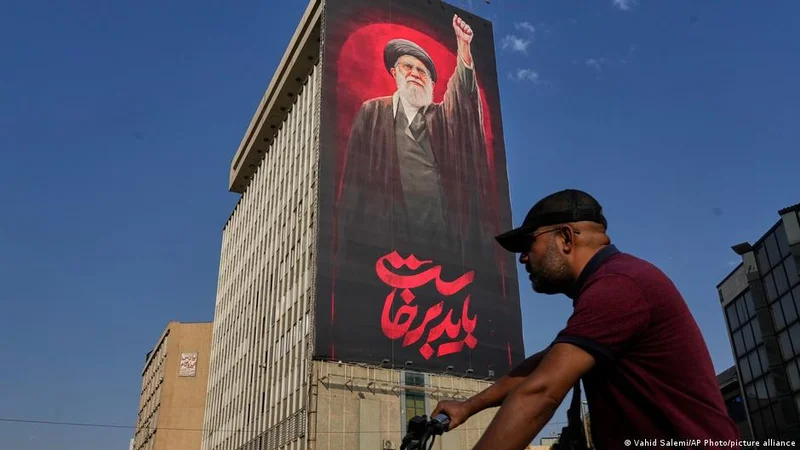
Iran's rubber-stamp parliament recently approved the broad outlines of a bill imposing new restrictions on contacts with foreign institutions, media and organizations, as authorities seek to expand the legal framework for combating what they describe as "foreign influence."
Under the version advanced on Sunday, contacts with foreign media, cooperation with overseas universities and research institutions, communication with foreign embassies and organizations, and the receipt of foreign financial support could be banned, require prior authorization or carry criminal penalties.
The text is still subject to final approval and must be passed by the 12-member Guardian Council before becoming law. Although Iran ostensibly holds elections for parliament, any candidate must be approved by the unelected Guardian Council, which is loyal to the Islamic Republic's ruling clerics.
Proponents of the bill say it is in response to increased activities of foreign intelligence services, governments and institutions. They also argue that while espionage is already covered by Iranian law, there is no clear legal framework for addressing foreign "influence."
Iran already an information black hole
Sina Yousefi, an Iranian lawyer and legal expert based in Germany, said the legislation leaves the boundary between legitimate contact and foreign influence unclear in many of its provisions, with the interpretation of that boundary effectively left to security institutions and the courts.
"When a citizen does not know whether speaking to foreign media, cooperating with a foreign university or sharing information could later be treated as a criminal act, the law creates an atmosphere of fear and insecurity," Yousefi told DW.
Iran already has one of the most repressive media environments in the world, ranking 177 out of 180 countries on Reporters Without Borders (RSF) 2026 World Press Freedom Index.
The government runs all broadcast networks, foreign media is barred from broadcasting in Iran, and authorities frequently block the internet and social media during civil unrest, as was seen during a bloody crackdown on protests in January 2026.
Obtaining information from within Iran is very difficult. RSF classifies access to information inside Iran as "severely restricted," with reporters working under bombardment while also facing pressure from state institutions.
Parviz Yari, a Germany-based journalist and senior researcher with the Defending Free Flow of Information (DeFFI), a non-profit tracking harassment of journalists in Iran, described the bill as a continuation of what he called the Islamic Republic's efforts to restrict freedom of expression.
"The Islamic Republic has used a wide range of tools and methods to disrupt the free flow of information and restrict freedom of expression. But the expansion of social media and the activities of media outlets and human rights organizations outside Iran have reduced the impact of official narratives on public opinion," Yari told DW.
Criminalizing reporting
Yari said the bill could also make it harder for independent media and international organizations to access information from inside Iran.
"Criminalizing new forms of activity by journalists, citizens and researchers is, on the one hand, an attempt to limit independent media and international organizations' access to first-hand sources, and on the other, an effort to strengthen the reach of the Islamic Republic's propaganda apparatus," he said.
Part of the proposed bill calls for penalties between six months and two years in prison for interviewing or discussing with media "deemed hostile to the Republic," Reuters news agency reported.
Media researcher Yari warned that the impact on journalists and researchers could be particularly significant if the bill becomes law.
"If finally approved, the bill would criminalize an unprecedented range of contacts with opposition media and international organizations, clearly aimed at disrupting the professional work of journalists and researchers, tightening the state's information monopoly and amplifying official narratives," Yari said.
Limiting academic research and civil society
However, one of the bill's most significant provisions concerns scientific and academic cooperation with foreign entities.
Article 5 requires the Intelligence Ministry publish an annual list of foreign universities and institutions approved for scientific and research cooperation.
Collaboration with institutions outside that list would be prohibited. Sending medical, research and archaeological samples to unauthorized foreign institutions could also result in criminal penalties, including imprisonment.
The provision would effectively make certain forms of international academic cooperation dependent on approval by the Intelligence Ministry.
The bill also extends restrictions to civil society. Certain foreign funding, contracts and forms of cooperation involving NGOs, associations and political parties would require approval from a committee involving government ministries and security institutions.
Lawyer Yousefi warned that the uncertainty created by the bill could discourage academics, researchers and civil society groups from pursuing international cooperation.
"When cooperation with a foreign university, participation in an educational course, contact with an international organization or support for a civil society activity can become a security case, people will distance themselves from these activities in advance," Yousefi said.
"The result is a restriction on universities, civil society, the flow of information and Iran's scientific engagement with the world. This is no longer simply a policy against espionage, but security intervention in areas that should be able to operate independently."
Regime expands its grip
Moein Khazaeli, an Iranian legal expert based in Sweden, warned that the bill could become "another tool for suppressing political opponents and human rights activists."
He told DW that the bill could criminalize ordinary conduct that would not normally be considered illegal in most countries.
"Acts that are classified as crimes under 99% of the provisions of this bill are not crimes in the first place and do not even warrant criminal prosecution," he said.
He pointed to a provision under which the punishment for an ordinary offense could be increased if authorities determine that it was directed or influenced by a foreign actor.
"An ordinary offense, such as an insult or a street fight, could potentially be deemed to have been directed or influenced by foreign actors, leading to a harsher sentence," Khazaeli said.
For Iran's authorities, the ongoing conflict with the US and last year's short war with Israel have created a particularly difficult security environment, with heightened concerns over foreign intelligence operations and vulnerabilities inside the country.
Yousefi sees the bill as less about addressing a concrete threat and more about making up for the government's security shortcomings by restricting and intimidating citizens' freedoms.
"If security agencies have failed to prevent genuine foreign influence, they cannot compensate for that failure by expanding criminal liability and placing citizens' contacts with the outside world under security oversight and authorization," he said.
"Combating espionage should target specific criminal conduct, not treat academic, media, cultural or civil society ties with the outside world as inherently suspicious."
*Edited by: Wesley Rahn *