With just days to go before the highly anticipated first Test between the Springboks and the All Blacks, additional tickets were released ranging from R850 to R4,000, despite the game seemingly being sold out.
This is the first of four major Tests between the nations for the Rugbyâs Greatest Rivalry tour and takes place this Saturday, 22 August, at Ellis Park. The tickets were reportedly released on Tuesday evening and by Wednesday morning between 1,000 and 2,000 tickets were still available, according to figures reported by News24.
Those tickets start at R1,650.
The late release and high prices have once again put South African Rugbyâs (Saru) ticketing strategy under the spotlight, with fans already questioning the affordability of Springbok Tests and the impact that has on stadium attendances.
Sold out?
As early as 27 June, the Rugbyâs Greatest Rivalryâs official Instagram page posted a graphic listing ticket availability for the four major Tests between the Springboks and All Blacks.
While tickets remained available for the third Test at FNB Stadium, which takes place on 5 September, and the fourth Test at Baltimoreâs M&T Bank Stadium on 12 September, both Ellis Park and Cape Town were clearly marked as âSold Outâ.
Daily Maverick, however, cannot find any record of Saru specifically saying the tickets were sold out.
According to News24, a Saru spokesperson said the additional tickets that were made available this week came as a result of âcommercial partners who have not taken up their full allocationâ.
A Saru spokesperson further explained to Daily Maverick that the general access tickets had sold out, while the tickets now available had been blocked out for commercial partners who had not taken up their option.
âThe general access tickets (i.e. publicly available tickets) were sold out. The ones now available are tickets that were blocked out for commercial partners who have now not taken up their option,â the spokesperson said.
Partners receive a free-of-charge allocation as part of their sponsorship, as well as an option on the âright to purchase ticketsâ, said Saru, but could not provide a specific breakdown of the allocation, citing commercial sensitivity.
What is further doused in uncertainty, however, is the Cape Town Test.
According to a source within Saru, about 3,000 tickets remain available for the match at Cape Town Stadium on 29 August.
However, attempts to buy tickets through the Ticketmaster link on Saruâs website are unsuccessful. While the site does not explicitly state that the match is sold out, no seats can be selected on the seating plan and there are no tickets available to purchase.
The source further stated that roughly 4,000 tickets remain unsold across the approximately 95,000-seater FNB Stadium.
A wider ticketing problem
Ticket prices and sparse stadiums have been the big talking point of the tour so far, but it extends beyond the tour and has been an ongoing issue for some time.
The first All Blacks tour match against the Stormers at Cape Town Stadium on 7 August attracted 47,130 spectators, roughly 85% capacity. While that was the best-attended fixture of the tour so far, ticket prices ranging from R650 to R1,350 were cited as a factor in the match falling short of a sellout.
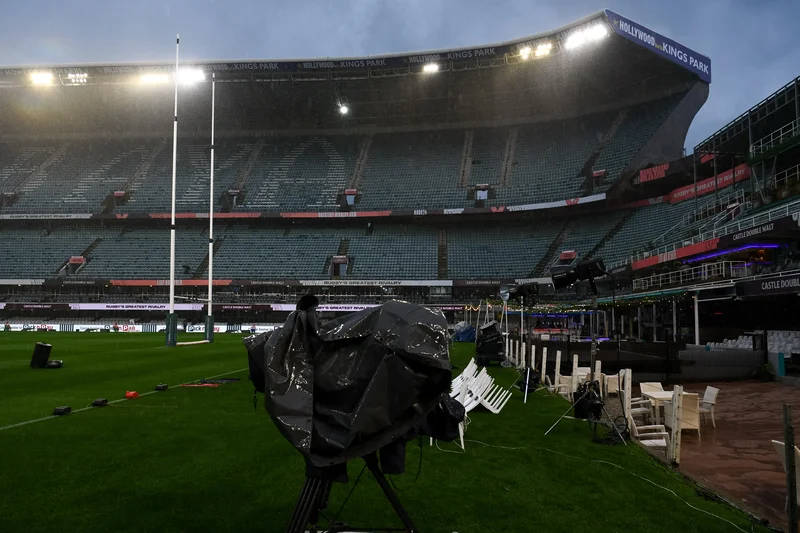
Attendance dropped sharply for the All Blacksâ match against the Sharks at Kings Park in Durban on 11 August â only 14,759 fans were in attendance for the clash. About 25,000 tickets had reportedly been sold, but cold and rainy conditions contributed to the low turnout. Additionally it was a game on a week night, unlike the Stormers and Bulls games.
The Bullsâ meeting with the All Blacks at Loftus in Pretoria on 15 August attracted 30,930 spectators, filling roughly 60% of the stadium.
For Saturdayâs Ellis Park Test, Saru said the pricing reflects the status of the fixture as a premium event.
âThis event occurs only every eight years in South Africa and as such is a scarce and premium event established in partnership with New Zealand with whom we share all income and all costs,â the spokesperson said. âSuch events in any field of entertainment command premium prices.â
Ticket strategy review
Saru further pointed Daily Maverick to the review of its ticketing strategy announced in July, saying it would be âthoroughly reviewedâ at the end of the 2026 season.
This came after Saru was forced to slash ticket prices for the Springboksâ Nations Championship Test against England at Ellis Park after slow sales. The cheapest tickets were reduced from R950 to R450, helping draw a crowd of 52,790 at the 62,000-capacity venue.
The following Test against Scotland at Loftus on 11 July attracted a crowd of 45,053, with unsold tickets ranging from R1,050 to R2,500.
âWe take full ownership of this matter and are committed to ensuring that our ticketing structure reflects accessibility and sustainability,â SA Rugby president Mark Alexander said previously. âSupportersâ passion and loyalty are central to our success, and we are deeply grateful for their commitment to our teams.
Alexander said Saru had recorded a loss in 2025 and rejected suggestions that ticket pricing was driven by profit-seeking.
âOur commercial strategies are designed to cover the cost of running rugby in South Africa, not to increase profits,â he said.
Accordingly, Saru said it would review its ticketing framework for the 2027 season and beyond and ensure the necessary adjustments are implemented so that the approach is both âsustainable and supporter-focusedâ.
Pricing out fans
In the meantime, however, the growing backlash over ticket prices suggests that Saru risks pricing out and alienating some Springbok supporters.
One fan, Johnny Black, in an email to Daily Maverick, said that on top of the frustration of paying the exorbitant prices, it was the last-minute drop in prices a week before that made him feel like a âmugâ.
For the Sharks game, this fan said he paid R1,350 a ticket for four people, making that R5,400 in total.
âI reluctantly paid what I felt was a ridiculous price because, for me, going to a live rugby match, with my family, is about more than just watching the game,â said Black. âYou go to the stadium for the atmosphere. The noise, the excitement, being surrounded by thousands of people all caught up in the game.
âInstead, I paid R1,350 to sit in a stadium that was so empty we could pretty much have sat wherever we wanted.â
âYou got my money, but youâve lost my custom,â he said. DM