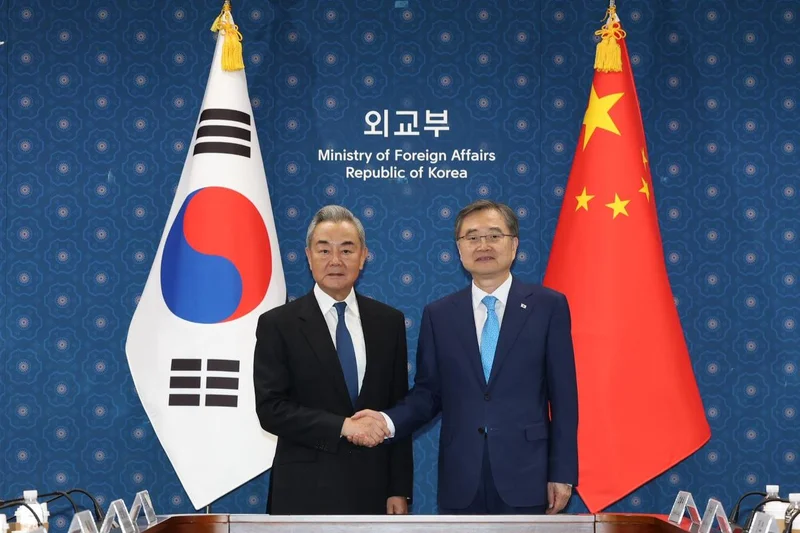
China continues to maintain its longstanding position on ensuring peace and stability on the Korean Peninsula, though Beijing has stopped short of explicitly expressing its support for the denuclearization of North Korea, officials in Seoul said Thursday.
The remarks came as Chinese Foreign Minister Wang Yi did not refer to the "denuclearization" of the peninsula during a meeting in Seoul the previous day, instead pledging to work toward "peace and stability," a slight shift in wording that China has maintained recently.
In his opening remarks during the ministerial meeting, Foreign Minister Cho Hyun outlined Seoul's efforts to achieve denuclearization and peace on the peninsula and called for China's role in encouraging Pyongyang to return to dialogue.
Wang, however, did not mention denuclearization in his remarks, instead saying China would continue to play a constructive role in promoting peace and stability on the peninsula.
"China has emphasized that its policy toward the Korean Peninsula maintains continuity and stability and that there has been no change in its position. It reaffirmed this stance during yesterday's meeting," ministry spokesperson Park Doo-soon said at a regular press briefing.
The two ministers also held "wide-ranging discussions" on ensuring peace and stability on the peninsula, including North Korea's nuclear issue, Park said.
"As the denuclearization of North Korea was also reaffirmed as a shared goal at the U.S.-China summit in May, we will continue to strengthen communication with China and encourage it to play a constructive role."
Another foreign ministry official said China has been refraining from using the term "denuclearization," apparently in consideration of its relations with North Korea.
"Even so, China is also well aware of the potential impact that refraining from using the term could have on the international nonproliferation regime," the official said.
"We could sense China's view that closer strategic communication between South Korea and China would help prevent a deepening bloc-based confrontation between South Korea, the United States and Japan on one side and North Korea, China and Russia on the other."
Explore More
- Q.
- Q.
- Q.