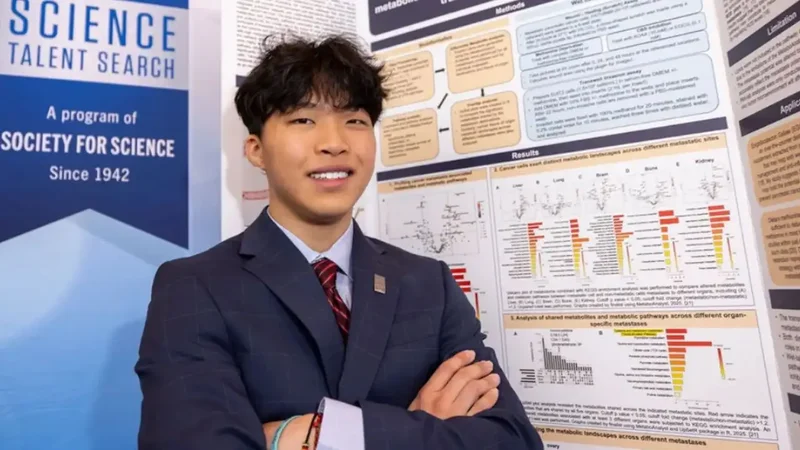
18-year-old Jonathan Yan, a student from Irvine, California sucessfully stopped spread of cancer cells by blocking the transsulfuration pathway in cancer cell lines. Yan studied 479 human cancer cell lines as part of his computational biology and bioinformatics project for the 2026 Regeneron Science Talent Search.
According to the organisers of the competition, his project focused on metastasis, the process in which cancer cells spread from their original location to other organs. Once cancer spreads, it becomes more difficult to treat.
Yanâs work looked for differences between cancer cells that spread and those that did not. He built a data integration and analysis workflow to examine information from hundreds of human cancer cell lines.
His analysis pointed to a particular biological process called the transsulfuration pathway. Yan found that this pathway was highly active in metastatic cancers. He then looked at what happened when the pathway was blocked in cancer cell lines.
The result was significant within the cell lines he studied. When Yan blocked the pathway, the cancer cells did not spread. His findings suggest that the pathway could be important in understanding how cancer cells metastasise and how their spread might be stopped.
The pathway that stood out
The transsulfuration pathway is involved in how cells process amino acids. Amino acids are the building blocks used by cells to make proteins and carry out other functions.
The pathway converts one amino acid into another. It also helps cells make antioxidants, which protect cells from damage. When Yan research found that this pathway was particularly active in cancers that had the ability to metastasise, that difference became the focus of his investigation.
By studying data from 479 human cancer cell lines, he compared how different cancer cells used energy and nutrients and whether they were linked with the ability to spread. His project used computational biology and bioinformatics to bring together and analyse the available data.
The findings led him to test whether the highly active transsulfuration pathway was connected to cancer cell movement. When the pathway was blocked in cancer cell lines, the cells did not spread.
Reaching talent search finale
Yan is a student at Sage Hill School in Newport Coast, California. His research project, titled 'Bioinformatic Discovery of the Transsulfuration Pathway in Metastatic Cancer', made him a finalist in the 2026 Science Talent Search. He presented his project as part of the competition, including at a public event in Washington, DC, on March 8, 2026.
The Regeneron Science Talent Search, organised by the Society for Science, recognises students for original research, creativity, real-world impact and scientific precision. As one of the top 40 finalists, Jonathan will receive $25,000 and compete for the top prize of $250,000 in March. The finalists will also compete for a total prize pool of $1.8 million.
âIt is such a great honor to have been recognized as a Regeneron STS Scholar. It also encourages me to continue working hard and growing my knowledge in the field.â Jonathan said as quoted by Sage Hill school's student run news site.
At Sage Hill School, Yan plays ice hockey and flute. He has played ice hockey for more than nine years and has taken part in more than 300 games.
He is also involved in his schoolâs DreamCatchers Foundation chapter, where he helps fulfil end-of-life wishes for hospice patients. He serves as president of the schoolâs chapter.
Yan has also worked on a project linked to cyclist safety. He created an app and hardware prototype designed to alert cyclists about dangerous objects, including cars approaching from their blind spots.