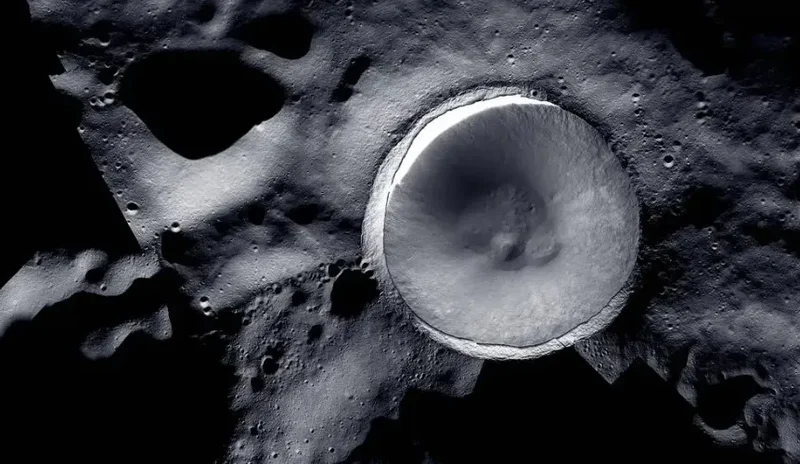
HELSINKI — China will launch a complex, multi-spacecraft mission late Sunday to study and land near the lunar south pole, including a search for evidence of water-ice.
A Long March 5 rocket was rolled out at Wenchang Satellite Launch Center on Hainan island, Aug. 19, setting the stage for launch of the Chang’e-7 mission. The China Manned Space Engineering Office (CMSEO) stated launch was scheduled for the coming days, but airspace closure notices indicate a launch window opening around 8:00 p.m. Eastern, Aug 23 (0000 UTC, Aug. 24).
The mission is targeting the scientifically intriguing lunar south pole, focusing on key questions regarding the potential presence, volume and accessibility of volatiles caught in shadowed craters, acting as cold traps. Volatiles have been detected via remote sensing but there have yet to be in-situ measurements or sampling. Together with the follow-on Chang’e-8 in-situ resource utilization mission, planned for around 2029, Chang’e-7 is intended to lay the technical groundwork for China’s planned International Lunar Research Station (ILRS).
The scheduled launch of the Long March 5 rocket aims to insert the Chang’e-7 stack, consisting of an orbiter, lander, rover and hopper spacecraft, into a translunar trajectory, with the spacecraft entering an initial lunar orbit around five days later. The orbiter will then begin imaging target landing sites near the lunar south pole for a later landing attempt. Authorities have yet to reveal a planned landing date, which could even come months after entering lunar orbit.
Precision landing
The Chang’e-7 lander will attempt a precise landing with a sub-100 meter ellipse, with the lander expected to target a feature known as the Peak Near Shackleton, referring to the large Shackleton crater. Any landing site will be chosen taking into consideration topography and suitably flat lunar terrain, elevated ground, which can provide extended periods of solar illumination, allowing the lander and rover to operate for longer periods, and access to permanently shadowed regions potentially harboring volatiles such as water.
A 2023 technical paper by engineers at the China Academy of Space Technology, published in the Journal of Deep Space Exploration, describes an environment where the sun never rises more than a few degrees above the horizon, casting shadows tens of meters long from even modest terrain features, and where viable landing zones with adequate illumination are only around 100 meters across.
Drilling in shadowed craters
The propellant-powered hopper spacecraft is designed to make a series of flights into shadowed craters. It also has legs to allow it to move away from touchdown sites and potential contamination and begin to analyse the surface. Once the hopper reaches a shadowed crater, its Lunar soil Water molecule Analyser (LUWA) payload first scans the surface with a laser-based spectrometer from 30-80 centimeters away, checking for surface frost and previewing whether the site is likely to yield water, according to a paper published in the Chinese Journal of Space Science. A drill then retrieves a soil sample from up to roughly a meter deep, where subsurface “dirty ice” is thought to reside, and the sample is brushed and tipped into a sealed heating chamber kept below -20 degrees Celsius. Once sealed, the sample, limited to under a gram, is heated above 200 degrees to release trapped water and other volatiles, which are piped to a mass spectrometer and a laser spectrometer, quantifying both the water content and its hydrogen-isotope signature, which could help identify whether the ice originated from the solar wind, comets, or asteroids.
Ambitious science
The orbiter, lander and rover, and the supporting Queqiao-2 relay satellite also carry a range of science payloads, including a seismograph, topography and panoramic cameras, magnetometers and spectrometers, and a lunar penetrating radar.
“It looks like an incredibly capable and ambitious mission with multiple scientific components on the orbiter, lander, rover and hopper,” said Katherine Joy, a professor of lunar and planetary science at the University of Manchester. “There is a potential for a huge science return if the mission can successfully land at its intended landing site close to Shackleton crater.”
Both the rover and the hopper carry mass spectrometers capable of analyzing lunar volatiles, Joy noted, raising the possibility of characterizing water not just at the surface but in the shallow subsurface as well. “What would be incredibly exciting is if the mission can get the hopper to survive landing into a more shadowed area to see if there is any subsurface ice present, and what the chemistry of this ice-soil mixture might be,” she said.
Joy also pointed to the value of comparing Chang’e-7’s findings with those of other missions expected to explore the same region in the coming years, including NASA’s VIPER rover, now targeting no earlier than 2027 for a landing aboard Blue Origin’s Blue Moon lander, and instruments such as ESA’s PROSPECT drill, whose flight assignment remains unresolved following the collapse of its original partnership with Russia’s Luna-27 mission.
Taken together, Joy said, the missions represent “a really important step for understanding the future human exploration potential of the south pole of the moon, and for investigating the origins of lunar volatiles.”
China has launched a series of Chang’e missions, starting in 2007, including orbiters, landers and rovers, and the 2020 and 2024 Chang’e-5 and Chang’e-6 sample return missions to the near and far sides of the moon respectively.
The sample return missions also provided a validation of techniques such as launching from the lunar surface and docking in lunar orbit needed for human exploration of the moon. China is aiming to land its first astronauts on the moon before 2030.
The Chang’e-7 probe arrived at Wenchang by air in April, while the Long March 5 rocket, designated Y14, arrived by sea in July. Next steps ahead of launch include final functional checks, joint testing and propellant loading, per CMSEO’s Aug. 19 statement.