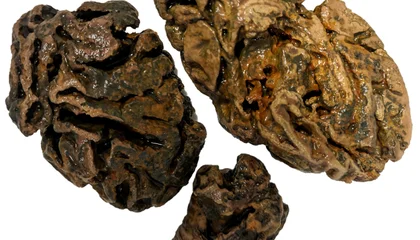
The brain is one of the first organs to begin decomposing after death. Yet archaeologists have discovered more than 4,400 preserved human brains around the world, some of which have remained intact for the last 12,000 years. In hundreds of cases, the brain was the only soft tissue left among otherwise skeletal remains.
But how—and why—do brains sometimes persist for millennia while all other types of soft tissue disappear? This preservation paradox has stumped scientists for years. Now, however, a team of researchers say they may have solved the mystery.
If a human brain ends up in a wet, oxygen-starved environment, the processes that usually cause decay can have the opposite effect, researchers report in a study published in the August 7 issue of the Journal of Proteome Research.
“Under the right conditions, preservation actually arises from decay itself: The same reactions that degrade tissue can also weld the breakdown products together into something far tougher,” study co-author Alexandra Seviour, a paleobiologist at the University of Oxford in England, tells Live Science’s Victoria Atkinson.
Many of the intact brains were found in watery, low-oxygen areas, such as shipwrecks, riverbeds, lakeshores and flooded caves. But since water is a key driver of decay, this pattern is puzzling. Seviour and her colleagues wanted to figure out why the brain specifically seemed to be immune to water’s destructive powers.
The researchers gathered 72 mouse carcasses and placed each in its own glass jar partially filled with quartz sand. The animals’ bodies were evenly divided among four burial conditions: wet and oxygen-rich, wet and oxygen-poor, dry and oxygen-rich, and dry and oxygen-poor. The team created wet or dry conditions by adding different amounts of water, and the oxygen-rich or oxygen-poor conditions by leaving the jars open or sealing them with airtight silicon gaskets.
Then, the researchers waited. They removed and analyzed three different mice from each burial condition at six time points: 24 hours, 72 hours, one week, six weeks, three months and six months. They dissected the animals’ brains, then looked at the molecular makeup of the tissue to track which proteins remained intact and which had broken down; they also looked at the chemical marks on the surviving proteins.
At first, the brains showed similar patterns of decay across all four conditions. But as time went on, the brains in both oxygen-rich conditions deteriorated faster and more extensively than the others. In the wet, oxygen-poor condition, however, the decay eventually slowed to a standstill.
The scientists think they know why. When oxygen is abundant, it triggers a cascading, chemical chain reaction that causes brain proteins to break down rapidly. This sequence hinges on free radicals, highly reactive, unstable molecules that “steal” electrons from nearby atoms and molecules. The process happens in the brains of living people too, and if left unchecked, can cause health problems.
In low-oxygen environments, however, this chemical sequence appears to play out differently. The researchers’ analyses hint that free radicals instead react and bond with nearby proteins, making the overall tissue tougher and more resistant to decomposition, Seviour tells Chemical and Engineering News’ Anirban Mukhopadhyay.
The findings show that “decay is not the opposite of preservation but, under specific chemical constraints, one of its mechanisms,” the researchers write in the paper.
Intriguingly, the chemical changes that seem to help proteins survive after death “closely mirror” those involved in brain aging and neurodegenerative diseases like Alzheimer’s, the researchers write. With that in mind, the new findings could have implications not just for archaeology, but also for medicine.
Richard Evershed, an organic geochemist at the University of Bristol in England who was not involved with the research, would like to see future studies build on this one, exploring whether the same protein-preservation patterns might occur in other archaeological materials.
“Comparing more tissues—other organs and muscles—would be really useful to get an idea whether what was happening in the brain was special compared to what was happening elsewhere, and also to resolve questions regarding proteins preserved in other environments in archaeology such as pots or dental calculus,” Evershed tells Live Science.