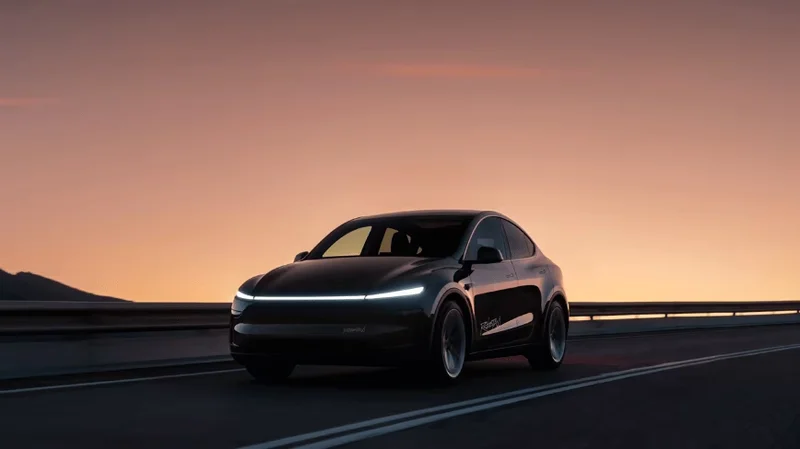
Tesla’s robotaxi service in Austin appears to have gone fully driverless. Over the past fortnight, every one of the 170 rides logged by an independent monitoring project ran with no human safety monitor on board, across 54 different cars.
Two days earlier, a passenger filmed one of those cars driving straight through a line of plastic bollards.
What the tracking shows, and who did it
A crowdsourced project called Robotaxi Tracker logged the rides. Its creator, Ethan McKanna, told The Verge that all 170 monitored rides over two weeks ran unsupervised. “Austin has seemingly stopped supervised rides for a couple weeks now,” he said. Plates previously marked as supervised are now offering unsupervised rides, he added.
One disclosure belongs at the top rather than buried. McKanna spent this summer interning with Tesla’s own Robotaxi team, as The Verge reports. That does not make his data wrong, and Tesla publishes nothing comparable, but readers weighing an independent count of Tesla vehicles should know who compiled it.
The method matters too. The tracker draws mainly on app users automatically logging their own rides, plus other crowdsourced and public information. It captures what observers happened to record, not the fleet.
Part of the jump is better data
The scale of the change looks dramatic and is partly an artefact. As recently as last week, Robotaxi Tracker showed just 28 active unsupervised vehicles across six markets in Texas and Florida. McKanna has now identified nearly twice that number in Austin alone.
He explained why. Some metrics on the site had been lagging, so he revised the sources feeding it and found more vehicles running unsupervised than the tracker had reflected. He is updating the site with the revised figures now.
So two things happened at once. Tesla expanded unsupervised operation, and the instrument measuring it got better at seeing. The Verge reports the Austin shift itself appears to be real, corroborated by riders posting on Reddit and X, and the tracker is one of the few windows available because Tesla does not publish fleet data and usually does not answer press questions.
The expansion is not confined to Austin. Roughly 30 driverless Teslas have been running in Dallas and Houston over the past week, McKanna said. Earlier this summer the unsupervised fleet had appeared to be stalling, or even shrinking.
What “unsupervised” actually means
The word does a lot of work here. An onboard safety monitor is a person in the car who can grab the wheel. A remote operator sits in an office and can advise or authorise a manoeuvre over a data link. Removing the first does not remove the second.
Nobody outside Tesla knows which applied in the bollard clip. Tesla does not disclose how often remote staff intervene, or how many cars one of them covers. A ride with an empty driver’s seat counts as unsupervised to an observer on the pavement, whatever is happening at the other end of the link.
The bollards had been there since 2024
Electrek reported the incident on 18 August. A rider in Austin filmed their car failing to negotiate a curb extension marked off with plastic posts. The car crept forward, reversed, crept forward again, then drove through the posts and carried on.
An audible thud is on the recording, along with the passenger saying “it hit em, it hit em”. There was no safety operator behind the wheel. It is not clear whether a remote operator approved the manoeuvre.
Reddit users then did something useful. Using the Texas Orthopedics building visible in the frame, they located the exact corner on Google Maps. Street View shows those posts have stood there since at least February 2024.
That detail points at mapping rather than sensors, as TechRadar noted. Tesla has declined to use the proprietary high-definition maps Waymo relies on, and it dropped lidar on cost grounds. The car has to identify a fixed obstacle from onboard compute in the moment, and this time it did not.
What Tesla told investors
Ashok Elluswamy, Tesla’s vice president of AI, defended the programme at the company’s second-quarter earnings call. Tesla has driven more than 380,000 robotaxi miles with “zero notable incidents”, he said. The company describes the safety record as impeccable. It has not defined what makes an incident notable.
Set that against the comparison TechRadar draws. Waymo has accumulated roughly 220 million unsupervised ride-hailing miles. Tesla’s 380,000 is about a fifth of one percent of that.
The Austin fleet has also reportedly shrunk, to around 17 cars from about 25 in the spring, inside a geofence far smaller than Waymo’s. Tesla publishes no fleet numbers, so treat that as reported rather than confirmed.
The Cybercab is next
The timing matters because of what comes after. Tesla is preparing to put the Cybercab on public roads, a purpose-built taxi that leaves the factory with no steering wheel and no pedals. Nobody in the car can take over, because there is nothing to take over with.
Tesla employees ride first. The company started by giving its own staff a lift this week, and the vehicles could join the Austin fleet after that.
Texas is why this happens here first. The state has no permitting regime comparable to the one Tesla ran into in Nevada, which granted just 10 after a request for 5,000. A New Jersey bill could exclude Tesla with one line about sensors. Tesla had already dropped the safety monitor in Miami in July.
Four things at once
The wider pattern holds. Robotaxi fleets keep scaling faster than they fix the problems that scaling creates.
In Austin, four things are true simultaneously. The service now runs with nobody aboard. Tesla will not say how many cars that involves. It told investors the programme has zero notable incidents. And a rider filmed one of its cars hitting posts that have not moved in two and a half years. Holding all four at the same time is the honest position, and the Cybercab will test it within weeks.
Get the TNW newsletter
Get the most important tech news in your inbox each week.