An influx of thousands of new satellites entering Earth's orbit threatens to severely hamper astronomers' ability to study the universe, research from the European Southern Observatory suggests.
The organization, which runs research facilities in northern Chile, warned that current proposals to deploy over 1.7 million satellites—including very bright ones—would significantly damage deep-space observations. At present, approximately 15,000 satellites are circling the planet.
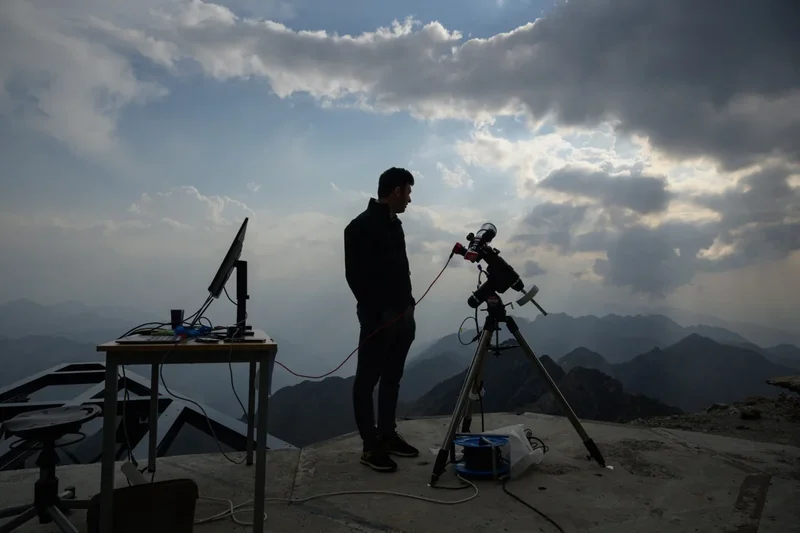
Ground-based observatories and astrophotographers are increasingly affected by bright trails of reflected light created by orbiting spacecraft.
"Each of these satellites, when it crosses a telescope's field of view, leaves a bright line," said ESO astronomer Olivier Hainaut, who authored the paper published in the journal Astronomy & Astrophysics.
While an isolated streak represents only a minor distraction, Hainaut noted that growing numbers pose severe difficulties, as every line erases a portion of a telescope’s view into space.
The rapid expansion of the worldwide satellite sector has accelerated dramatically since 2019, largely propelled by commercial internet projects including Elon Musk’s SpaceX Starlink and Amazon’s Leo network.
Researchers reached their conclusions through predictive models conducted at the Paranal Observatory in Chile's Atacama Desert. One scenario evaluated an orbital constellation reaching one million satellites, revealing thousands of sunlit devices traversing the sky above the ESO’s Very Large Telescope shortly after nightfall.
Hainaut emphasized that the overall disruption hinges on both the quantity and luminosity of the satellites deployed.
"If there are 100,000, that is a level of pain that is bearable," Hainaut said.
However, should that figure reach 300,000, certain observatories might lose the vast majority of their observational data, Hainaut added.
Even with these warnings, scientists acknowledged that the advantages provided by global satellite internet coverage should not be minimized. The core challenge, they noted, is striking a sustainable balance between technological progress and scientific discovery.
"The problem is that this kind of research takes time, but the satellites are already being launched," Hainaut added.