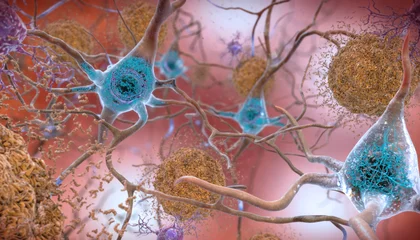
An experimental drug might slow early Alzheimer’s disease by targeting a hallmark of the illness that researchers have historically had less success with: toxic tangles of tau proteins inside the brain.
Accumulations of these tau tangles and sticky clumps of the protein amyloid beta are the neurodegenerative disease’s defining features. In recent years, two drugs that clear amyloid plaques have been approved by the Food and Drug Administration—the first new Alzheimer’s therapies in about two decades. Meanwhile, many experimental treatments targeting tau have failed, despite research suggesting that tau tangles are a stronger predictor than amyloid of brain deterioration.
Now, findings from a mid-stage clinical trial presented on July 14 at the Alzheimer’s Association International Conference in London could change that. Researchers revealed that an experimental anti-tau drug slowed cognitive decline at a level on par with the approved anti-amyloid drugs—although puzzlingly, that result came about in the treatment group that received the lowest dose. The work offers hope for the treatment of a disease that affects more than seven million Americans ages 65 and older, though a larger follow-up study will need to confirm the therapy’s benefits.
“This is really quite promising if it were to hold up” in further testing, says Jessica Langbaum, senior director of Alzheimer’s prevention and research at the Banner Alzheimer’s Institute who wasn’t involved in the trial, to Lauran Neergaard at the Associated Press.
The drug, called diranersen, was developed by Biogen, a Massachusetts-based biotech company. It works by attaching itself to genetic instructions for making tau, forcing the brain to produce less of the protein.
The recent trial involved more than 400 patients with early-stage Alzheimer’s split into four groups. One received 60 milligrams of diranersen every six months via injection into the spinal cord, one received 115 milligrams every six months, one received 115 milligrams every three months and one group received a placebo. They were tracked for 18 months and given several cognitive tests.
In all three treatment groups, the drug lowered tau levels in brain and spinal fluid by 50 to 65 percent compared to the participants’ starting baseline. Brain imaging of 131 participants also showed decreases in tau tangles relative to baseline across all doses.
But the drug defied one of the researchers’ main expectations: that cognitive outcomes would strengthen with dose. In the trial, the lowest-dose group experienced the greatest slowing of cognitive decline—by 26 percent in one test—and the smallest decrease in tau levels. The middle-dose group’s cognitive decline slowed by 14 percent based on that test, and the highest-dose group’s slowed by 9 percent.
While many outside experts welcome the findings, they highlight the deviation from the expected dose-dependent response. And some participants who received higher doses suffered from a state of confusion for up to one week following injection. That’s why the findings represent “a double, not a home run,” says Adam Boxer, a neurologist at the University of California, San Francisco who is working on a different anti-tau therapy, to Jennie Erin Smith at Science.
Rob Howard, a psychiatrist at University College London who wasn’t involved in the study, explains to R.J. Mackenzie at Science News that the counterintuitive cognitive results could be due to the study’s small cohort or the drug’s small effect sizes.
The size of change in cognitive scores was “pretty tiny,” and it’s unclear how it would translate to patients in the real world, he adds. “It’s the age-old question: Are these clinically meaningful differences?”
What’s more, the side effect of confusion was unexpected, Boxer tells Science. It may have happened because the drug affected something it wasn’t supposed to, but a more troubling possibility is that it’s related to lowering tau, he says. “Maybe we can’t knock down tau without some effects.” Biogen, for its part, notes that the confused state was temporary.
“This was a well-tolerated trial where people wanted to continue on treatment,” neurologist Cath Mummery of University College London said as she presented the study at the conference, reports Andrew Joseph at STAT.
The company now plans to test diranersen in a late-phase clinical trial to see how it fares with a larger group of participants. And perhaps it could one day be tested in conjunction with amyloid-targeting drugs, Heather Snyder, a neuroscientist and senior vice president of medical and scientific relations at the Alzheimer’s Association, tells Science News. She notes that other trials are studying combinations of different anti-tau and anti-amyloid drugs.
“We are seeing the entire movement of thinking about these different targets and how [we can] start putting tau together with amyloid,” Snyder says.