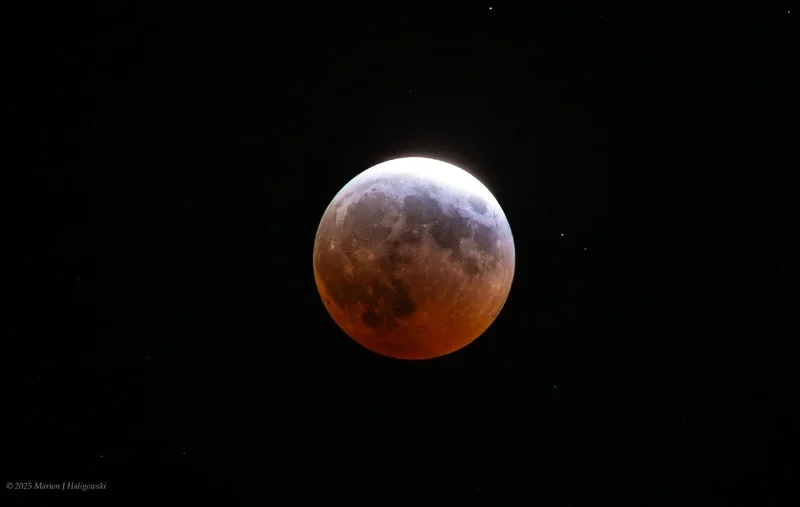
The Americas take center stage for next Thursday nightâs deep partial lunar eclipse.
So, did you miss the August 12th total solar eclipse? Like lots of humanity, we sat out the celestial drama of this month's solar eclipse, both total and partial. But the good news is, a large swath of the world can still catch the eclipse season spirit, with a deep, nearly total partial lunar eclipse next week.
The event is the last eclipse of four (two lunar and two solar) for 2026. This also marks the current end of the second eclipse season for 2026, which began with the total solar eclipse on August 12th.
Eclipses occur when the Moon, Earth and Sun line up in whatâs known as a syzygy. The Moonâs orbit is actually tilted just a little over five degrees versus the ecliptic plane, meaning the nodes where the two line up are where the eclipse action occurs.
The Moon passes ascending node just under 10 hours prior to Full on August 28th, meaning it will pass through the northern half of Earthâs umbral shadow, but wonât get fully immersed in totality this time around. The event also occurs just six days after the second-most distant lunar apogee of the year, meaning the Moon will be a tad smaller than usual versus the Earthâs umbral shadow, which is about three times larger in diameter than the Moon.
Visibility for this eclipse favors the Americas for the entire event. Europe and Africa will see the eclipse finishing up at moonset early on August 28th, while central Pacific regions see the eclipse already underway at moonrise on the evening of August 27th.
The visibility prospects for this month's lunar eclipse, and the passage of the Moon through Earth's shadow. Credit: NASA/GSFC/F. Espenak.
The entire eclipse including penumbral phases lasts for just under 5 hours and 38 minutes, starting at 1:23 Universal Time (August 28th) 9:23 PM EDT (on the 27th). Partial phases start at at just before 2:34 UT/10:34 PM EDT, and last just over 3 hours and 18 minutes in duration. Maximum partial eclipse occurs at 4:14 UT/12:14 AM EDT, with the Moon 93% immersed in the Earthâs umbral shadow.
What to Watch For
Youâll start to notice that something's askew with the Moon about 30 minutes into the penumbral phase, as it takes on a slight tea-colored cast. Youâll also start to see the scraggy charcoal edge of the Earthâs inner shadow a bit later on, as a harbinger of the partial phases that are about to begin.
Then comes the dark curve of the Earth and the start of the partial eclipse. You can see that our planet is indeed round, by the shadow we cast on the Moon. Though it's only a partial eclipse this time around, you still might see the lower southern limb of the Moon turn blood red. This is the hallmark of a total lunar eclipse. This is a function of a hundred sunsets, filtered through the atmosphere of the Earth and cast upon the Moon.
Watch for a subtle bluish ozone fringe near the edge of the Earthâs shadow. An eclipse is the one time that the bone white Moon comes alive with color.
Imaging is as simple as tracking and focusing the Moon. With a little practice and patience, you can simply aim a handheld smartphone camera at the Moon as seen though the eyepiece of a telescope, or just sit back and enjoy the sky show. Unlike the frenzied minutes centered around solar totality, total lunar eclipses are slow and leisurely affairs.
This eclipse is also notable as the final partial eclipse for lunar saros series 138, which started in 1521 and runs all the way out to 2982. September 7th, 2044 will see the very first total eclipse for the series, with totality just lasting 34 minutes long. The shortest for the current century fell on April 4th 2015, with a totality just 4 minutes long.
Near the end of partial phases during the Winter Solstice total lunar eclipse of 2010. Credit: Dave Dickinson.
This eclipse completes an âalmost tetradâ of four total lunar eclipses in a two year span. We had two last year (one on March 14th and another on September 8th) and another early this year on March 3rd. A full tetrad last occurred in 2014/2015 (spoiler alert: the world didnât end...)
Views from Space
While weâre enjoying a lunar eclipse here on Earth, an observer on most of the Moonâs Earthward face would see a total solar eclipse. Firefly Aerospaceâs Blue Ghost lander witnessed just such a strange scene on March 14th 2025.
Firefly Aerospace's Blue Ghost lander sees a total solar eclipse from the surface of the Moon. Credit: Firefly Aerospace.
South Koreaâs Danuri orbiter also had a unique view of the August 12th total solar eclipse as seen from lunar orbit:
The Moon's shadow (on the Earth's upper right) skims our home world during the August 12th total solar eclipse, as seen by Danuri. Credit: KARI.
The Virtual Telescope Project also has plans to carry the eclipse live starting at 1:30 UT on the 28th.
Enjoy the scene, as a lead up to the next total lunar eclipse on December 31st, 2028.
Donât miss next weekâs total lunar eclipse, as a fine coda to the end of a memorable eclipse season.