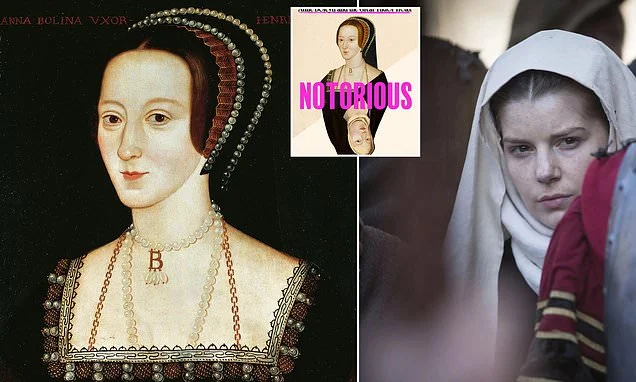
- Notorious by Hayley Nolan (Bloomsbury £20, 272pp)
On April 20, 1534, Elizabeth Barton, a 28-year-old former domestic servant from Kent, had the doubtful honour of being the first woman to have her severed head stuck on a spike on London Bridge.
Her crime was high treason. Recently, Elizabeth had taken to declaiming loudly in public that God was furious with Henry VIII for marrying Anne Boleyn.
The Tudor world was full of crackpots, and the king would normally not have bothered with an illiterate girl who was convinced that she had a hotline to Heaven.
'The Imposture of the Holy Maid of Kent' (1796)
The difference here was that over the preceding ten years, Elizabeth had built up an international reputation for being able to chat directly with the Virgin Mary, Jesus Christ and the Angel Gabriel.
The Archbishop of Canterbury had investigated and declared her the real deal, while the Pope was keeping an eye on her from Rome. Crowds of ordinary people flocked to see Elizabeth in action, hoping to catch sight of one of her violent and theatrical trances, during which the Holy Spirit took hold of her body and blurted out some home truths. The first inkling that Elizabeth had special powers occurred in 1525, when she was 19 and working as a domestic servant in Kent.
During a terrifying seizure in which her eyes bulged and her tongue lolled, she declared that her master’s little boy would soon die. Within hours the child was indeed dead. News of the extraordinary prophesy spread like wildfire. From now on the ‘Holy Maid of Kent’ would be placed in a convent in Canterbury where she could be watched – and controlled – by her newly-appointed spiritual advisors.
Now the trances came thick and fast. Mostly the prophecies Elizabeth conveyed were a bit preachy, particularly when they concerned the Protestant Reformation currently sweeping Northern Europe. The Virgin Mary was stern about the importance of people continuing to confess their sins to Catholic priests and pray – and pay – for the intercession of saints.
Altogether more exciting was the fact that Elizabeth had acquired the ability to perform miracles herself.
She could light candles without fire, help mothers produce breast milk and, on one occasion, even managed to bring a dead man back to life. No one had seen her doing these marvellous things, but that only added to the divine mystery.
For a while Henry VIII tolerated Elizabeth Barton’s growing notoriety: it was useful to have a relatable figure urging the general population to toe a conservative line.
But as Henry started to move away from the Catholic church as a preliminary to divorcing Catherine of Aragon and marrying Anne Boleyn, Elizabeth’s prophecies started getting altogether too political – and personal.
S he announced that an angel had told her to go to ‘that infidel Prince of England, and command him that if he should marry the lady Anne Boleyn, the vengeance of God should plague him’. As a bonus she had been shown the exact spot in Hell which had been reserved for Henry.
Claire Foy as Anne Boleyn alongside Mark Rylance as Thomas Cromwell in Wolf Hall (2015)
Elizabeth Barton’s story has been told many times before, both by distinguished historians and prize-winning novelists. She pops up in Hilary Mantel’s Wolf Hall and also features in Philippa Gregory’s The King’s Curse.
Aware of the need to carve out some new (or newish) territory, Hayley Nolan has chosen to tell Elizabeth’s story in relation to her nemesis Anne Boleyn, the lady-in-waiting for whom Henry was willing to ditch both his lawful wife and the Roman Catholic Church.
In Nolan’s version, Anne and Elizabeth are mirror images of one another. Elizabeth is devoutly attached to the Roman Catholic Church, believing that it is the best way for men and women to live good, if conservative, lives. Anne, meanwhile, is a die-hard religious reformer, convinced that being able to read the Bible in English is the only way to push back against the arbitrary power of corrupt priests.
According to Nolan, Anne’s quarrel with the patriarchal Catholic Church was part of her wider brief as a social justice warrior, determined to pass a new Poor Law to help Society’s most wretched.
Indeed, maintains Nolan controversially, Anne was executed in 1536 ‘not for sordid affairs or failing to give Henry a son, but for fighting for the rights of the people of England, for trying to give the downtrodden a better standard of life’. While there is nothing wrong with floating a revisionist view, Nolan’s theory rests on a profound misunderstanding of the workings of the Tudor court.
Portraying Anne as a martyr for good causes is as misguided as that older cliché about Henry’s second wife being nothing more than a minx with a spooky extra finger.
Elizabeth Barton gets a modern make-over, too. The Holy Maid of Kent is re-cast as a ‘celebrity’ who is at the mercy of her ‘manager’, ‘publicist’ and ‘promoters’, all men of the cloth who exploit Elizabeth’s star quality to raise money for the church – and themselves. Forced to cater to ‘the algorithm of the 16th century’, Elizabeth is crushed by ‘having to provide an endless stream of content for fans to consume’.
I t is at this point you notice that Nolan’s publishers boast that her History TikTok videos have garnered 25 million views.
It is often very interesting when historians write popular – and even provocative history – but you do need to avoid basic howlers. Like the fact that the Protestant reformer Martin Luther ‘asserted that the Bible should be written in English, as opposed to Latin’. Luther, a German who had never been to Britain, would have had no reason to ask for such a thing.
In the end it was Thomas Cromwell who brought down Elizabeth, just as he was also responsible for Anne’s demise two years later.
In 1533, the wily lawyer summoned the Holy Maid of Kent to the Tower and, under duress (which probably means torture), she admitted that the whole thing had been a fabrication. She had faked her fits, and had not been speaking to angels, let alone God. From here it was a painful and bumpy road to the gallows.
Did Elizabeth believe herself to be a mystic in touch with higher powers or was she, as this book’s sub-title proclaims, guilty of a notorious hoax?
Nolan avoids getting into the weeds on this tricky business and instead substitutes a pacey popular novel, apparently aimed at a young adult audience. Indeed, Notorious reminds me of the Jean Plaidy yarns that I used to devour as a young teenager. And that, to be clear, is a compliment.