- In the company of sheep by Polly Pullar (Birlinn £12.99 258pp)
At some point between 11,000 and 9,000 BC, prehistoric man realised sheep were worth domesticating.
These small, amazingly hardy animals were able to provide humans with three of the essentials for survival: meat, milk and wool.
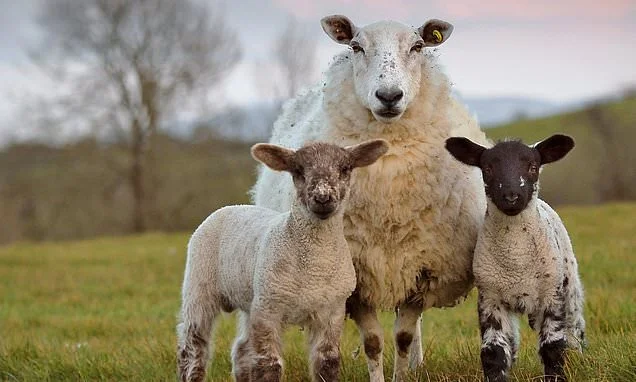
Blackface lamb in Perthshire
By the Middle Ages, the trade in sheep’s wool had become central to the British Isles’ economy, funding the construction of many grand country houses as well as the magnificent ‘wool churches’ of East Anglia and the Cotswolds. To this day, the Speaker of the House of Lords sits on the Woolsack, a large cushion stuffed with wool, introduced in the 14th century to symbolise the importance of the wool trade to England.
Farmer and conservationist Polly Pullar has adored sheep ever since she was a child, when Lulu, the Blackface lamb she was given to raise, had the run of her family’s hotel on the west coast of Scotland.
Lulu would sneakily munch her way through trays of shortbread and lap at cooling vats of home-made marmalade, and in the era before health and safety ruled supreme, ‘having a pet lamb in the hotel attracted rather than repelled guests’.
Sheep farming is in something of a crisis at the moment. Synthetic fibres are cheap, and pure wool – ‘the world’s finest natural fibre,’ Pullar says – has fallen out of favour.
Prices are so low that many farmers are forced to burn or bury their wool. We think nothing of buying New Zealand lamb instead of supporting British sheep farmers. Many of our 63 native breeds of sheep are in danger of extinction.
Pullar puts up a stout defence of sheep farming and hammers home how diminished our countryside would be if we lost our ancient hill farms. Admittedly, you’d have to be pretty keen on all things ovine to fully immerse yourself in this book, but it’s also an enjoyable travelogue, as the author zips around many of the loveliest places in Britain talking to sheep farmers, from Dorset, Yorkshire and Wales to the Lake District, the Scottish Borders and the Western Isles.
Sheep, Pullar says, are much misunderstood. Far from being stupid they are intelligent, strong-willed and, if given the chance, very affectionate. ‘Few animals have existed beside us for quite so long,’ she points out.
If we remain indifferent to the steep decline in sheep farming, and simply view sheep as picturesque white blobs dotting our fields, Britain will be a hugely diminished place.