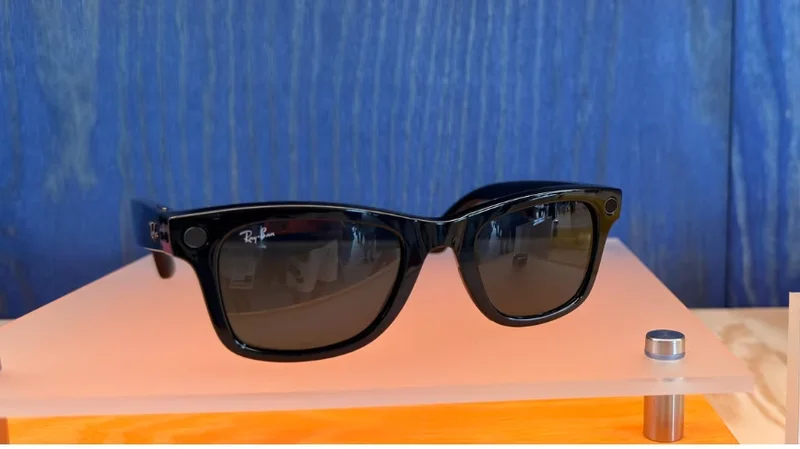
Cinemas became the latest institution to move against Meta smart glasses on Thursday. The UK Cinema Association said many operators are introducing policies to restrict camera-enabled eyewear. It gave two reasons: film piracy, and customer privacy.
Taken alone, that is a trade body managing a risk. Taken with the past fortnight, it is something else. American school districts, a federal immigration agency, a hacker conference, NBA arenas and a British pub chain have all reached the same conclusion about the same product. Their reasons have almost nothing in common.
Operators are “mindful of the issues around privacy and film piracy” raised by the technology, the association said. Many now have policies “to prohibit and/or restrict the wearing of camera-enabled smart glasses in particular in their venues”. It knows of no outright bans by members yet. The body represents more than 90% of UK cinema operators by number and by market share.
Accessibility complicates the picture, and the association said so. Smart glasses can deliver bespoke subtitles. They can also help viewers with sight loss or hearing loss.
The cinema policy is twelve years old
The association did not mention that it wrote this rule once already. It still sits on the trade body’s website under its own key issues, dated 2014 and last updated in January 2023.
Cinemas should ask customers not to bring image-recording wearables into auditoriums at all, it says. That holds whether or not a film is playing. Staff should ask anyone wearing one to remove it, and may ask them to leave.
The association wrote that text for Google Glass. It went by the name Cinema Exhibitors’ Association then. Its chief executive Phil Clapp has held the post since October 2007, so the man who set the rule still runs the body invoking it.
Clapp gave his reasoning to The Register in June 2014. Glass had just reached Britain at £1,000. “We believe that it is generally more difficult to detect when they are and are not recording, so our approach is a precautionary one,” he said.
The policy never changed. Glass never left beta, and Google withdrew it from consumer sale. Meta debuted its glasses in 2021 and sells them through high street opticians at £359. They now rank among its best-selling hardware.
The schools problem is the serious one
The hardest account of the past week came from American classrooms. Futurism’s Maggie Harrison Dupré reviewed large numbers of videos filmed inside middle and high schools on smart glasses, almost always Meta’s, then posted to TikTok and Instagram.
A teenage boy filmed every video the publication found. The behaviour was overwhelmingly directed at girls. It included following them after they walked away, and mocking their appearance. Futurism declined to link to any footage because so many minors appear in it.
Both platforms missed the material. It stayed online until the publication flagged it. Meta then removed most of the videos, and TikTok removed those brought to its attention.
TNW reported the same pattern on 17 August. Instagram had blocked the relevant search terms, and its algorithm kept recommending the videos anyway.
A phone ban does not reach a face
One detail shows why schools cannot treat this as a phone problem. A student filmed himself dropping his smartphone into one of the pouches schools use to confiscate devices. He was still wearing the camera on his face.
“These are way more discreet than I thought they would be,” one teacher said after catching a pupil filming.
Andy Liddell of the EdTech Law Center in Austin told Futurism the classroom is not the street. “Traditionally the classroom has been a private place that not everybody in the world has access to, and so you do have an expectation of privacy in the classroom,” he said. “Really, school is the last place that these glasses belong.”
Districts in Florida, California and Nevada have written explicit bans. Meta said schools know their students best and that it respects their authority to set rules. It also noted that some pupils with disabilities benefit from the technology.
ICE banned them, then asked for its own
Immigration and Customs Enforcement barred employees from wearing Meta smart glasses at work this week. The agency treats them as body-worn cameras.
The devices “could unintentionally capture, record or transmit sensitive information, potentially compromising privacy and legal protections”, acting director David Venturella wrote in a Tuesday memo reported by the New York Times. The ban covers all staff in the federal workspace, not only law enforcement officers.
An ICE spokesperson was brisker with The Register. “This isn’t news, nothing has changed,” they said. Personally owned body-worn cameras have always been prohibited, the spokesperson added.
Two facts sit beside each other here. In April, the Department of Homeland Security requested $7.5m to build its own smart glasses prototype, including glasses that could “enable biometric identification of illegal aliens”. That same month, the American Civil Liberties Union sent Meta a letter signed by 77 organisations, asking it not to add facial recognition to consumer eyewear.
Meta pulled facial recognition code from its glasses app in June, a day after WIRED found it. The company denied the timing was related.
Everyone is watching for the same light
Meta’s answer throughout is the LED that switches on when the camera runs. The company says users cannot turn it off, and that covering or damaging it disables the camera.
The counter-evidence is practical rather than theoretical. Futurism pointed to modified glasses that defeat the light, and to cheap stickers that cover it. Unbranded copies sold online make no such promise at all.
The anti-piracy guidance cinemas already use tells staff to hunt for that exact signal. Employees should look closer at “a small green or red glow in the dark of the auditorium”, it advises. Nobody disputes the light exists. They disagree about whether a small light amounts to consent.
The bans arrive from opposite directions
DEF CON told attendees to leave recording-capable glasses at home before its August conference. Soho House and Wetherspoons joined the pubs and restaurants already turning wearers away. NBA arenas have reportedly told fans to leave them in the car.
New York became the first US state to bar them from court buildings last month. Courts across England and Wales followed. Britain’s privacy watchdog opened an investigation in March, after reports that contractors reviewing recordings saw deeply private moments.
None of these institutions coordinated. A hacker conference and an immigration agency do not share a threat model. Neither resembles a cinema chain worried about a camcorded blockbuster. What they share is an inability to tell, at a glance, whether the person in front of them is recording.
Meta’s strongest argument runs the other way, and it is not a public relations line. The glasses genuinely help blind and low-vision users. The company spent June giving free glasses to blind veterans across the US. “Limiting how people can use this technology would be a major step backwards,” a spokesperson said, adding that rules should apply consistently.
That is the bind. Every venue writing a policy now chooses between the person who cannot read the subtitles and the person who cannot tell they are on camera. Twelve years after a cinema trade body first wrote that sentence for a product almost nobody bought, the answer is still a member of staff, squinting into a dark room.
Get the TNW newsletter
Get the most important tech news in your inbox each week.