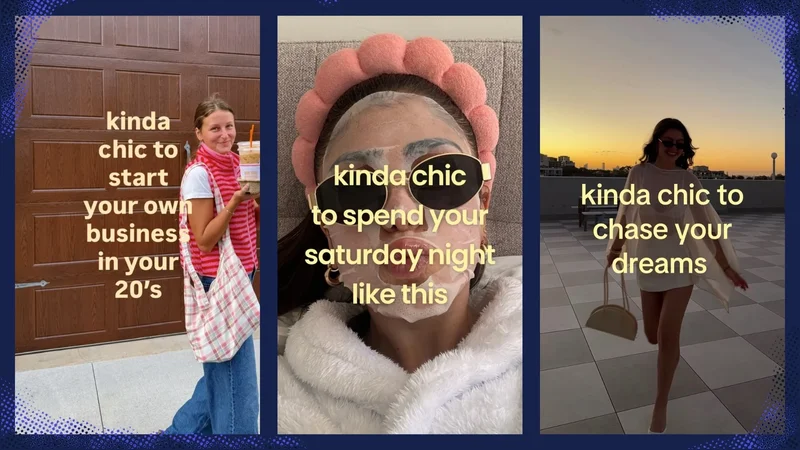
If you have opened TikTok or Instagram lately, you have probably been informed that something — anything — is “kinda chic.” Repeating outfits is kinda chic. So are taking a coffee walk at work, letting people be wrong about you, being a beginner at something, and making all your major decisions in the bath.
The phrase’s takeover did not come from nowhere. For years, the internet has applied "chic" to an ever-expanding collection of clothes, products, habits, and lifestyles, stretching its meaning until it became little more than shorthand for "something I like." Fashion writers have declared the word dead, even as Google search interest in "chic" has reached its highest level since the company’s publicly available data began in 2004.
This Tweet is currently unavailable. It might be loading or has been removed.
Over the past several months, however, "chic" has found new life through an endlessly reusable social media format. TikTok and Instagram users have been posting videos and carousels that declare their habits, hobbies, insecurities, and occasional displays of wealth "kinda chic." Almost anything can qualify, which may explain why some people are already begging the internet to find a new phrase.
You May Also Like
What is the 'kinda chic' trend?
The format is simple: Users place text, generally in a pale yellow font, over a photo or video and complete the phrase "kinda chic to…" with something they want to celebrate.
Some posts declare it "kinda chic" to eat pizza, be overdressed, spend time outdoors, or love Joe Jonas. Others are more earnest, celebrating setting boundaries, following your dreams, accepting your body, moving somewhere new, continuing to learn, or doing something alone and scared.
This Tweet is currently unavailable. It might be loading or has been removed.
The trend’s exact origin is unclear, but examples began appearing as early as April. Know Your Meme points to an April 27 post from plus-size creator Maria Castellanos, known online as MariaBegins, as one of the earliest examples, writing at the end of her carousel, "tell me something 'kinda chic' about you!"
At its most sincere, the trend separates chicness from money, designer clothing, Ibiza trips, and whatever other aspirational lifestyles the algorithm is currently selling. Users don't need an extensive wardrobe, expensive hobby, or packed social calendar to participate. Chic is a mindset: if something makes you feel more comfortable, confident, or like yourself, it qualifies.
By early August, celebrities including Drew Barrymore, Ashley Graham, and Reese Witherspoon had joined in. Witherspoon’s version deemed it "kinda chic to cheer on other women," start a book club, and call your mom. Barrymore announced that it was "kinda chic to be in your 50s," while Graham said it's "kinda chic to know cellulite never held you back."
Brands have joined in, too — naturally. Boots called reapplying sunscreen, romanticizing your daily routine, and removing your makeup before bed "kinda chic." Simple Skincare used the trend to promote sensitive-skin care, while Laneige declared it "kinda chic" to be obsessed with its Cream Skin toner. Outside the beauty aisle, Aldi celebrated selling a foldable sock hanger beside the wine, and Virgin deemed requesting the window seat "kinda chic."
This Tweet is currently unavailable. It might be loading or has been removed.
This Tweet is currently unavailable. It might be loading or has been removed.
This Tweet is currently unavailable. It might be loading or has been removed.
According to The Guardian, Google searches for "kinda chic" increased by 5,000 percent as the hashtag accumulated more than 60,000 Instagram posts.
The internet is already experiencing 'kinda chic' fatigue
This Tweet is currently unavailable. It might be loading or has been removed.
Yet rising search interest does not mean people feel positively about the word. Madé Lapuerta, the fashion data analyst behind Data, But Make It Fashion, conducted a sentiment analysis of online articles containing "chic" and found that positive sentiment had fallen by an average of 14 percent per month since March.
Online, users are fed up: "It’s every second post I see on Instagram," one Threads user wrote. Another said they had reached the point where they see "kinda chic" and "just scroll," describing their aversion as "trend fatigue." "It’s chic to not be annoying as heck," one Reddit user wrote on the r/petpeeves subreddit. Some influencers agree; New York stylist Coco Schiffer announced that “kinda chic” had been “revoked.” By Aug. 18, Naomi May’s Cultural Memory newsletter was calling for the adjective to be retired "for the sake of humanity."
This Tweet is currently unavailable. It might be loading or has been removed.
This Tweet is currently unavailable. It might be loading or has been removed.
The problem is not what the posts are saying, of course. Loving your body, establishing boundaries, and calling your mom are all perfectly nice things to do. The irritation comes from watching one person’s personal observation become a fill-in-the-blank strategy for thousands of creators, celebrities, and social media managers.
"Kinda chic" is also only one format in a feed increasingly built from templates. Examples are endless: Remember the Unfortunately, I do love… trend? "This and yap?" "5 things that are worth the money"?
Fashion editor and creator Brenda Weischer has called this sort of resulting sameness "template slop." In her newsletter, she described an Instagram Explore page filled with butter-yellow and pastel type, recycled "cool girl" advice, and interchangeable cultural recommendations. "Everyone is getting good. No one is getting better."
The exhaustion, then, is larger than any one meme. Users are not simply tired of being told what is "kinda chic." They are tired of scrolling past supposedly personal posts that all use the same handful of fonts, hooks, and formulas. Even when the person filling in the template has something sincere to say, the result can feel like content the viewer has already consumed dozens of times.
I mean, if everything is “kinda chic,” nothing really is — right? At this point, coming up with a different caption might be the chicest move of all.
Olivia Tauber is the deputy editor of digital culture, covering creators, media, movies, beauty, and more. Based in New York, her work has appeared in The New York Times, Vanity Fair, The Cut, Teen Vogue, Complex, and Interview Magazine. She holds a Master's degree in Journalism from NYU and a Bachelor's from the University of Michigan. She also runs Fan Mail, a weekly pop-culture newsletter.