Hubert Nendakala no longer describes Ebola as a distant threat. In three weeks, the 40-year-old architect has lost a cousin and her husband, both border police officers in the Democratic Republic of Congo (DRC), whose eastern provinces are enduring an outbreak that has already caused more than 5,100 infections and 2,420 deaths since it began circulating earlier this year. “Taking it lightly could decimate us,” Nendakala warns EL PAÍS.
In the streets of Bunia, the capital of Ituri province and one of the outbreak’s epicenters, fear has seized local residents like Nendakala. “I am very afraid and I urge my fellow citizens to protect themselves,” he says from the town.
The outbreak, caused by the Bundibugyo variant, is the 17th recorded in the DRC and has just become its deadliest on record after surpassing the 2018 outbreak, which caused 2,300 deaths over 30 months. The World Health Organization is watching it with concern, since its virulence also makes it the fastest-growing outbreak to date and the second-deadliest after the 2014–2016 epidemic that swept Liberia, Sierra Leone, and Guinea, killing more than 11,300 people.
The UN’s head of humanitarian affairs, Tom Fletcher, warned last week that one person is dying every 30 minutes in the DRC as a result of this Ebola variant, for which there is still no approved vaccine or authorized treatment. Existing products are ineffective because they were designed to fight the Zaire strain, which caused the crisis in western Africa a decade ago.
Tedros Adhanom Ghebreyesus, director-general of the World Health Organization (WHO), said from Geneva on Tuesday that the situation remains “very high” risk for the DRC, “high” risk for Uganda and countries bordering the DRC, and “low” for the rest of Africa. “We have to be frank: the outbreak is far from under control. It has pulled well ahead, and we are still playing catch-up. What worries me most is where people are dying: at home, within their communities, outside healthcare centers and off the lists of identified contacts,” he acknowledged.
We have to be frank: the outbreak is far from under controlTedros Adhanom Ghebreyesus, WHO director-general
The current outbreak has already affected six of the DRC’s 26 provinces in the east and northeast: Haut-Uélé, Tshopo and Bas-Uélé, Ituri, North Kivu and South Kivu. More than 55 health zones are affected by the disease and over 1,000 people have recovered after receiving symptomatic treatment.
One of the challenges of this outbreak is controlling chains of transmission. According to Dr. Jean Kaseya, director of the Africa Centres for Disease Control and Prevention (Africa CDC), between 60% and 70% of deaths related to this hemorrhagic fever have occurred within communities rather than in hospitals or treatment centers.
Containing it is not impossible: Uganda managed to extinguish its Bundibugyo outbreak in July after recording barely two dozen cases, thanks to early diagnosis and intensive contact tracing — a contrast epidemiologists use to explain the initial failure of the response in the DRC.
Hervé Amani, an activist for good governance and human rights in the DRC, says the country’s Ebola response is marked by unprecedented “lethargy” and calls for greater seriousness from the authorities. “Instead of telling us that we have experience in responding to Ebola outbreaks, the fundamental question is rather what the state is doing to anticipate the challenges posed by Ebola and adapt its response. With Ebola, every hour counts. We know the consequences of late detection. Unfortunately, we are in a situation where the outbreak is spreading faster than our ability to contain it,” he tells this newspaper.
That late detection is due to the fact that, although the outbreak is suspected to have begun circulating in January or February 2026, it was not declared until May because of doctors’ diagnostic errors, who attributed patients’ symptoms to other illnesses such as malaria, typhus, or seasonal flu — which present similar symptoms in early stages — because the diagnostic tests used initially were designed to detect the Zaire virus and did not identify Bundibugyo.
Esther Makalili, a resident of Rwampara in Ituri, has also felt Ebola’s blow up close. She lost her uncle in early August and now feels she will never get used to seeing his empty chair at home. “The death of our loved ones from Ebola leaves gaps in our lives that will never be filled. We can no longer come to terms with seeing certain seats empty in our homes. May the state put in place the necessary measures to contain this disease,” she says.
Ebola is also having a huge economic impact on the population of Ituri province. Many parents say the restrictions imposed by the Congolese authorities are placing them in a difficult situation.
That is the case of Upoki Uruturu, 55, a father of 12. He earns a living fishing on Lake Albert in Kasenyi, on the border between the DRC and Uganda, and says it is increasingly difficult to afford basic living costs. He is struggling to prepare for his children’s return to school, which will take place in 10 days. “The new school year is about to start and I still haven’t bought notebooks or other school supplies for my children,” he laments.
Uruturu adds that the social-distancing measures recommended by Congolese health authorities have reduced the number of fishermen on Lake Albert, negatively affecting the amount of fish caught.
Professor Pierre Akilimali, one of the DRC’s Ebola response coordinators, lists other factors besides late detection that are contributing to the spread of the Bundibugyo strain, such as overcrowding caused by mining, insecurity from armed conflict, and community resistance. Eastern DRC has been mired for almost three decades in violence carried out by more than a hundred armed groups that has forced at least 6.9 million people to flee, according to the UN High Commissioner for Refugees (UNHCR). That constant mobility hinders contact tracing, epidemiological surveillance, and early isolation of cases.
WHO response
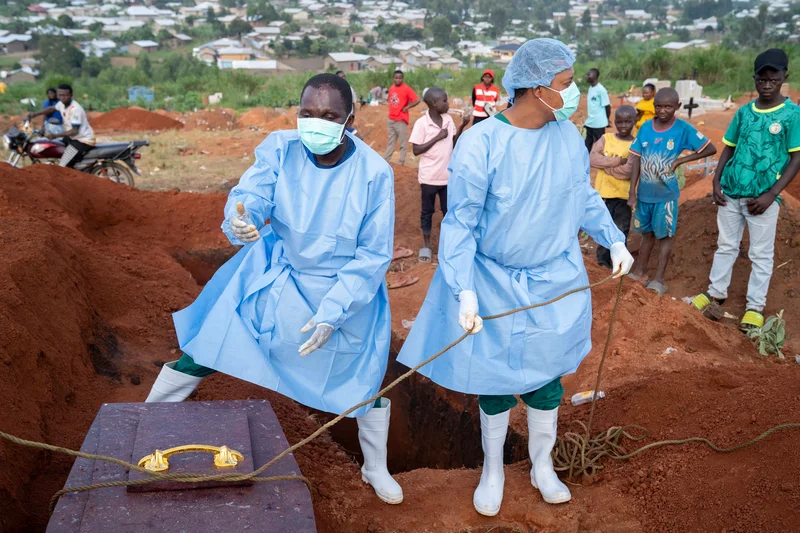
In an effort to control the disease, WHO has announced a reinforcement of community surveillance, increased treatment capacity, more work with communities to build trust to involve them in the health response, as well as progress in clinical trials of treatments and two experimental vaccines already in the human testing phase. It has also focused on ensuring safe and dignified burials to prevent infections that can occur during handling, washing, and other traditional rituals performed by the deceased’s loved ones in these communities.
Thierno Baldé, WHO lead for Bundibugyo virus disease in the DRC, based in Bunia, says efforts are focusing on decentralizing the response and bringing it closer to communities. “WHO and its partners hope to see the effects of this scaled-up response in the coming months, but cannot set a precise timeline for when the outbreak will be brought under control,” he said during a videoconference with the press on Tuesday from Geneva.
Baldé said the outbreak could be reversed in three months if the necessary resources were available. However, WHO has warned it has received only 60% of the $115 million needed to contain the epidemic. This shortfall comes at a time when international aid has suffered draconian cuts after a sharp reduction in U.S. funding — historically one of the world’s largest donors — which has cut about 70% of funds allocated to the health sector in the DRC, according to WHO.
Nevertheless, Baldé says efforts to end this virulent outbreak will not cease. “We plan to increase our capacity to 3,000 beds in the coming months, whilst ensuring that the three healthcare and nursing professionals required to care for each patient are properly trained,” he asserts.