By Song Sang-ho and Lee Yumi
WASHINGTON, Aug. 20 (Yonhap) -- As North Korea hews to its growing nuclear arsenal and U.S. President Donald Trump leaves his ultimate goal for reengaging with North Korean leader Kim Jong-un unclear, questions are mounting over whether denuclearization will remain the centerpiece of any renewed Trump-Kim summitry.
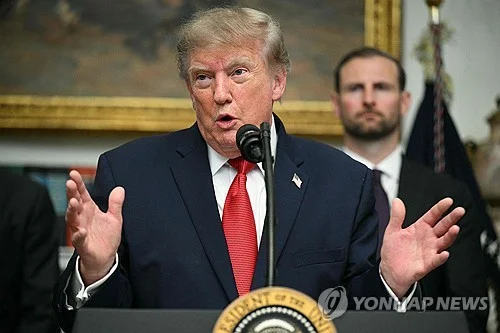
On Wednesday, Trump confirmed his plan to meet Kim later this year, but declined to answer a reporter's question about whether his goal for reengagement is still denuclearization despite his administration having repeatedly stated its commitment to the "complete" denuclearization of North Korea.
Observers said that Trump's ambivalence could be part of an effort to avoid any potential tension with Pyongyang and leave room for diplomacy, given that the regime has vowed not to bargain away its nuclear program, insisting that its nuclear status is "irreversible."
But his ambivalence has raised questions over whether the U.S. would shift its policy focus to goals short of North Korea's denuclearization, such as a nuclear freeze, arms control, tension reduction and risk management at a time when Pyongyang's nuclear disarmament remains elusive.
During a press availability on Wednesday, Trump told reporters that the North Korean leader has 57 "very powerful" nuclear weapons, in an apparent acknowledgment of the stark reality that North Korea does possess a substantial trove of nuclear arms, and the growing need to reengage with Kim.
Commenting on Trump's mention of the North's 57 nuclear weapons, Andrew Yeo, SK-Korea Foundation chair at the Brookings Institution's Center for East Asia Policy Studies, said that the president might be building a case for meeting Kim.
He also pointed out that goals like a pause in Pyongyang's nuclear program are more "realistic" than seeking to rid the recalcitrant regime of its nuclear arms.
"A nuclear freeze or some form of risk-reduction agreement is far more realistic than complete denuclearization, and even a verifiable pause in the expansion of North Korea's nuclear and missile programs would be preferable to the status quo," he told Yonhap News Agency via email.
"But I remain skeptical that a leader-level meeting itself would produce firm commitments -- Kim could meet Trump and still continue expanding his arsenal afterward, so the real test is whether a summit generates a sustained negotiating process with concrete, verifiable constraints," he added.
Patrick Cronin, chair for Asia-Pacific security at the Hudson Institute, said that Trump's mention of a specific number for the North's nuclear arsenal might indicate that Trump wants summitry not to dismantle Kim's nuclear weapons, but to persuade him to stop converting Pyongyang's stockpile of fissile material into more nuclear warheads.
Trump's equivocation on denuclearization has touched off a debate over whether he would pursue more achievable near-term goals should a summit with Kim materialize, or whether it is just a tactical move to bring a wary North Korea back to the negotiating table.
His ambivalence came amid speculation that he apparently seeks to achieve a major foreign policy coup and burnish his image as a peacemaker at a time when the Iran war has dragged on for months, keeping energy prices high, particularly ahead of the U.S. midterm elections slated for November.
"While senior members of his administration continue to assign high priority to 'denuclearization' (of North Korea), Trump himself has become much more ambiguous about it, which is a sharp departure from his first term as well as from U.S. policy over the past 3 decades," Rob Rapson, a former acting U.S. ambassador to South Korea, told Yonhap News Agency.
"This is probably for tactical reasons given Kim has thrown ice water on 'denuclearization' as an agenda item for any repeat engagement with Trump, but (it's) hard to tell for sure."
During a press availability at the White House this week, Trump confirmed that he intends to meet Kim later this year, although it remains uncertain whether Kim would agree to talks amid deepening cooperation with Russia and improved ties with China.
The Wall Street Journal has already reported that Trump is seeking a meeting with Kim, which could take place during his next trip to Asia, likely for the Asia-Pacific Economic Cooperation summit in Shenzhen, China, in November.
Trump last met Kim at the inter-Korean border village of Panmunjom in June 2019, following their earlier meetings in Singapore in June 2018, and Hanoi in February 2019.
Raising cautious prospects for renewed engagement between the U.S. and the North, Trump recently ordered the scaling back of South Korea-U.S. military exercises -- a move seen as a conciliatory gesture toward Pyongyang which has long decried the drills as rehearsals for war.
Kim Yo-jong, the powerful sister of the North Korean leader, said Wednesday that Pyongyang has no interest in a reduction of the ongoing allied military exercise. But she apparently left open the door for dialogue with the U.S., saying that the Trump-Kim relationship is "still excellent."
"North Korea's seeming non-response to Trump's overture, I think, is actually Kim's opening play in sussing out how far Trump is willing to go in addressing his interests. In essence, he's applying his own leverage with Trump, who appears to be the one more desirous to meet," Rapson said.
"However, as we've seen and learned about Trump 2.0 over the past 18 months, everything and anything can change at a moment's notice, including, perhaps, even his soft spot for Kim and dreams of a legacy-defining rapprochement with the North. So stay tuned."
The retired diplomat also pointed out that South Korea, a longtime U.S. ally, has a "paramount" role to play in any engagement or rapprochement with the North, noting that Trump has expressed his unease over Seoul's claimed refusal to help the United States secure the crucial Strait of Hormuz amid the ongoing Iran war.
The reemerging talk of renewed summitry came as some observers highlighted the need for the U.S. to take a more realistic approach to tackle North Korea's nuclear quandary.
In a written interview with Yonhap News Agency in April, Victor Cha, president of the geopolitics and foreign policy department at the Center for Strategic and International Studies, urged the U.S. to abandon its longstanding but unsuccessful focus on the North's denuclearization and shift toward "immediate" goals, including arms control, stressing that Pyongyang's nuclear disarmament is "unattainable for now."
"Denuclearization is a noble goal, but past policy failures and North Korea's dogged determination to obtain weapons have made it unattainable for now," Cha said.
"Washington needs to shift the logic of its strategy from disarming North Korea's nukes to achieving immediate goals that will make the United States more secure against those weapons."
Some observers said that Trump's ambivalent stance on the North's denuclearization, his complaints against South Korea and Pyongyang's escalating military threats could push the Asian ally to bolster its independent defense capabilities and reduce reliance on the U.S.
South Korea's efforts to boost its own military capabilities have been partially driven by the Trump administration's call for Seoul to bolster its defense spending and undertake "primary" responsibility for deterring North Korean threats "with critical but more limited" U.S. support.
sshluck@yna.co.kr
(END)
- N. Korea silent on Lee's proposal for dialogue to officially end Korean War
- BIGBANG named honorary ambassador for space agency
- (2nd LD) Lee proposes dialogue with N. Korea to officially end Korean War, halt Pyongyang's nuclear program
- U.S. favorability for BTS hits record 46 pct in Q2: poll
-
(LEAD) Lee reiterates support for four-year, two-term presidential system
-
N. Korea silent on Lee's proposal for dialogue to officially end Korean War
- Trump signs memo permitting foreign shipbuilders to build up to 2 U.S. ships in their shipyards
- (LEAD) Lee reiterates support for four-year, two-term presidential system
- (2nd LD) Lee proposes dialogue with N. Korea to officially end Korean War, halt Pyongyang's nuclear program
-
(URGENT) Lee proposes dialogue with N. Korea to officially end Korean War, halt Pyongyang's nuclear program
-
(3rd LD) Trump says he will meet N. Korea's Kim this year, puts N.K. nukes at 57
- (LEAD) N.K. leader's sister says Pyongyang more focused on S. Korea-U.S. drills continuing than reduced scale
- (LEAD) N. Korea typically estimated to have 80-120 nuclear weapons: defense minister
- N. Korea fires unidentified projectile toward East Sea: S. Korean military
- (3rd LD) N. Korea fires barrage of short-range ballistic missiles despite Trump overture