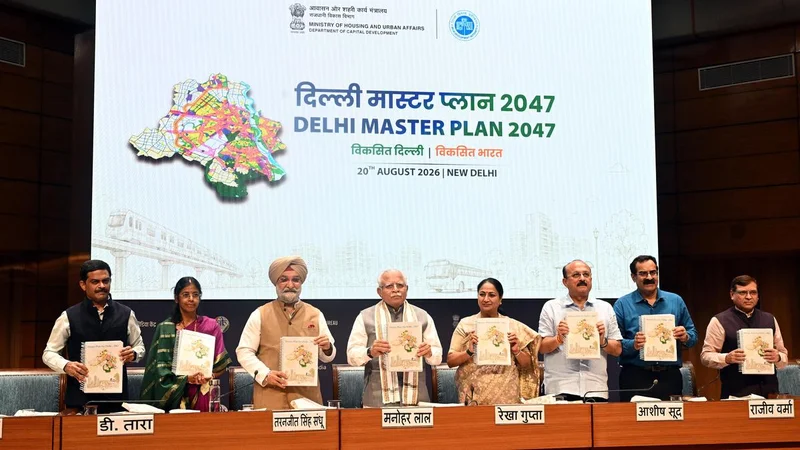
The Master Plan for Delhi-2047 was notified on Thursday, setting out a 20-year framework for housing, redevelopment, transport and urban expansion in the national capital.
The framework aims at nearly 43 lakh new houses, most of them aimed at meeting affordable housing needs, said Union Housing and Urban Affairs Minister Manohar Lal while unveiling the plan, along with Chief Minister Rekha Gupta and Lieutenant-Governor Taranjit Singh Sandhu.
Ms. Gupta called the document a “comprehensive road map” for the development of the national capital. “Keeping the Capital’s current challenges in mind, it will set the direction for development in line with its future needs. Better coordination between the Central and Delhi governments will give fresh momentum to the city’s development,” she said.
Mr. Lal said provisions in the MPD-2047 will help address the city’s growing population, which is expected to reach 3.2 crore within the next two decades, and housing demand despite limited land availability.
The plan was approved by the Delhi Development Authority on August 12.
Of the proposed 40 lakh houses, the largest component will come from transit-oriented development (TOD), followed by land pooling, redevelopment of slum clusters and group housing societies, and high-density development corridors along Urban Extension Road-II, said DDA vice-chairperson N. Saravana Kumar.
High-density growth
The master plan introduces high-density development, transferable development rights and town planning schemes while simplifying several land-use and building regulations, added Mr. Kumar.
The maximum height restrictions for buildings of all kinds, including residential and commercial, have been removed across most of the national capital, except in areas including the Lutyens’ Bungalow Zone, Civil Lines Bungalow Area, Connaught Place, the Yamuna floodplains, the Ridge, land pooling and low-density areas, and locations subject to restrictions imposed by the Archaeological Survey of India and the National Monuments Authority.
Under the revised TOD policy, development will be promoted within 500 metres on either side of metro corridors and around the Regional Rapid Transit System and railway stations. The minimum plot size for TOD has been reduced from 10,000 sq m to 2,000 sq m while the maximum floor area ratio — the ratio of a building’s total built-up area to the total area of the plot — has been increased from 300 to 500.
Land pooling is expected to enable nearly 200 sq km of planned urban expansion and a road network of about 600 km.
The DDA will develop roads of 30 metres and above upfront in these areas to support planned growth, said the Union Minister.
The plan also seeks to make the redevelopment of existing areas easier. The minimum plot size for redevelopment of group housing projects has been reduced from 40,000 sq m to 3,000 sq m.
To promote ease of doing business, the number of land-use categories has been reduced from 133 to 45. The plan proposes single-window online approvals for TOD, change of land use and layout plans.
New economic activities such as data centres, integrated industrial parks, co-working spaces and start-up hubs have also been included in the MPD-2047.
Published - August 21, 2026 01:03 am IST