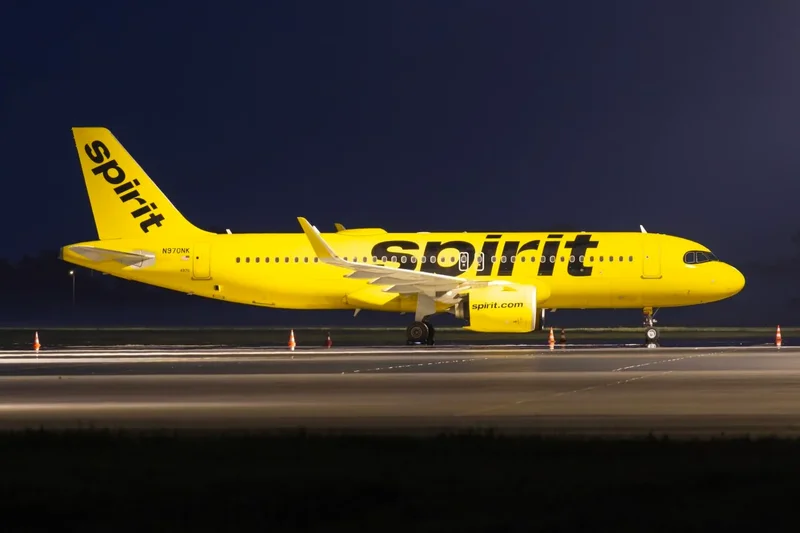
The late Spirit Airlines, which shut down all operations earlier this year after filing for bankruptcy for a second time, agreed on Friday to give Google a vast trove of its company records for (what else?) training new AI models. Its former flight attendants have organized to fight back against the deal.
On Tuesday, the Association of Flight Attendants (AFA), a union representing the ex-Spirit employees, filed an official objection to the agreement in the U.S. Bankruptcy Court in the Southern District of New York. It argues that while the terms of the deal require all consumer information to be carefully scrubbed from Spiritâs data, no such protections are in place for the thousands of flight attendants who used to work for the airline.Â
Announced after Google offered a successful bid of $10 million for the defunct airlineâs records (beating AI training startup Mercorâs bid of $7.5 million), the deal stipulates that Google must work with a third-party âdeidentification agentâ to ensure no sensitive information that can be linked back to Spirit customers makes it into the soon-to-be training data, following a standard laid out in the California Consumer Privacy Act. But the CCPAâas its name indicatesââwas built for customers, and no comparable screen has been applied to the employment record that this transaction actually conveys,â AFAâs lawyer Charles Rubio writes in the objection.
That record, according to Fridayâs court filing, includes âemployee business travel records,â âcrew training records,â âemployee tax forms,â and 100 million emails.
The fact that the names of former employees will not be included in the data when itâs handed over to Google is beside the point, according to Rubio. âA pseudonymized dataset can still disclose which crew bases generated grievances, how a small subset of flight attendants performed on recurrent training, which employees were subject to investigation, what compensation adjustments followed which events, and what employees said to one another about management, staffing, or their union.â
Rubio goes on to argue that the deal should be rejected by a judge unless it âexpressly and categorically [excludes] all flight attendant informationâ from the data that would be transferred to Google. The Wall Street Journal reported on Wednesday that the bankruptcy court postponed the approval of the $10 million deal following the AFAâs objection.Â
As AI grows, so too does its appetite for training data. Big tech companies have already harvested most of the content on the internet to feed their gargantuan foundation models, forcing them to get creative in their search for more. So-called synthetic data has been touted as a way to continue feeding the algorithmic beast indefinitely, but that can lead to problems of its own.Â
Googleâs aiming to take another approach with its multimillion-dollar Spirit deal. Taken as a whole, the swathe of records from the bankrupt budget airline comprises a detailed picture of day-to-day life inside a modern business. All that training data could in turn help Google make its AI tools more useful for enterprise customers, which are widely viewed as a key demographic for developers. And at a time when the internet giant has been losing a steady stream of AI talent to competitors, it could use all the help it can get.