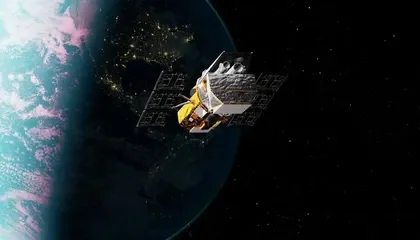
In early July, NASA launched a rushed first-of-its-kind rescue mission to save a decades-old space observatory that was falling from its orbit. As of August 19, however, the agency is calling it quits.
The mission failed “due to an ongoing commercial spacecraft attitude control issue,” according to a statement. Experts predict that its target—NASA’s Neil Gehrels Swift Observatory—will probably re-enter Earth’s atmosphere and burn up later this year.
Swift launched in November 2004 for a two-year mission to study gamma-ray bursts, the most powerful explosions in the universe, which are often associated with the collapse of massive stars or the birth of black holes. It has far exceeded expectations. Over the past 21 years, it has observed around 2,000 of these high-energy bursts. Swift also captured data on other astronomical objects and events with its three telescopes that see in visible, ultraviolet, X-ray and gamma-ray wavelengths of light.
Fun fact: Swift’s most distant gamma-ray burst
On April 29, 2009, the observatory witnessed a gamma-ray burst that took 13 billion years to reach Earth. That means the event that produced the energetic explosion happened in the early universe, since the Big Bang occurred around 13.8 billion years ago.
But recently, NASA realized that the spacecraft was falling from its orbit faster than predicted because of unexpectedly strong solar activity in late 2024 as the sun reached the peak of its 11-year cycle. Intense solar flares caused a series of reactions that ultimately resulted in more atmospheric drag on Earth’s satellites, reported the New York Times’ Kenneth Chang in late July.
That put a “hard deadline” on any attempt to save Swift, writes Scientific American’s Adam Kovac. In September 2025, NASA awarded a $30 million contract to Arizona-based company Katalyst Space Technologies to build a spacecraft for a rescue mission. The company constructed one called Lightweight In-Space Navigation and Kinematics (LINK) in nine months. But the rush job meant it wasn’t tested and scrutinized as much as those in other NASA missions, per the Times.
“We knew this was a high-risk, high-reward mission—a first-of-its-kind attempt, developed on an unprecedented timeline driven by the sun’s activity,” Shawn Domagal-Goldman, the astrophysics division director at NASA headquarters, says in the statement.
In what sounds like a scene straight out of a science fiction movie, LINK was supposed to use its robotic arms to grab Swift and physically push it into a higher orbit to extend its life. If the mission was successful, the observatory potentially could have continued operations into the 2030s.
LINK launched from the Kwajalein Atoll in the South Pacific Ocean on July 3. But the mission ran into trouble before the spacecraft could even reach the observatory.
In a July 28 update, NASA explained that a few days earlier, LINK had experienced orientation control issues that had made the spacecraft spin and caused sporadic communications. Additionally, two of its three wheels used to point the spacecraft weren’t operating, and its cold gas thruster system also had issues. Although the agency later wrote that it was hopeful LINK could still give Swift a boost, those hopes have now been dashed.
“This does not mean LINK’s mission is over,” Katalyst writes in a social media post. “The Katalyst team will continue making the most of LINK’s capability and time on orbit. Our focus is on conducting rendezvous and proximity operations where possible and exercising the spacecraft to gather as much data as we can.” A space rendezvous is when two spacecraft meet, which requires their speeds and positions to match.
“This is not the outcome we were working toward, but it does not change why this mission was worth attempting,” NASA Administrator Jared Isaacman says in the statement. “We are going to learn everything we can from LINK’s rendezvous attempt and put those lessons to work on the missions that follow.”