In one week in 1972, Josef Kompalla went from being an unknown to the most hated man in Canada.
The German hockey referee became the target of nationalist enmity while officiating two of the games of the legendary Summit Series, pitting the Soviet Union’s national team against all-star Canadian professionals from the National Hockey League.
Mr. Kompalla, who has died in Germany at age 90, was called a Nazi, a Communist, a stooge, “myopic,” “Team Canada’s nemesis,” a “Moscow man,” a “puppet of the Kremlin” and “a cheater, a plain all-out stinkin’ cheater.”
He was portrayed as a villain in documentaries and televised dramas about the series.
It was his unenviable task to be one of two on-ice officials responsible for handling the finale of the eight-game series, a hockey exhibition that had become a do-or-die struggle between competing ideologies during the Cold War.
The frenetic last game included a horrifying episode in which a Canadian player threatened to club the referee in the head with his stick; an off-ice incident involving R. Alan Eagleson of Canada, who was rescued from Soviet police by Canadian players before being escorted across the ice while waving his fist; and the unforgettable series-winning goal by Paul Henderson with just 34 seconds left in the game.
That Mr. Kompalla was on the ice at all was only over the angry objections of the Canadian team.
Mr. Kompalla and fellow West German official Franz Baader had earlier refereed two bloody and violent exhibition games pitting Team Canada against Sweden. Those games, like all eight of the Summit Series, used the European system of two referees with no linesmen. The Canadians felt the Germans were a pair of whistle-happy incompetents, calling them Baader and Worse.
In Game 6 at the Luzhniki Palace of Sports in Moscow, the German refs assessed 31 minutes in penalties on Team Canada and just four minutes on the Soviets. Canada managed to win 3-2.
The referees were confronted outside their dressing room between periods by Bobby Orr, the star defenceman who sat out the series with a knee injury. As well, NHL referee-in-chief Ian (Scotty) Morrison tried to challenge them only to be refused admission to the dressing room.
Canada threatened to leave Moscow without playing the final game if the German referees were in charge.
“No way we should play if they referee,” Mr. Henderson told Dan Proudfoot of The Globe and Mail. “You know me, I don’t get too excited too often, but I swear I can’t make it through another game without punching that Kompalla.”
After hours of negotiations, including talks which continued between Mr. Eagleson and his Soviet counterpart even during intermission at the Bolshoi Ballet, the compromise was for each team to pick a referee. Canada chose Uwe Dahlberg of Sweden, only to be told he was sick. They instead selected Rudy Bata of Czechoslovakia. The Soviets went with Mr. Kompalla.
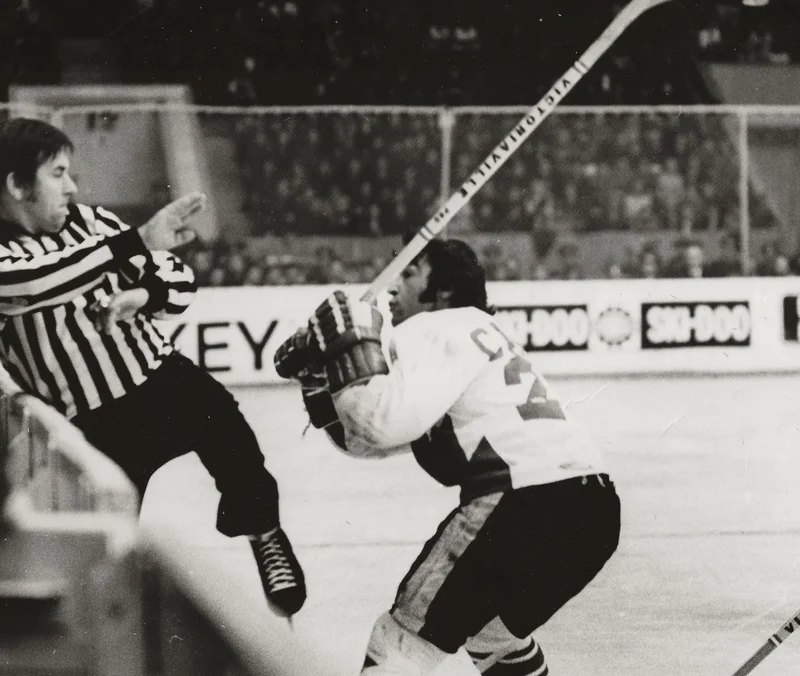
Three minor penalties had already been assessed in the game’s opening minutes (two against Canada, one against the Soviets) when Canada’s Jean-Paul Parisé got called for interference, a two-minute minor penalty, at 4 minutes, 10 seconds of the first period. The player then lost his mind, and Mr. Kompalla nearly lost his head. After skating to the penalty box, Mr. Parisé quickly exited before slamming his stick on the ice, which resulted in a 10-minute misconduct penalty. He then charged at Mr. Kompalla, wielding his stick over his head like an executioner’s axe. The referee flinched, lifting his left leg and raising his arms to protect against a blow that never came in what was the ugliest incident of a fraught series. Mr. Parisé received a game misconduct.
A small stool was thrown from the Canadian bench onto the ice, followed by a chair. For a time, it seemed as though the game might be suspended but play resumed after the ice was cleared.
Though the Canadian team prevailed thanks to Mr. Henderson’s historic, last-minute goal, the players and journalists never forgave Mr. Kompalla for his to-the-letter enforcement of international hockey’s rulebook.
The two German referees joined Team Canada on a flight out of Moscow for a final exhibition game against the Czechoslovak national team. On the way, Wayne Cashman, who had missed the Moscow games after suffering a mouth injury in Sweden, tossed bits of food at Mr. Kompalla. On landing, the referees announced they would not work the game in Prague.
Mr. Kompalla was the target of further vitriol two years later, when the Soviets challenged another team of Canadian professionals from the World Hockey Association. Mr. Kompalla handled Game 1 in Quebec City and Game 8 in Moscow, though the intensity of the exhibition series did not come close to that of its predecessor.
His every assignment in international hockey provided an easy column for his detractors among the Canadian media.
“Josef couldn’t referee a sidewalk wrestling bout between two drunks who have just been tossed out of a dockside tavern,” the columnist Jim Coleman wrote in 1976.
His reputation outside Canada was entirely different, as he was regarded as a top European referee, working three Olympic tournaments, as well as a dozen world championships. He officiated more than 2,000 games, including 157 international showdowns, before compulsory retirement as an official at age 50.
He was inducted into the Hall of Fame of the International Ice Hockey Federation in Toronto in 2003. He was also named to the German Hockey Hall of Fame in Augsburg. In 1992, he was awarded the Order of Merit of the Federal Republic of Germany, his adopted land’s highest honour.
Mr. Kompalla, whose nickname was Jupp, was born on March 13, 1936, to an ethnic German family in Katowice, a Polish borderland city in Silesia. An invading German army occupied the city three years later before the city was captured by the Soviet Red Army in 1945.
Some of Mr. Kompalla’s earliest memories involve long train rides to Warsaw where his father was imprisoned after the war, said Cedric Bolz, a German-born historian from the Vancouver area who interviewed the referee extensively for his 2023 book, The September He Remembers.
At school, he learned Polish and Russian, while the language spoken at home was German. The boy’s mother bought him a second-hand pair of hockey skates at age 12.
As a young adult, he gained a reputation as a hard-nosed defenceman, winning a national Polish championship with Górnik Katowice in 1958. Later that same year, his family was permitted to emigrate. They settled in Krefeld, West Germany, where he continued to play semi-professional hockey until 1969.
Trained as an auto mechanic in Poland, he worked as a bartender at a nightclub, while also making about $15 per game as a referee. He was only in his third season in a referee’s striped sweater when selected with seven others (including four Americans for the four games in Canada) for the Summit Series.
The referee was disappointed not to be invited to the many reunions held over the years, as former Soviet and Canadian combatants became friends, much like opposing veterans of a long-ago war.
“He considered himself part of a fraternity,” Mr. Bolz said.
On the 30th anniversary of the series, he offered an assessment of the series to Swedish hockey writer Szymon Szemberg: “Canada rediscovered that hockey was a team sport, while the Russians learned to play hockey the tough way.”
He was unapologetic for how he applied the rulebook in that tense series.
“If I had to do it all over again,” he once said, “I would do exactly the same thing today.”
His modest apartment in Krefeld was a shrine to his career, filled with memorabilia from his lengthy hockey career. After he mused it would all end up in a dumpster after his death, Mr. Bolz helped arrange for the material to be acquired by the city archives and a local museum.
Mr. Kompalla died in Krefeld on July 12. Among his survivors is a daughter, Nicole Kompalla-Doucet, who was the first female referee to work in the men’s top professional league in Germany. She also served as a linesperson at the inaugural women’s world championship in Ottawa in 1990.
In his long hockey career, Mr. Kompalla only ever had one fistfight, he told Mr. Bolz. Immediately after blowing a whistle to signify the end of a game in Germany, he jumped the boards to punch a fan who had been heckling him with the slur, “Polakensau!” (“Polish pig!”) He broke the man’s nose.
“That guy,” Mr. Kompalla said, “had it coming.”
You can find more obituaries from The Globe and Mail here.
To submit a memory about someone we have recently profiled on the Obituaries page, e-mail us at obit@globeandmail.com.