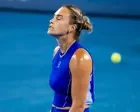
Towards the end of a messy first set tie-break late on Wednesday, Aryna Sabalenka wildly sprayed another painfully nervous backhand before slamming her racket to the ground. As the racket connected with the acrylic floor, its vibration dampener detached from the strings and rolled off in the direction of the broadcast camera pit by the side of the court.
With the diminutive 20-year‑old Czech player Sara Bejlek leading Sabalenka 6-5 in the tie-break, this slapstick sequence forced play to pause while the Belarusian and a couple of volunteers comically searched for the missing vibration damper underneath the cameras until she gave up and retrieved a new one. A few minutes later, Sabalenka trailed by a set.
Nothing in the world seemed to fall in the world No 1’s favour at the Cincinnati Open as Sabalenka was toppled 7-6 (7), 6-4 by Bejlek around midnight, and it has been some time since anything did. On this occasion, Sabalenka sprayed errors, she moved sluggishly and failed to maintain her composure throughout her time on the court.
Bejlek is a cunning lefty capable of narrowing the court with her excellent defensive skills and keeping opponents guessing by intelligently mixing up the spin and trajectory in her strokes. Still, Sabalenka’s mental collapse in both sets made for a shocking sight. After leading 5-1 in the first set tie‑break and losing five points in a row, Sabalenka led 4-1 in the second set before conceding the final five games of the match.
Nothing about the way the world No 1 started her 2026 season hinted at the struggles to come. Sabalenka won 26 of her first 27 matches of the season; her painful defeat in the Australian Open final to Elena Rybakina was counterbalanced by a remarkable achievement in March as she won the Sunshine Double, consecutively triumphing at Indian Wells and Miami.
Even at the height of her powers, Sabalenka has had plenty of mental demons to battle. However, most of those difficulties have been confined to grand slam finals or semi-finals, the most consequential and pressure-filled matches. Otherwise, this period of Sabalenka’s career has been underscored by her toughness, composure and how often she finds a way through.
After Miami, Sabalenka’s level abruptly collapsed. She is 17-7 in wins and losses since the start of April, having reached one semi‑final and zero finals in her past seven tournaments. Some of these losses have been absolutely shocking, particularly her total collapse against Diana Shnaider in the quarter-finals at the French Open, where she led 6-3, 4-1 with a double break before losing 12 of the subsequent 13 games.
As a result of these struggles, the No 1 ranking will surely fall. Sabalenka’s fourth-round loss in Cincinnati meant Rybakina, the current Australian Open and WTA Finals champion, has narrowed the gap to just 434 points as of Thursday.
While Sabalenka will have 2,000 points to defend at the US Open as the defending champion, Rybakina reached only the fourth round last year. Her own form had briefly faltered earlier in the summer, but Rybakina, a finalist last week in Toronto, is playing well again at just the right time. It would take another title from Sabalenka in New York and a few catastrophic results from Rybakina for her to miss the boat.
There are times when such drastic form shifts are often tied to injuries or off-court turmoil, but Sabalenka has remained healthy this year and, from what she has publicly shared, she does not appear to be enduring any significant personal issues away from the court.
Before her loss, Sabalenka tried to project a positive mindset as she addressed her recent difficulties: “I feel like time flies faster and faster the older I get,” she said, smiling. “It’s crazy. I would say that I’m super‑happy with the beginning of the season. Then I went a bit down the hill, but I feel like I’m building myself back and I feel like I had a lot of great matches, a lot of great wins, a lot of tough lessons, but it’s also my journey and I only get better from that.”
Her recent form merely stands as a reminder of how difficult it is to remain on top for a lengthy period. When things start to go wrong, the gruelling, relentless nature of this sport means there are few opportunities for players to regroup until the end of the season. Meanwhile, the great depth of the modern game ensures there will always be quality players ready to pick off a vulnerable top player.
In recent years, the achievements of all-time greats such as Serena Williams, Novak Djokovic, Roger Federer and Rafael Nadal have made sustained dominance look so easy. These legends are total outliers in the history of the sport. Sometimes, great players just reach their mental or physical limits, and they quickly find themselves down the hill again, unable to summon the same intensity, toughness and quality that came so naturally before. Their responses to such difficult periods usually reveal plenty about them. How Sabalenka manages herself after a few challenging months is what will define the next stage of her career.