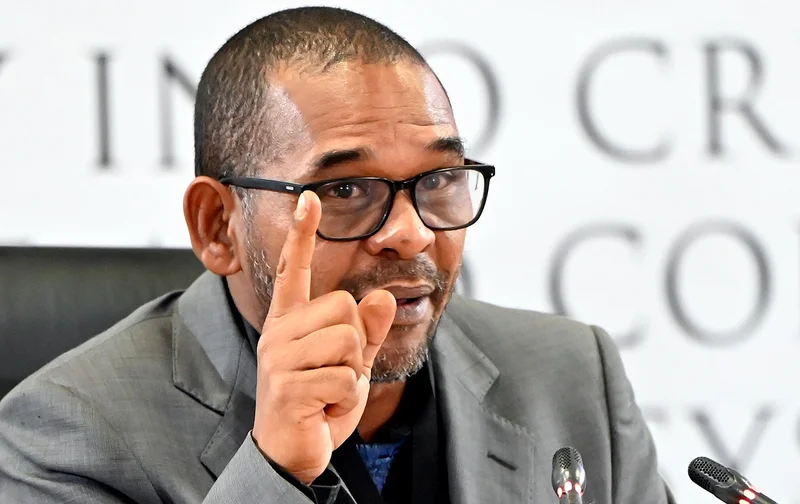
The credibility of suspended National Coloured Congress MP Fadiel Adamsâ evidence came under increasing pressure on his second day at the Madlanga Commission on Thursday, 20 August.
The genesis of the controversy was an envelope containing classified documents that Adams said had been slipped under the door of his parliamentary office. What followed, however, has become the source of increasing scrutiny.
Adams opened three cases in October 2024 in Cape Town before travelling to Gauteng, where further cases were registered. These charges implicated top SAPS Crime Intelligence members, including Crime Intelligence boss Dumisani Khumalo.
Adams claimed that his dockets went missing after he opened cases at Cape Town Central Police Station on 29 October 2024, and that the same appeared to have happened with the cases he opened at Orlando Police Station two days later.
The Investigating Directorate Against Corruption (Idac) later charged the Crime Intelligence members, but the National Prosecuting Authority has since provisionally withdrawn fraud and corruption charges against Khumalo and his co-accused.
Those charges stemmed from Adamsâ case regarding the alleged irregular appointment of Brigadier Dineo Mokwele, but the commission has heard that there were multiple procedural flaws in Idacâs investigative process, including unjustifiably expanding the scope of its investigation, and that Mokwele was in fact qualified for her job.
Idacâs arrest of Khumalo in June 2025 appeared to lead to KwaZulu-Natal police commissioner Nhlanhla Mkhwanaziâs explosive July 2025 press conference in which he alleged that criminal cartels had infiltrated law enforcement, political and judicial arenas.
Lincoln, Mchunu and Mogotsi
Adamsâ decision to reopen cases against the Crime Intelligence members in Johannesburg at the Orlando Police Station brought into focus an unexpected chain linking the late top cop André Lincoln, North West businessman and ANC fixer Brown Mogotsi and sidelined police minister Senzo Mchunu.
Commissioner Sandile Khumalo SC noted that December 2024 was a period of significant activity around Mogotsi, and asked Adams whether he had spoken to him around that time. Adams said Lincoln had been in contact with Mogotsi, whom he described as being close to Mchunu.
Lincoln, the controversial former Anti-Gang Unit boss, retired in 2021 and died in May 2025.
Adams and Lincoln shared a personal relationship, and Adams visited Lincolnâs house regularly
Mogotsi has been accused of acting as an intermediary between alleged cartel members and Mchunu to try to disband the Political Killings Task Team, led by Khumalo, to shield alleged criminals from prosecution.
Adams acknowledged speaking to Mogotsi once, sometime between November 2024 and January 2025, but insisted their conversation had nothing to do with opening cases.
The conversation took place at Lincolnâs house, with Mogotsi on speakerphone. Adams recalled Lincoln introducing him as âthe ministerâs friend, Brownâ. According to Adams, the discussion centred on Lincolnâs complaints that Mchunu was not helping him resolve his pension problems.
The significance of Lincolnâs role emerged when Adams explained why he travelled to Gauteng to reopen the cases. He said Lincoln had advised him not to open them in Cape Town, warning that the dockets could disappear again, and suggested he register them in another province.
Adams chose Orlando, Soweto, saying it was one of the police stations he knew. But Lincoln also gave him the contact details of a man called âElvisâ, telling him to call when he arrived because Elvis would assist him.
âI was inside the police station when I called Elvis. He led me [to meet a detective],â Adams testified.
The Feroz Khan link
The contact later emerged as a significant link. The man Adams knew as Elvis was identified as Witness G, a Crime Intelligence officer described as a friend of Crime Intelligence officer Feroz Khan and Mogotsiâs handler.
Khanâs name has come up multiple times at the commission, with allegations that there was a âKhan cabalâ within the Investigative Directorate Against Corruption (Idac), which later acted on Adamsâ claims and charged Khumalo and other Crime Intelligence members.
Khan faces criminal charges in another matter, and his appearance at the commission was delayed after he was involved in a shooting.
Evidence leader advocate Lee Seegels-Ncube shifted the questioning to the source of Lincolnâs apparent knowledge of developments inside Crime Intelligence. Adams said he was âlow-key surprisedâ by the connections but denied any association with Khan. His contact with Elvis, he said, came through a WhatsApp number supplied by Lincoln.
Asked whether Lincoln knew Khan personally, Adams said he did not know, although Lincoln had spoken to Khan âon and offâ.
The evidence leader put it to Adams that Lincoln, despite being retired, appeared to have extensive knowledge of what was happening inside Crime Intelligence and was feeding that information to him.
âI would say yes,â Adams replied.
Asked where Lincoln obtained this information, Adams said: âThat man knew so much about SAPS and the underworld.â Given Lincolnâs former position as head of the Anti-Gang Unit, Adams described him as a âwalking encyclopediaâ on SAPS affairs.
That trust was central to Adamsâ account of the missing dockets. He said Lincolnâs apparent knowledge of SAPS affairs was why he accepted, without questioning it, Lincolnâs claim that his dockets had been intercepted.
âI believed him without questioning him,â Adams said.
The missing dockets trail
Adams claimed that his dockets went missing after he opened cases at Cape Town Central Police Station on 29 October 2024, and that the same appeared to have happened with the cases he opened at Orlando Police Station two days later.
He was informed by Lincoln that the dockets went missing but later conceded that the late Lincoln may have been mistaken or wrong regarding claims that specific police dockets had been intercepted.
He raised the matter with Mchunu in an email on 1 November 2024, followed by a second email on 10 November requesting an independent investigation into the alleged disappearance of the dockets.
Mchunuâs chief of staff Cedrick Nkabinde forwarded Adamsâ complaint to a Major General S Sebola, instructing him to investigate the matter and provide a report so that the ministry could respond. The complaint subsequently reached the office of then Divisional Police Inspectorate head Lieutenant General Peter Jacobs, where a Colonel Philips was tasked with investigating the matter.
Philips said in his affidavit that he had been assigned to assist with Adamsâ complaint, in which he alleged that SAPS provincial officers had interfered with criminal dockets opened at Cape Town Central and Orlando. The allegations were directed at senior officers attached to Crime Intelligence.
Philips made several attempts to contact Adams and ultimately obtained six criminal dockets as part of the investigation. The evidence leader clarified that Philips was based in Jacobsâ office. This explained why the dockets were in Jacobsâ possession and, ultimately, why they had moved beyond the police stations where they were originally opened.
Commissioner Sesi Baloyi SC challenged Adams on his expectation that the dockets should have remained in Cape Town or Orlando after he had escalated the matter to the minister.
Adams said he expected the minister to take âsome sort of actionâ. But he questioned how an effective investigation could be conducted once the dockets had been transferred to Pretoria. He suggested that the information appeared to become âscarceâ because he had been sitting with the information while the investigation was taking place.
Baloyi, however, pointed to what he described as a clear âthreadâ in the handling of the dockets. The complaint had been escalated from Cape Town to Orlando, then to the minister and ultimately to the national level. In those circumstances, he suggested, there was nothing inherently sinister about the dockets being obtained from Cape Town and Orlando and taken to Pretoria for investigation.
Commissioner Sandile Khumalo reinforced this point, drawing Adamsâ attention to Philipsâ affidavit and the attempts made to contact him to explain why investigators wanted to speak to him.
âThere was no interception of the dockets. They ended up in Pretoria because there was an investigation into the complaint you lodged,â he said. DM