Normalisation not discussed during months of Saudi-US nuclear negotiations, sources say
Since November 2025, the US and Saudi Arabia have been hashing out a civilian nuclear agreement, but in dozens of exchanges between officials, Riyadh’s diplomatic recognition of Israel never once came up, one current and one former US official familiar with the talks told Middle East Eye.
“Normalisation was never listed as a condition,” one of the sources told MEE. “Not once.”
Less than 24 hours after Saudi Arabia and the US signed a nuclear deal on Wednesday, President Donald Trump declared the agreement “totally subject to Saudi Arabia joining the very respected and successful Abraham Accords”.
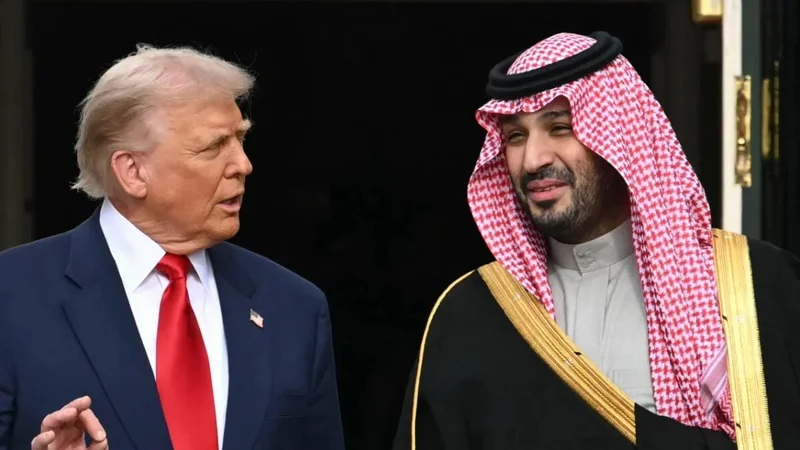
The social media post likely blindsided US and Arab officials, not least because Trump and Saudi Arabia's Crown Prince Mohammed bin Salman had just spoken that day. The two countries’ top diplomats also held a phone call on Wednesday.
Trump hasn’t made it a secret that he wants Saudi Arabia to join the Abraham Accords. He considers the 2020 diplomatic framework by which the UAE, Bahrain and Morocco established ties with Israel as his greatest foreign policy achievement.
But Trump’s single tweet changed the context of a historic deal that could reorder the Middle East.
If Saudi Arabia enriches uranium domestically, it could spark a race to compete among other states like Turkey and the UAE. Iran, which is fighting a war to preserve its nuclear programme, will harden its position.
Israel, which is the region’s only nuclear-armed state, is wary of losing its advantage. Israel has never publicly acknowledged its nuclear weapons.
On Wednesday, the deal appeared to be the culmination of closer US-Saudi ties, with Trump potentially rewarding the kingdom for standing by the US amid a chaotic war on Iran that it opposed from the start.
'The US has no national interest, regardless of Israel, in allowing Saudi Arabia to enrich uranium'
- Rosemary Kelanic, Defense Priorities
Now, a deal that the White House praised as "benefiting American workers and supply chains" appears to be conditioned on a separate diplomatic deal that Saudi Arabia makes with Israel.
“The President just put out this statement a few hours ago; I don’t believe he’s had a call with [Crown Prince Mohammed bin Salman] in the hours since,” White House spokesperson Karoline Leavitt told reporters on Thursday, sidestepping when asked whether Trump had discussed the condition with the Saudi leader.
“The president is always the final dealmaker,” she added, “If they don’t join the Abraham Accords, the deal is off.”
“Whatever Trump tweets doesn’t affect whatever he signed,” Rosemary Kelanic, a Middle East expert at Defense Priorities, told MEE. “That said, he could always kill the deal.”
Saudi Arabia's nuclear journey
Saudi Arabia has ruled out establishing official diplomatic ties with Israel until the latter commits to what it calls an “irreversible path” to a Palestinian state. Saudi analysts say that Israel’s genocide in Gaza has made normalisation especially difficult.
It’s no secret that the US and Saudi Arabia have been discussing a nuclear deal.
The Biden administration tried to entice Saudi Arabia into normalisation by promising to reward Riyadh with military, defence and business deals - selling it advanced nuclear technology and F-35 warplanes were some of the sweeteners. But Israel’s war on Gaza and attacks against Syria, Lebanon, and more recently Iran, have changed Riyadh’s willingness to tie itself to the country.
Saudi Arabia’s top diplomatic priority during the Trump administration has been to separate the two tracks and effectively convince Trump, a business-minded president whose family also has financial interests in the Gulf, of the benefits of closer cooperation regardless of Israel.
Mohammed bin Salman’s November 2025 visit to the White House laid the groundwork. The 40-year-old crown prince was welcomed with pomp and pageantry to the White House even though he sidestepped calls by Trump to normalise ties with Israel.
The nuclear cooperation deal, known as a "123 agreement" that Saudi Arabia and the US signed on Wednesday, was viewed as the culmination of months of diplomacy following that visit.
“The decision to separate nuclear cooperation from the normalisation track reveals pragmatic American calculations,” Saudi analyst Hesham Alghannam, the director general of strategic studies and national security programmes at Naif Arab University in Riyadh, said on Wednesday.
“A thirty-year agreement that ties Riyadh to American nuclear supply chains would achieve a tangible commercial and strategic benefit for both countries,” he added. “Everybody wins.”
That is also how the US Department of Energy first framed the 123 Agreement and a separate deal on nuclear safeguards.
“These two agreements lay the legal foundation for a decades-long, multi-billion-dollar partnership that advances several priority economic and strategic objectives, including nuclear nonproliferation,” the statement said.
“The 123 agreement provides great access for American companies in the Saudi nuclear energy program, benefiting American industry, workers, and supply chains while helping to meet Saudi energy needs,” it added.
All eyes on enrichment
The agreement's terms have not been released to the public, but several US media outlets say it opens a pathway for Saudi Arabia to enrich uranium by creating a joint panel to study the economic viability of enrichment.
Saudi officials have long called for the ability to enrich uranium, as a matter of sovereignty and economic independence. Other US allies, such as Japan and Brazil, have signed 123 agreements with the US that allow them to enrich uranium for civilian purposes. But the UAE, which signed a 123 agreement in 2009, is not permitted to enrich uranium.
'Is this a way to counter pushback from the Israeli lobby and anti-Saudi lobby?'
- Randa Slim, Stimpson Center
Abu Dhabi also signed up to the International Atomic Energy Agency’s “additional protocol”, which allows inspectors wide-scale access to its programme.
Some critics say the drama around normalisation is distracting from the bigger risk the deal poses to nuclear proliferation. If Saudi Arabia is able to enrich uranium, it will be noted by other regional powers such as Turkey, Qatar and the UAE. That could spark a nuclear race in the volatile Middle East.
Iran has gone to war, partly, over its right to enrich uranium.
“The US has no national interest, regardless of Israel, in allowing Saudi Arabia to enrich uranium. There are a million ways for US companies to make money without the risk of nuclear proliferation,” Kelanic, at Defense Priorities, told MEE.
Some experts say that Trump could have inserted the language on normalisation in order to gain support for the deal in Congress after blowback. The deal must be submitted to Congress, which can block it with a two-thirds majority. Trump could override lawmakers with a veto.
“You have to wonder who interfered in this? Who asked Trump to put that condition in - the Israelis? Or is this a way to counter pushback from the Israeli lobby and anti-Saudi lobby,” Randa Slim, head of the Middle East programme at the Stimson Center, told MEE.