We are now one year away from the latest possible date — Aug. 22, 2027 — that Spain can hold a general election.
For embattled Socialist Prime Minister Pedro Sánchez, it looks like it’s going to be a bruising ride to get that far. He insists he will seek reelection, brushing aside the predictions that he is doomed by pointing to his well-established knack for defying political gravity.
But this time, the odds are especially stacked against him and his fragile minority government, which has never appeared so isolated.
The challenges that lie ahead are so daunting that Sánchez could well chuck the schedule and call for an early vote.
Here’s why he’s up against it.
Rough rentrée
Summers have historically been kind to Sánchez.
In the past, the seasonal break helped reduce the heat generated by crises like the June 2025 arrest of high-ranking Socialist Party official Santos Cerdán for allegedly awarding public works contracts in exchange for kickbacks. The prime minister was no doubt hoping a similar scenario would play out following this spring’s high-profile indictment of his ally, former Prime Minister José Luis Rodríguez Zapatero, on money-laundering charges, and after a major raid on his party’s headquarters as part of a separate criminal investigation.
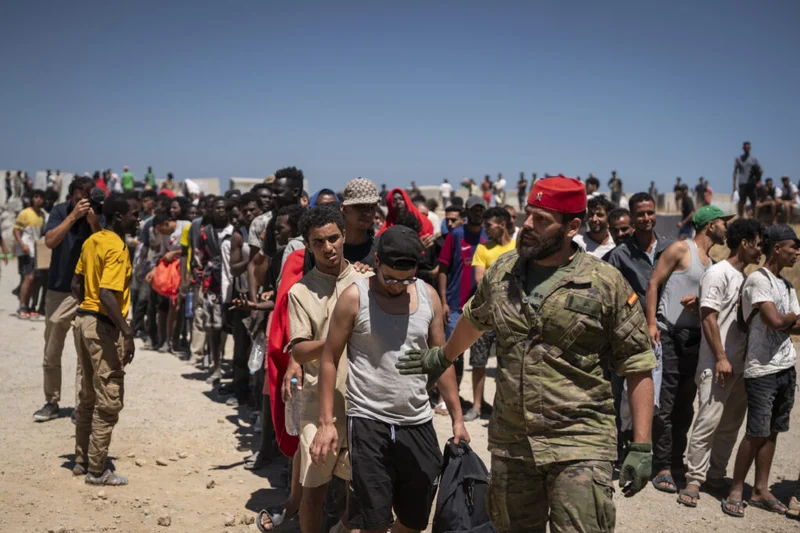
But just days before he was due to head off on a beach break on the island of Lanzarote, Sánchez’s summer was upended by a surge of 72,000 migrants into Ceuta, a Spanish exclave in northern Africa. Even though the prime minister did eventually resume his scheduled vacation, the Ceuta crisis has continued to dominate the news. Thousands of unauthorized migrants remain in the city, with local authorities complaining Madrid isn’t doing enough to address overwhelmed hospitals and other public services.
The government is bound to face tough grillings over security failures, whether intelligence warnings went unheeded and whether something went badly wrong in relations with Morocco. The Ceuta debacle also left Sánchez looking painfully isolated on the EU stage, with 22 leaders writing a letter suggesting his liberal migration policies could have helped attract the influx.
Nearly a third of Sánchez’s ministers have been summoned to testify at extraordinary hearings in the Spanish parliament next week, and the prime minister himself is due to face tough questions when plenary sessions resume in September.
So much for a fresh start.
Budget bloodbath
The fall promises no relief for Spain’s prime minister, who faces defeat in a battle over the national cashflow.
The minority government has been unable to pass a single budget bill during this legislative term, and has been operating on the spending plan approved by Sánchez’s previous government in December 2022. The Socialist leader has vowed to submit a draft budget for 2027 this fall, but it is almost certain to be rejected by lawmakers.
A major obstacle is the Catalan separatist Together for Catalonia group, whose support is key to getting any legislation passed. The party voted down the deficit framework for the draft budget this summer, with its spokesperson, Josep Rius, characterizing the long-shot legislation as “yet another Sánchez frivolity.”
The separatists were instrumental in getting Sánchez a third stint as prime minister in 2023, but relations have since soured, with the party now accusing the government of reneging on its commitments to Catalonia, and refusing to back budget plans it considers to be Madrid-centric.
But the prime minister is determined to move forward, raising questions about his motivation to present a doomed budget bill.
“There’s growing speculation that Sánchez may want to call voters to the polls as early as March, and the budget’s failure would provide him with an excuse to do so” said Pablo Simón, a political scientist at Madrid’s Carlos III University, who pointed out that Spain is due to hold local and key regional elections in May 2027.
Sánchez’s personal unpopularity has been cited as a key factor in Socialist Party losses in previous local and regional races. Holding national elections earlier in the year could remove the prime minister from the equation when the May vote is held, helping center-left candidates running in key cities and enabling the socialists retain control of regional governments in Castilla-La Mancha, Asturias and Navarre.
“There’s no sense in stretching this term to its limits if you’re not only going to lose, but drag others down with you,” Simón said.
(More) legal woes ahead
Sánchez’s tumultuous relationship with Spain’s judiciary is also likely to grow even more strained over the next year.
In the coming months the prime minister’s wife, Begoña Gómez, could stand trial on charges of influence-peddling and embezzlement. She denies all wrongdoing, and the prime minister has consistently argued that his wife is the victim of so-called “lawfare” targeting his friends and family.
Gómez’s trial follows on this summer’s conviction of the prime minister’s brother on administrative misconduct charges, in connection to the rigged allocation of a public job — a ruling Sánchez called “unjust.”
Beyond the cases involving his immediate family, the prime minister faces potentially damaging judicial probes into alleged bid-rigging and kickbacks involving key allies — as well as an explosive investigation into suspected illegal financing of his Socialist Party.
Crucial parliamentary allies such as Gabriel Rufián of the Republican Left of Catalonia have warned that illegal financing is a “red line.” Hard evidence could force Spain’s current prime minister to suffer the same fate as his conservative predecessor, Mariano Rajoy, whom Sánchez ousted from power after his People’s Party was proven to have engaged in the same crime.
Left-wing logjam
Spain’s fragmented politics make majority governments increasingly unlikely: Power goes to whoever can secure enough parliamentary support to be declared prime minister.
For now, the polling suggests the center-right People’s Party and the far-right Vox party are on course to control a majority of seats in the parliament in 2027. The two parties currently govern in coalition in four Spanish regions, and PP leader Alberto Núñez Feijóo in June explicitly endorsed a partnership at the national level.
Sánchez faces tougher odds in building an alliance strong enough to keep him in power. In 2023, he formed a coalition with the Sumar group — an amalgam of far-left parties — and won the backing of key regionalist and separatist parties.
But this time around, the numbers don’t add up. Sumar has effectively collapsed amid internal infighting, and its unifying leader, Deputy Prime Minister Yolanda Díaz, has ruled out standing as its candidate at the next election. Polls indicate the far left will suffer heavy losses at the national level, leaving Sánchez with fewer viable paths to a parliamentary majority.
No relief abroad
There are also signs that Sánchez will no longer be able to boost his fortunes at home through his performances on the global stage.
Engagement in international affairs — ranging from his condemnation of Israel’s military operations in Gaza, to his ongoing feud with U.S. President Donald Trump — has previously bolstered his standing in Spain.
But political scientist Simón said that the harsh criticism the prime minister from fellow EU leaders for his handling of the Ceuta crisis reveals he is increasingly considered to be a figure on his way out.
“As one of the few social democrats still governing in Europe, his positions are out of step with the conservative consensus, and they aren’t taken seriously because he is now seen as a lame duck who is going to lose the next elections,” said Simón.
“That leaves him with little capacity to make a difference because he isn’t seen as representing Spain’s position at this point,” he added. “Everyone accepts someone else will be in charge next year, and likely have a very different perspective.”
Sánchez’s broader international vulnerabilities will be on display in November, when Madrid hosts a summit of Ibero-American heads of government that will underscore the region’s rightward shift. Roughly half the leaders attending are from the right, and include figures like Argentina’s populist president, Javier Milei, with whom the prime minister has a prickly relationship.
“The summit highlights a global political realignment,” said Simón. “One that Spain narrowly avoided in 2023, but seems increasingly inevitable next year.”