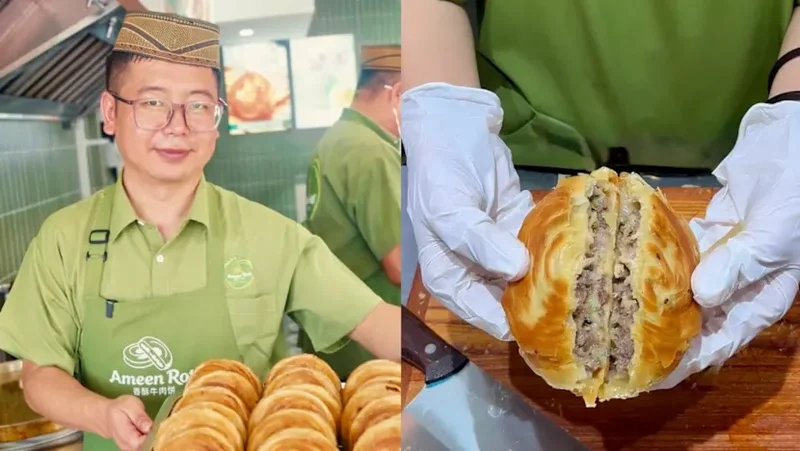
This former teacher started a Chinese-Muslim beef roti business in Singapore with cooks from his hometown
The two Ameen Roti shops – a 15-seater at Haji Lane and a takeaway stall at Century Square – draw long queues.
When Harun Min, 36, from Linxia in northwest China first vacationed in Singapore in 2024, opening a beef roti shop wasn't part of the plan.
The Chinese-Muslim former middle school teacher launched two Ameen Roti outlets in June, a 15-seater at Haji Lane and a takeaway stall at Century Square, serving authentic Chinese-style beef and chicken roti prepared by cooks from his hometown.
Popular among China's Hui Muslim community, beef roti is a flaky pastry made with paper-thin dough that’s traditionally stuffed with spiced beef filling and fried till crispy. At Ameen Roti, diners can watch the chefs fry each roti to order, using a traditional Xi'an Muslim recipe with spices imported from China and fresh beef sourced locally. While it may look a little like prata or Taiwanese scallion pancakes, Min says its savoury flavours are distinctly Chinese-Muslim.
In China, the snack is known as niu rou bing (beef pancake) or guo kui (pot helmet flatbread due to its shape), depending on the region. In Singapore and Malaysia, it’s commonly marketed as “Chinese beef roti”.
Min tells 8days.sg that beef roti dates back to China's Tang dynasty and was enjoyed by royalty, before eventually becoming a popular street food.
Before making the leap into food, Min spent six years teaching in his hometown as a middle school Chinese and mathematics teacher.
While he enjoyed teaching, entrepreneurship had always been at the back of his mind.
"I've always liked doing business," he said. "Even after graduating with a postgraduate degree in Sociology from Northwest Minzu University in China, I explored different businesses part-time. I wanted to try something new while I was still young."
He had previously dabbled in ventures ranging from educational training workshops to selling retail sports shoes, but never imagined he would eventually become a restaurant owner.
"Never," he laughed. "It all happened by accident."
Before opening his standalone outlets, Min tested the waters at pasar malam stalls around Singapore earlier this year, including Woodlands, Tampines, and the Ramadan bazaar at Jalan Sultan.
The snaking lines convinced him there was room for the concept here. “Chinese tourists told us our roti reminds them of home. It tastes exactly like what they had back home,” he told 8days.sg. “Our Malay friends’ feedback is that it's the best beef roti in Singapore.”
“Even after opening our permanent outlets, customers can still expect to queue for around 30 to 60 minutes during peak periods,” Min shared.
Though not the first to offer beef roti at local bazaars, Min believes Ameen Roti stands out because he and his Chinese-Muslim cooks are all from Linxia, where the dish has long been part of their food culture, making the flavours truer to those found back home.
Ameen Roti has only two items on the menu: the signature Beef Roti (S$6) and Chicken Roti (S$5.50).
“The crispiness of the outer layer requires skill,” he said. “We stretch the dough thin and fry it on high heat evenly in small batches to get crispy layers.”
“We have our own seasoning and recipe for the fillings to ensure our beef and chicken fillings stay tender,” Min added.
While the eatery is currently Muslim-owned, Min says it’s planning to apply for halal certification.
Some netizens on 8days.sg's previous TikTok video featuring the eatery remarked that S$6 (US$4.70) was too expensive for a beef roti. Min, however, disagrees.
"Our roti uses premium beef and handmade dough, which requires time-consuming manual work," he explained. "The cost of labour and quality ingredients make this price reasonable."
Min himself doesn't cook. He has invested about S$300,000 in the business so far with two partners, one of whom is a chef. There are altogether three Chinese-Muslim cooks from his hometown of Linxia here, each with more than 20 years of experience making beef roti.
"Our cooks already know how to make beef roti. They all come from my hometown, where this type of food is part of our culture," he explained.
Keen for a fresh start, Min began exploring opportunities outside China. "I wanted to change my life while I was still young," he said. "I wanted my children to have more opportunities to choose where they want to work."
A trip to Malaysia later sparked the idea for his next venture. "I [initially] planned to open a Chinese cuisine restaurant in Kuala Lumpur," he said. "But I noticed beef roti was so popular among the Malays there."
Although he first considered starting a business in Malaysia, Singapore eventually stood out as the better place to launch the business after he spent a week there.
"Singapore boasts stable policies, transparent business rules and a multicultural food market that welcomes international snacks. There's no hidden red tape,” he shared.
He added: "I love food and traditional Chinese-Muslim cuisine, so I chose to work in F&B despite its challenges."
While he is now based in Singapore, his daughter and son currently study at an international school in Johor Bahru.
Min's wife, also from his hometown in China, looks after their children full-time in JB, occasionally helping out with the business remotely. “My wife sometimes helps to manage the company’s accounts and communicate with suppliers,” he shared.
He lives in Singapore but visits them weekly and plans to relocate them here once his business stabilises. “When my children come to Singapore, they give me support at work,” he laughed. “Sometimes, they help serve customers.”
Does he hope they take over the business one day? “I hope they have their own [careers] — it’s up to them if they want to take over,” Min mused.
Ameen Roti is at 674 North Bridge Road, Singapore 188804, open daily 10am to 10pm, and #03-19, 2 Tampines Central 5, The Food Market by Food Junction, Century Square, Singapore 529509, open daily 9am to 9pm.
This story was originally published in 8Days.
For more 8Days stories, visit https://www.8days.sg/.