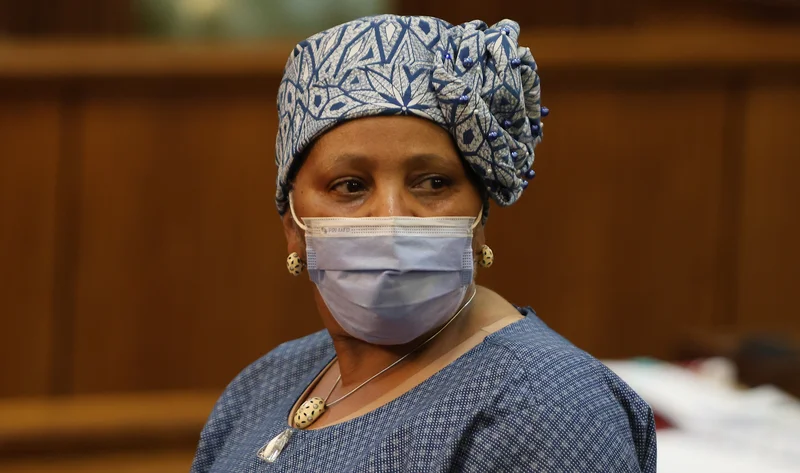
Long before the alleged cash bribes, coded messages and secret phone calls that define former National Assembly Speaker and defence minister Nosiviwe Mapisa-Nqakulaâs corruption trial, the saga began with a routine government contract.
This narrative unfolded on Wednesday in the High Court in Pretoria through the testimony of businesswoman Nombasa Ntsondwa-Ndhlovu. The court ruled that while Ntsondwa-Ndhlovu could be identified by name, no photos, video or audio broadcasts of her testimony would be permitted.
Ntsondwa-Ndhlovu, the sole director of logistics company Umkhombe Marine, testified under an indemnity agreement with the National Prosecuting Authorityâs Investigating Directorate Against Corruption.
Before she resumed her evidence on Thursday, the court reminded her that the indemnity depended on her giving truthful testimony.
Ntsondwa-Ndhlovu detailed how a R104-million defence logistics contract awarded to her company was abruptly suspended, prompting her to sue the military. However, she said, before the matter reached a judge, military officials offered her a secondary R79-million contract â on the condition that she drop the lawsuit.
After that, Ntsondwa-Ndhlovu testified, the requests for cash began, first for R300,000, then R400,000 and several more, following a meeting with Mapisa-Nqakula.
Mapisa-Nqakula has pleaded not guilty to 12 counts of corruption and one count of money laundering. The State alleges she solicited or received about R4.5-million from Ntsondwa-Ndhlovu between December 2016 and July 2019 while serving as minister of defence.
A suspended contract
Ntsondwa-Ndhlovu testified that her company had an uncomplicated relationship with the SANDF until February 2016, when Umkhombe Marine secured its biggest contract, a R104-million tender.
The contract required the company to provide logistical support for military operations, including transporting cargo into Sudan.
Ntsondwa-Ndhlovu immediately moved forward, using the official appointment letter to secure subcontractors and kick off operational planning.
âFirstly, Sudan is not a friendly place; there is constant war, itâs not safe. The airstrips are very small, so the trucks that are supposed to be doing [the] distribution are not that many ... because we are supposed to be doing airlifting. I therefore now had to make a booking of 11 airplanes. This was based on the amount of cargo needed to be moved,â she said.
She told the court she also arranged satellite tracking systems and armed escorts as part of the operation.
Barely a week after the awarding of the contract, according to Ntsondwa-Ndhlovu, SANDF officials informed her that following the then president, Jacob Zumaâs decision to recall South African troops, the operation had been placed on hold.
Months passed without formal communication after she and the subcontractors had already incurred costs.
She instructed her lawyers to inquire about the status of the contract and, when no satisfactory explanation came, to institute legal proceedings against the SANDF.
She said this entailed speaking to several people, including Mapisa-Nqaluka, who claimed to be shocked at the treatment she had endured and promised to get back to her.
Soon afterwards, she received an unexpected call, offering her another multimillion-rand contract.
âI was called by Captain Bologo; he informed me they had reached a decision internally to give me a replacement tender for DRC and that I must do an operations plan.â
**The R79m replacement contract **
Ntsondwa-Ndhlovu testified that she was told she would only receive the new contract if she withdrew her legal action against the SANDF.
She said she was instructed to write and sign a letter abandoning the lawsuit before being handed an appointment letter for a tender she had never bid for.
That contract proceeded without incident, she said. The work was completed, and Umkhombe Marine received payment in full.
After that, she testified, the requests for money began.
Ntsondwa-Ndhlovu told the court that the first request came through the late secretary for defence, Dr Sam Gulube. She had known Gulube professionally and had been friends with his wife, Lillian.
She said Gulube called her to his home, where he requested R300,000 on behalf of Mapisa-Nqakula, who was then defence minister. She handed over the cash, telling the court the funds came from a safe at her home, which regularly held up to R800,000.
Barely a week later, another phone call came. âI once again received a phone call from Gulube. He said I should come to his house and gave me the access code [for the gate], the exact same way it would happen previously.â
She said that when she arrived, Gulube made another request â for R400,000.
State prosecutor Advocate Emile van der Merwe asked what she felt about this.
âIt made me very angry. I ... was disrespected. Because how come, when I was still trying to sort out the other one, and there is another request that is much more,â said Ntsondwa-Ndhlovu.
âFor a moment I thought Gulube was making a fool of me. It did not immediately register to me that someone whoâs just requested R300,000 would come back again and ask for so much money. I initially thought heâs asking the money for himself.
âI then decided, I am going to investigate this further; I am not going to deliver money just like that.â
The first hotel meeting
Ntsondwa-Ndhlovu contacted a retired general and family friend whom she said knew Mapisa-Nqakula and, through Mapisa-Nqakulaâs office, arranged to meet in December 2016 at the InterContinental Hotel at OR Tambo International Airport.
She told the court that several ANC leaders appeared to be attending a gathering there, including then labour minister Thulas Nxesi, with whom she exchanged contact details.
When she entered the suite, she said, Mapisa-Nqakula greeted her as âThokoza Gogoâ â which is how traditional healers often greet one another.
Ntsondwa-Ndhlovu said that during the meeting, Mapisa-Nqakula confirmed receiving the initial R300,000.
She also allegedly proposed that future conversations about money should not be direct. Instead, the two would use words such as âendumbeni [a sacred space]â, âumuthi [traditional medicine]â, âImpepho [African sage]â, âwigâ, âpadkos [road food]â and âsnuffâ.
This prompted an intervention from Judge Mashudu Munzhelele.
âI just want to find out from you: what did you understand the request of impepho or umuthi to be? Did you understand it to be a literal meaning?â
Ntsondwa-Ndhlovu replied: âI knew exactly what she meant, because there is no sangoma who would ask for impepho from another sangoma and the snuff part is something very personal,â she said.
Robbed before making delivery
Ntsondwa-Ndhlovu testified about another request, this time for R200,000, which, she said, was made directly by Mapisa-Nqakula months after their meeting.
She said she withdrew the money at an FNB branch and hid it under the passenger seat of her car, before stopping at a petrol station to make another withdrawal of R12,000 to buy food.
There, men travelling in a white BMW confronted her. One allegedly pointed a firearm at her chest while another assaulted her. The attackers stole her handbag, cellphone and R12,000. They did not see the R200,000 because it was hidden beneath the driverâs seat.
She reported the robbery to the police and her bank.
Despite being injured and traumatised, she testified that she delivered the money that evening. She said Mapisa-Nqakula repeatedly phoned her while she was dealing with the aftermath of the robbery.
The trial continues. DM