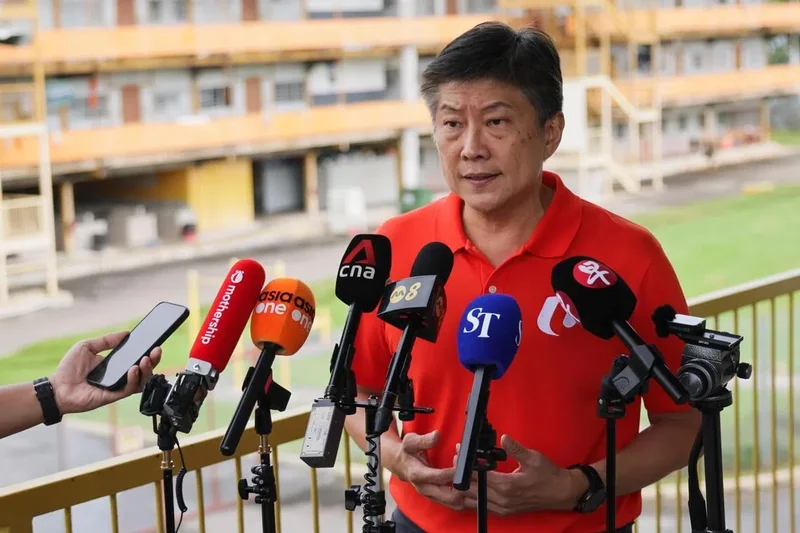
Ng Chee Meng’s Cabinet return gives workers a stronger voice amid AI disruption, say union leaders
SINGAPORE – Workers will have a stronger voice at the national decision-making table as they face AI-driven job disruption, following labour chief Ng Chee Meng’s return to Cabinet, said unionists.
Ng’s appointment as Minister in the Prime Minister’s Office – which takes effect from July 27 – marks an end to six years without an NTUC secretary-general in Cabinet.
The timing of his return is crucial, said union leaders, as the labour movement prepares to take the workforce through unprecedented job changes due in part to artificial intelligence.
“I’ve never seen such a transformative period in my entire working life,” said National Trades Union Congress president K. Thanaletchimi, adding that many workers fear AI will replace them.
Singapore Teachers’ Union general secretary and NTUC central committee member Mike Thiruman said this is the first technological wave to hit professionals, managers and executives earlier and harder than blue-collar workers.
“Now we are at the forefront of it, and it’s happening across the board to everyone, and the anxiety level is high,” he said, adding that Singapore is now at a critical juncture for AI-led transformation in the workplace and of the workforce.
It is in this climate that Ng is returning to the Cabinet, and union leaders said having a seat at the table will allow him to insert workers’ voices directly into the national policy and strategy tackling this disruption.
The labour chief has traditionally held a Cabinet seat as a minister in the Prime Minister’s Office since 1980, when Lim Chee Onn was appointed to the Cabinet.
Ng vacated the seat after he lost the contest for Sengkang GRC in the 2020 General Election, but returned to Parliament after the polls in May 2025.
He initially asked not to be assigned any position in government so he could focus on his duties as MP for Jalan Kayu and his role as labour chief.
On July 22, Prime Minister Lawrence Wong brought him back into the Cabinet as part of a reshuffle, about 14 months after Ng’s re-election. PM Wong said he felt it was timely for Ng to return to government, given that jobs and workforce transformation have “become a much higher priority”.
Public policy researcher and Nominated MP Terence Ho said being in Cabinet gives the labour chief greater influence.
Unionists agreed, outlining the ways in which this seat is valuable to the NTUC. Nominated MP and Amalgamated Union of Public Employees general secretary Sanjeev Tiwari said Ng’s presence will give workers a stronger voice and representation.
It will also allow him to convey their sentiments, aspirations and fears directly to the Government, Thanaletchimi said, adding that it is also a platform where the labour chief can ask for resources and buy-in for various programmes.
Asked how the last six years without the labour chief in Cabinet have affected the NTUC, Thanaletchimi said the conversations between the Government, NTUC and employers have continued.
While the labour MPs have done what she described as a fantastic job in Parliament over the past six years, it is “not sufficient” to have workers’ voices be represented only in the House, she said.
Thiruman said there has not been a large difference to the unions’ work with Ng out of Cabinet because of the tripartite system, referring to Singapore’s system of cooperation between the Government, unions and employers.
But at times, decisions are made and the unions are consulted afterwards, he added.
“If you’re not at the decision-making table, your voice may not be completely heard or fully heard, and sometimes it may be compromised.”
The unions and workers have a “suite of requests” for Ng once he is in Cabinet, said NTUC vice-president Abdul Samad Abdul Wahab.
Chief among these are dealing with the cost of living and creating good job opportunities for Singaporeans, said Samad, who is general secretary of the Union of Power and Gas Employees.
Others like unionist Cherlyn Ng, who sits on the Creative Media and Publishing Union’s executive committee, hope Ng will push for more support for middle-income workers who are taking care of children as well as elderly parents.
To Samad, a former Nominated MP, Ng’s return to Cabinet is also recognition from the Government of his work in Jalan Kayu and on the ground with workers.
Agreeing, NTUC assistant director-general and former PAP MP Zainal Sapari said: “Having devoted the past year to serving his constituents, the timing is right for his reappointment.”
Unionist Raman Kathavarayan, a mechanical maintenance supervisor, said he has appreciated Ng’s work on the ground in recent months – including his intervention in a case that came to light in June where about 400 migrant workers were not paid for several months.
NTUC found 40 firms with about 150 vacancies. It gave affected workers who were members of its Migrant Workers’ Centre $100 cash and $100 FairPrice vouchers each, and Ng was seen on the ground speaking to workers and offering NTUC’s support.
Raman said moves like this showed that Ng “has the heart”, adding that he hopes the labour chief continues to be close to the ground.
His reappointment also solidifies the relationship between the Government and the labour movement, and reinforces its importance in the tripartite system, Thanaletchimi said.
“This announcement augurs well to say that in this new journey our partnership is still as strong,” she said.
It is also recognition of NTUC’s recent work, including the announcement of a new tripartite jobs council in April to help workers facing disruption, she added.
“It’s time for us to reinforce that we have a powerful force: the minister, secretary-general, wearing two hats, and he is our voice for the workers.”