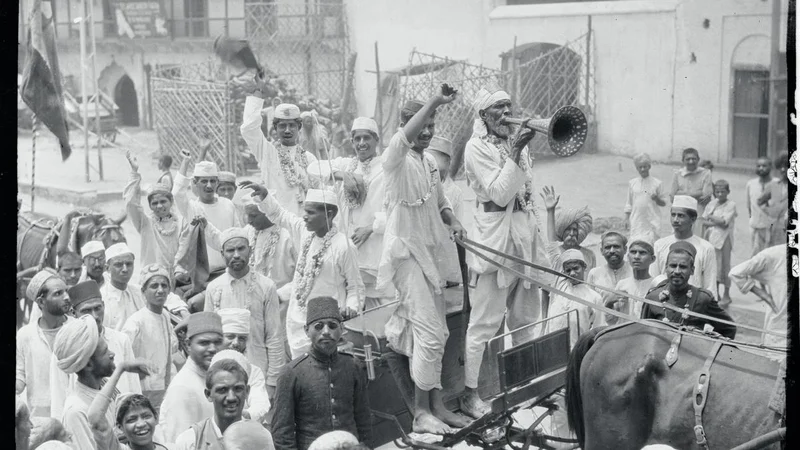
Slogans are dispatches, a voice of persuasion and resistance, and hence, carry as much historical and cultural value as our monuments. Though the trajectory of sloganeering has evolved with time, the essence of its purpose is still the same — bringing change.
British gets checked
More than 150 years ago, sepoys in North India echoed three words with intense vigour. Maaro Firangi ko (Strike down the foreigners) kept ringing in the air, shaping the message of the 1857 revolt, the first major and revolutionary uprising against British authority. The revolt also came to be known as the First War of Independence. The slogan was a linguistic weapon, which spread from the sepoys towards the common people like artisans and peasants, awakening and uniting them (cutting across religions) for the first time, excavating bits and pieces of a national consciousness and the idea of a nation-wide resistance. For the British, this was a shocker.
The spirit of resistance, social frustration, and emotional call to action packed in those simple three words had a sense of straightforward urgency. At the most immediate of our understanding of slogans in any case, is this function. In this way, slogans become rhetorical devices. This is why slogans are able to catch the attention as well as support of a large number of people. Slogans thus help a revolt, like the 1857 one here, achieve virality.
Political culture of ‘opposition and resistance’
After spending much time in jail in Mandalay, Myanmar for defending, in his newspaper Kesari, Indian revolutionaries and calling for Swaraj (self-rule), Bal Gangadhar Tilak from the Lal Bal Pal trio formed the Indian Home Rule League in 1916.
Tilak perfectly captured the emotion of discontent and protest and cried out an unforgettable, goosebump-inducing slogan — Swaraj is my birthright and I shall have it! The slogan was confidence personified and it inspired an anti-colonial solidarity where ‘we’ are in opposition with ‘them’.
Coming out of a preoccupation with constitutional reforms, “Swaraj” symbolised an Indian renaissance, spontaneously becoming a language of its own and developing sister ideals like swadeshi and non-cooperation. “Swaraj” travelled through gossip, tea conversations, news, songs, and performances instantly into the cultural and economic spheres of thought.
Long Live Revolution
With working class strikes and labour unrest clearly on rise against colonial exploitation during the 1920s, the British government began committing brutal atrocities and heavily censoring the press. Mahatma Gandhi had also risen as a prominent leader, launching the non-cooperation movement after the Jallianwala Bagh tragedy. The resistance was unrelenting. Students participated, protesting in their colleges (walking out of colonial institutions), with placards and their own slogans.
Did you know?
Mygurudu was a Malayalam-based secret language developed during the Malabar Rebellion in 1921, which helped prisoners communicate without their messages getting leaked amidst an environment of military-excercised heavy brutality which saw deaths as many as 10,000!
Young Bhagat Singh, in 1929, popularised Urdu poet Mualana Hasrat Mohani’s “Inquilab Zindabad” in India’s struggle for freedom. After throwing non-lethal, low-intensity smoke bombs in the Central Assembly, Bhagat Singh and B.K. Dutt stayed shouting “Inquilab Zindabad”. This marked a significant shift towards a higher level of resistance, aiming for “Poorna Swaraj” (complete independence), also coined by Mohani. Even today, in protest spaces we hear the booming chants of Inquilab Zindabad, depicting that slogans are versatile, universal, and move beyond the space-time of its birth and breakout.
Nation-building
Resistance was not the only idea covered by slogans. National consciousness and collective identity were simultaneously being formed via slogans. The first rallying cry in that regard was thanks to Bengali novelist and poet Bankim Chandra Chatterjee who wrote down two words together — Vande Mataram — in his Bengali language novel Anandamath. The words meant “I Bow to Thee, Mother”, venerating India as home and mother. During the partition of Bengal in 1905, which showcased ‘divide and rule’ policy from the British to weaken the nationalist movement, Vande Mataram took a life of its own. For the people of Bengal, the slogan was a mantra and the passion behind it caused severe anxiety to the British. B.T Ranadive, who was an Indian politician and freedom fighter, wrote in an essay published in 1986 that even schoolchildren who sang Vande Mataram were beaten.
“Jai Hind” was another slogan that carried the same message of a united Indian nation. It was coined by Indian revolutionary Chempakaraman Pillai as a salutational watchword meaning ‘Hail India’. Look at the simple lexical choices here. In minimal presentation, the slogan represented a maximal thought of freedom. Throughout the freedom struggle, these words were rock, even becoming the official slogan of Subhas Chandra Bose’s INA (Indian National Army) which increased the revolutionary spirit. Bose solidified the sentiment by giving a fierce, direct slogan of his own — Give me blood and I shall give you freedom! — which inspired people as they began to believe in total mobilisation. Indians living in other British colonies like Malay (present-day Malaysia and Singapore), Burma (Myanmar), etc., were now an active part of the country’s freedom movement. Things were looking precarious for the British.
Seeing, hearing, and memory (especially, Simon)
By now you must be understanding that slogans are not just some aesthetic catchy accessories of a rebellion. It carries as much depth as an efficient conversation between two people. When one says Jai Hind, the meaning is that you stand for unity. When you see Inquilab Zindabad written on a wall or a placard, it is a symbol that the fighting spirit will prevail no matter what.
The most iconic, specific, and punchy visual of a slogan from our freedom struggle has to do with the memory of a man named Simon. Under British politician John Simon’s chairmanship, a commission arrived in India in 1928 to review the constitutional reforms in British India. The 1920s, which saw massive protests and strikes unlike never before, with a politically conscious working class could see that the commission was insulting without a single Indian member in it. The dislike was evident. Large flags with “SIMON GO BACK” (in all caps, one cannot imagine this slogan without all caps) in its faces were paraded through streets alongside people chanting the same. Again, look at the lexical choices here — Simon’s name and a pressing directive voicing the people’s opinion against the British government’s movements. The tale and memory of the commission is forever etched into this slogan.
The final blow
After years of negotiating and protesting, India’s freedom struggle reached its climax. The rising new world order, effects of World War II in the global arena, fall of British colonies like Burma, Malay, etc. was worsening the situation in India. The need for freedom couldn’t be delayed anymore. On August 8, 1942, Gandhi famously said, “Karo ya Maro”, which translated as “Do or Die”, starting the great Quit India movement. It signalled that whatever the result is, it will be made now. “Quit India — Bharat Chodo” slogan was a threat to the British which was carried forth by “Do or Die” becoming the social attitude of all the common Indian people. This was radical. The two primary word choices ‘Do’ and ‘Die’ angled towards extremes — either we get freedom or we die. From professing “Jai Hind” and “Swaraj is my birthright”, the shift is drastic. There would be no more in-between, no more waiting, no more compromise. All the past years had been precisely that. The slogan started a chain of events and mobilised people across the nation into a final act which, in retrospect, we know made British powers realise that there are no more chances.
“Here is a mantra, a short one, that I give you. You may imprint it on your hearts and let every breath of yours give expression to it. The mantra is: ‘Do or Die.’ We shall either free India or die in the attempt; we shall not live to see the perpetuation of our slavery.”Gandhi
Published - August 15, 2026 07:30 am IST