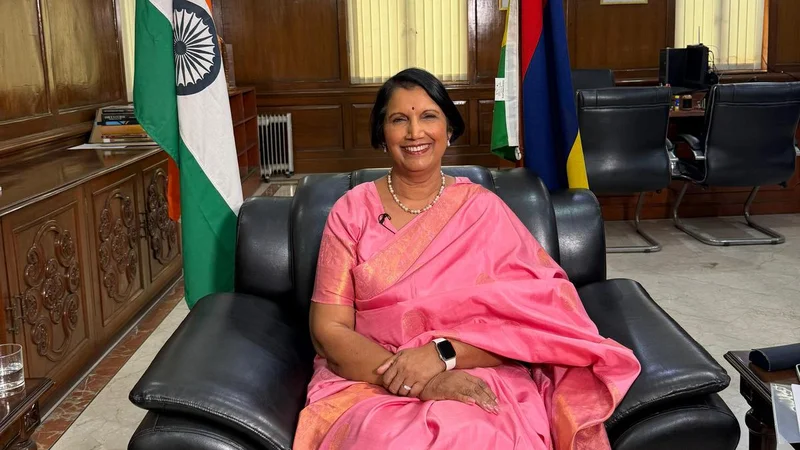
India remains a very attractive destination for global investments and its economic fundamentals form the basis for strong investor confidence, Jyoti Jeetun, the Minister of Financial Services and Economic Planning of Mauritius told The Hindu in an interview.
Ms. Jeetun added that the amended Double Taxation Avoidance Agreement (DTAA) between the two countries, which was recently ratified by the Mauritian Cabinet, would ensure that genuine and constructive investments flow from Mauritius to India.
**Also Read | India and Mauritius are not just partners but a family, says PM Modi **
She also said that whatever concerns investors had with the amendments to the DTAA have now been ironed out.
Major source of FDI
Mauritius has historically been a major source of investments into India. It accounted for about $6.6 billion or 11.2% of the total foreign direct investment (FDI) that entered India in 2025-26, the second-highest that year after Singapore, according to data from the Department for Promotion of Industry and Internal Trade (DPIIT).
Over the course of April 2000 to March 2026, Mauritius accounted for $186 billion of FDI, which is nearly a quarter of the total FDI that entered the country during that period.
**Editorial | Old ties, new priorities: On India-Mauritius ties **
“India remains a very attractive destination for global investment flows,” Ms. Jeetun said. “As one of the world’s top four economic powers, India’s primary economic ambition is to become a $5 trillion economy by fiscal year 2028-2029.”
“This ambition underscores the scale of capital it will require to grow its economy,” she added. “India’s fundamentals, its vast market size, ongoing reforms, and rapid digital transformation continue to underpin strong investor confidence.”
Plugging loopholes
While Mauritius has been a major source of FDI into India, there have been some concerns that a large part of these investments are not genuinely from Mauritius and that companies were using its tax treaty with India to route investments through shell companies simply located in Mauritius but that did not actually do business there.
The tax authorities on both sides have over the years tried to plug these gaps.
The India-Mauritius DTAA was signed in 1982 has historically played an important role in facilitating investment into India through Mauritius, Ms. Jeetun explained, adding that it has been pivotal for Mauritius’ economic partnership with India for four decades.
“The 2016 Protocol introduced source-based taxation of capital gains on shares acquired on or after 1 April 2017, whereby India was allowed to impose a capital gains tax,” she said. “A change in FDI flow from Mauritius to India has since been observed. Mauritius moved from being the leading source of FDI into India to generally ranking among the second or third largest sources.”
Then, in 2024, the agreement was further amended to introduce the Principal Purpose Test (PPT). This basically said that, if the principal purpose of setting up a company or passing investment flows through Mauritius is to receive tax benefits, then India can refuse to provide those tax benefits.
Addressing investor concerns
This amendment was signed by the previous government in Mauritius in March 2024. However, due to concerns raised by investors on both sides, it was ratified by the Mauritian Cabinet of the new government only in July 2026. Ms. Jeetan explained how the Indian tax authorities had cooperated with Mauritius to iron out the various concerns and issues.
The amendment still needs to be notified by both sides before it can come into effect.
“Since we assumed office in November 2024, we have through diplomatic channels engaged with the Indian authorities to bring certain clarity and restore the trust and certainty for investors,” she said.
In January 2025, the Central Board of Direct Taxes of India (CBDT) clarified that the PPT provision would only apply prospectively. That is, it will apply only after the amendment comes into effect. The CBDT in March 2026 also issued the Income Tax (Amendment) Rules 2026 to provide greater certainty for legacy investments.
“So, the concerns of the industry in Mauritius and in India were discussed thoroughly during the past 18 months with the Indian authorities and government at the highest level,” Ms. Jeetun said. “We had an open and constructive engagement with India. On the basis of the above clarifications, the Mauritius Cabinet approved the ratification of the Protocol.”
“We are confident that investments with genuine economic substance, commercial rationale, regulatory compliance and the overall quality of the investment platform will continue,” she added.
Published - August 21, 2026 11:17 am IST