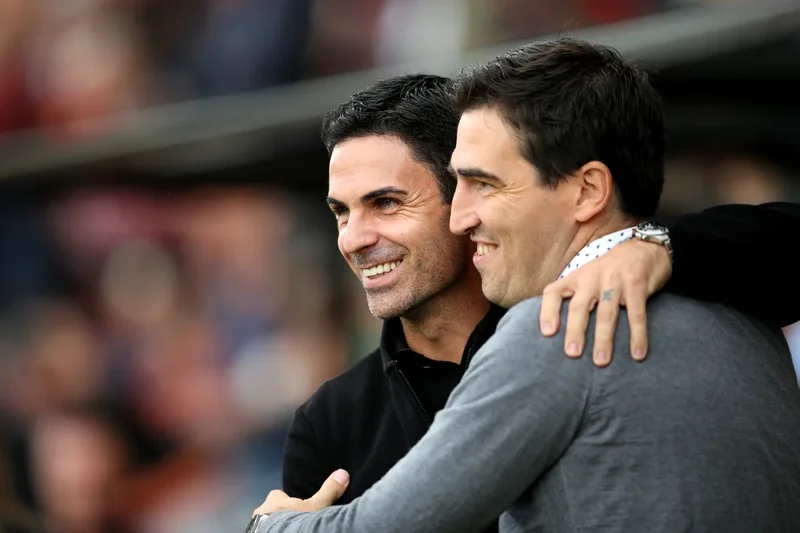
At Chelsea’s Cobham training ground, players have already remarked on one way that Xabi Alonso has lived up to his reputation. The training sessions rarely follow a set pattern, ensuring the squad have to think about everything a lot more. They’re kept on their toes, if not to the same degree that Liverpool are. Andoni Iraola has his new group adapting to different “physiological demands”. There’s been a jolt.
At Newcastle United, Matthias Jaissle may not have such a reputation, but he’s had a similar effect. People have already been impressed, to the point of perceived “sacrilege”. Many are talking about how the coaching is a higher quality than Eddie Howe.
If Howe had long been seen as a “next England manager”, Jaissle is genuinely viewed as “the next big coach”.
And despite such disparate situations across the Premier League, there is a link here, especially when you look back to the obvious contrast of the summer of 2016.
Then, when Pep Guardiola was arriving rather than going, the Premier League really wasn’t about the next big names.
It was about the biggest right then, as Guardiola joined Jurgen Klopp, Jose Mourinho, Antonio Conte, Arsene Wenger and Mauricio Pochettino.
The Premier League became the “league of star managers”, a status that fit England’s grand history of managerial patriarchs.
The lack of such names now is all the more notable amid a debate about the lack of “star players”, since a longer lineage has been broken.
This is the first Premier League season with none of Ferguson, Wenger, Mourinho or Guardiola involved. In other words, the great title-winning totems.
Mikel Arteta is in fact the only current coach to have even won the English league at all, having just claimed his first.
That victory came out of “almost complete control” at Arsenal, a level of command that emulates those “big beasts” of the past, as they were called, and is increasingly rare in the modern game.
That it’s Arteta may be all the more apt since he does fit into one theme that has been discussed in the same way as 2016's stars.
If that was about the biggest names, this is about Basque names.
The one piece of discourse you’ve probably seen more this pre-season than Alonso’s superior technique in training is discussion of how the Chelsea boss is one of three coaches – along with Iraola and Arteta – to come from the same team in Antiguoko, to go with how Unai Emery also hails from the same region around San Sebastian.
If it’s obvious to say this is immensely impressive overrepresentation for such a small area, it is equally unfashionable to state some of it is possibly just coincidence. This has happened in numerous cities in various fields throughout history, and you don’t have to go as high-brow as Vienna and its nucleus composers. Just consider the great documentaries made on how Glasgow’s industrial hardships produced Jock Stein, Sir Matt Busby and Bill Shankly all at the same time, and eventually Ferguson.
The freakish coincidence of producing coaches of such high quality can still be connected to wider cultural forces, though. The Basque country shares Spain’s wider football ideology, with Salamanca-born Alvaro Arbeloa now sharing a place in the Premier League. His first Fulham match comes against former teammate Alonso, on Monday.
English inquests are warranted at how a quarter of the Premier League’s managers are Spanish at the same time as Spain are reigning European and world champions, with their national team having displayed a depth of tactical sophistication that England couldn’t get close to. England actually seem so far away they had to opt for another big-name coach in Thomas Tuchel, at the expense of a figure like Howe.
The country may be the home of the vintage managerial patriarch but it is not currently a hot house for elite modern coaches. Something has been missing, despite brilliant talent production with players.
And it is within that gap that the most telling link between this season’s managers lies.
More relevant than a fifth of the coaches being Basque is how two of those are among nine managers new to their jobs.
More than half of the Premier League – including Michael Carrick and Roberto De Zerbi, taking it to 11 – are currently working through their first pre-seasons with these teams. The 33-year-old Fabian Hurzeler is meanwhile the joint-fourth longest serving coach, with newly-appointed Marco Rose the 12th.
Such statistics from quite a contrast to 10 years ago, when it was all about stature and legacy.
Against the 28 titles that eight managers had won across eight different countries in 2016, only five of the current group have won titles – and four of those seven came in Austria, Bosnia and Herzegovina and Croatia.
Outside Arteta, only Emery and Alonso have experience of winning a major league.
Premier League’s current title winners
Five managers have won league titles
Mikel Arteta (Premier League)
Unai Emery (Ligue 1)
Sergej Jakirovic (Premier League of Bosnia and Herzegovina, Croatian Football League)
Xabi Alonso (Bundesliga)
Matthias Jaissle (Austrian Bundesliga x2)
Some in football have been talking about a group of “unknowns” and “randoms” set for multiple sackings, evidently ignoring the instructive example of Pochettino’s Southampton appointment back in 2013.
And that is where there is a spin on this akin to an especially creative training drill.
The current crop may not have anything near the recognition of 2016, but numerous more people in football are adamant the Premier League is now collectively much better coached.
This is just what the competition is now, with years of broadcasting wealth gradually ensuring almost all clubs have properly invested in their football intelligence. They're simply hiring the brightest.
And if the short time spans of these managers also speaks to the grand theme of last season, and the increasing influence of directors and executives, it similarly reflects the speed at which all of this is evolving. This is now a fast-moving game, to go with how it is defined by physical intensity.
Clubs now actively prefer low-maintenance managers who will concentrate on the coaching, of which Iraola is a rare ideal. An irony is that successful management often necessitates stronger personalities, but that also plays into an intense concentration on the coaching.
Long-time football figures have been blown away by this.
Relatively standard practice now is coaches working from 6am to well into the night, with new plans presented every single morning. The manager will then ensure every cone is in its exact place so everything can be executed to the essential level, with all of this then pored over for hours on video afterwards.
It’s been written on these pages before that pressing systems are so sophisticated that they form the unseen map that shapes matches, normally nurtured by drill programmes that even have the positions of water bottles marked out.
In other words, the obsessiveness that elevated Guardiola is now commonplace.
Little wonder coaches talk of the most competitive Premier League ever, due to how much everyone has to think and prepare. This constant battle for space is partly why there's been an inevitable devolution into wrestling matches for space at set-pieces.
The neural networks that all of this forms – a little like, say, Vienna in the 1700s – have at least ensured that football tactics, certainly at a micro level, are constantly evolving faster than ever.
As an illustration, Alonso’s core ideas were seen as brilliantly innovative five years ago but a lot of the Premier League have now taken those even further. It's just as well he's so good as a pure manager. That is another constant challenge, though, that Arteta is known to be obsessed with. You don’t just have to think about your own team’s coaching all the time, but whether you yourself are keeping pace with all of the most advanced ideas.
As one club insider says, the game has just changed so much from even three to four years ago.
And that’s almost a completely different world to 10 years ago.
It’s not about the big names. It’s about greater ideas, executed to the most granular level.