In the increasingly crowded Soulslike genre, a game's opening minutes need to do a lot of work. The good news for Mortal Shell 2 is its opening is superb, starting as well as it continues, and condensing the magic of its next 30-odd hours into a few minutes with aplomb.
It starts with your character being woken up by a whisper, before a talking crow with a human skull (Souslikes!) sets up the mystery: telling you you're not from this world, and that the people you're about to meet aren't like you. You walk through what initially seems to be a normal village festival. The atmosphere is joyful; music is playing; little boys and girls are singing; a woman invites you to a dance. Listen closely, however, and you quickly realise this is more like something out of Midsommar. Everyone is talking in hushed tones about looking their best to "meet Mether". The road through the village ends at a pyre, where it becomes clear exactly what type of festival this is.
The festival ends the way you expect, my character has a moment with said Mether before grabbing an oval-shaped egg and heading off. This is when Harros is re-introduced; a returning Shell from the first game. After embodying it, you're set on your way into an open section, where Mortal Shell 2 gets to brilliantly demonstrate its biggest strengths. The grounded, brutal combat, the lack of a stamina bar, your Shell ability, the forgiving parry timing, the Resolve mechanic and its new sidearms. It's a brilliant teaser, by the end of which I'd fought countless enemies, defeated multiple bosses, and felt the weight of combat as everything clicked into place. It also demonstrates a level of confidence that was clear to see across the rest of the game, and that's nowhere more clear than with the prologue's end, where Mortal Shell 2 emphatically cuts ties with the original.
The original game felt like an indie take on Dark Souls 1 - its pacing in particular - though without the RPG mechanics. Combat relied on the same stamina-bound rhythm typical of classic FromSoftware games, so it felt familiar. But the first Mortal Shell introduced its own ideas too, almost as if for an audition for a seat at the Souslike table. Much of it was a clear first attempt, but it came with a demonstrable passion. The headline addition was its Hardening mechanic, whereby you could turn into stone at the push of a button rather than block. If you weren't attacking or managing stamina, you were waiting for the right moment to Harden.
And with that there were some drawbacks. The game only had four Shells, and each mapped to an RPG archetype, which felt like a compromise an inexperienced indie team might come up with to make their game stand out. There wasn't a lot of depth, and the game seemed to almost run out of steam in its final third, with vastly underpopulated areas and a sudden difficulty spike. But I couldn't help but love it for earnestly attempting to advance the genre, even if technical shortcomings and a lack of polish also got in the way.
Against that first game, Mortal Shell 2 is a highly accomplished sequel - one that could arguably earn a spot amongst the great Soulslikes. Everything has been overhauled, with aspects either replaced with something that fits better within the sequel's updated designs, or refined to reach the potential its progenitor couldn't. Perhaps that's why the game is positioned as a standalone sequel. It takes place in the same general world, brings back some of the original's Shells, but doesn't go beyond making rare nods for the lore fiends.
The setup is entirely separate and easy to follow. The Undermether is a god of unknown origin forced to crash-land in the realm after a foul creature latches onto her. The Mether was carrying many eggs (Ova) within her, and, in seeking shelter amongst humanity, they have been stolen. Many have been corrupted, but a few unspoiled Ova remain. You are her child, a Harbinger, hatched out of one of the untainted eggs bearing immense power. Your goal is to bring back your stolen kin. Though you can hold your own in that skeletal form, you're driven to find a Shell to embody.
The narrative unfolds through interactions with the different factions that sprung up around The Mether's arrival, and through her devoted servants - who take shelter in a keep carved from her bones - which also acts as your hub area. The other part of the narrative is the personal stories of the Shells, the vessels you inhabit.
Like the original, Shells are what you'll embody for the entirety of the game. You can switch between them as you like, but I stuck with one for most of my time. Shells don't offer any perspective of their own, but they all have stories of what they were before, and they sometimes intersect with the A plot, though not enough to give it more depth. Every Shell is based on someone who lived somewhere in the world at some point. By increasing your bond with them, you uncover more of their past and unlock more of their abilities.
This is an area where presentation is drastically improved over the original, with playable vignettes rather than simple memoirs read by the character. You may end up seeing only a few of them, however, as the resource associated with bonding is rare. Over the course of my playthrough, I ended up unlocking one or two memories for most Shells while only fully bonding with one.
Combat in Mortal Shell 2 flows faster than many of its genre contemporaries, in part because, unlike its predecessor, there's no stamina to worry about. This encourages aggression, and the game uses it to fuel its Resolve mechanic - a resource spent on powerful character abilities and as ammo for ranged sidearms. The more of your melee attacks land, the more Resolve you generate.
This is the single most impactful change from the first game, but I was initially worried it would turn combat into a race of attack spam, taking away the considered approach the original handled so well. You can technically never stop attacking, but enemies in the sequel are designed to work around that and force you into a particular rhythm. They're more resilient, don't stagger easily, and often come at you in groups. The rhythm, then, is a flow of prioritising threats, managing crowds, and finding the right window to unleash your Shell abilities.
Though the sequel's pace may not be as deliberate, attack animations deliver the same tactile heft the original was known for. Hits stagger enemies and visibly scar their bodies as they land. I used the Veteran's Battle Axe for most of my playthrough, which is notable as I rarely pick heavy weapons in those games. Perhaps I simply couldn't get over how a horizontal swing at an enemy with low enough health can chop their head clean off.
Mortal Shell 2 has plenty of Souls-y elements, but it's an action game first, and it commits to that track far more than the original's somewhat wishy-washy design. This isn't a game where you're going to study a character sheet or hoard an arsenal of 50+ weapons, most of which never get used once. There's only a handful of weapons and a few authored character classes, each specifically tailored for a certain style. It's a tight focus that gives them all a character, with bespoke animations and unique moves.
The eponymous Shells, meanwhile, are far more important to gameplay than they are to the narrative. You can think of them as the pre-made classes from the start of a FromSoft game, except each one has a unique ability or two, and underlying stats that support that - even if the game never exposes those numbers. Some are clearly better at resisting certain ailments, for instance, or have bigger health bars than others, just as another's lighter frame is designed for players who like dodging.
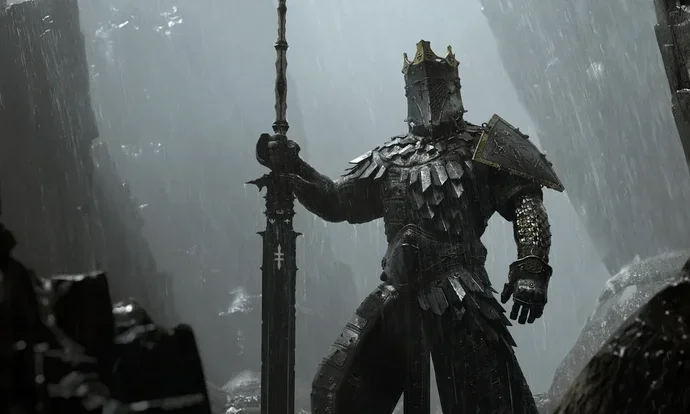
Most of my time was spent with Eredrim, an absolute unit of a man whose main ability is to shoulder charge enemies to stun them, opening them up for a follow-up attack. I foresee him being the 'easy mode' Shell, in part because his supporting ability also happens to be excellent at crowd control, interrupting enemies who get close enough to surround him. He also has a vast health bar that fits well with that headbutt-first-ask-questions-later approach, and the attire to match - a chainmail covered in metal scales with plating underneath, an angular helmet shaped like a fortress, and large pauldrons that make it hard to believe he's not from Warhammer.
If you take enough damage and your Shell's health reaches zero, you simply get knocked out of them, giving you a second chance in every encounter. You can return to your Shell by landing melee hits on enemies - but crucially not ranged attacks. There's no limit on how many times this can happen, except for the fact it takes longer and longer to return to your Shell each time you're kicked out of it.
Your Harbinger - the thing that embodies the Shell - can be levelled up, and each level comes with boosts here and there to your Shell. You don't control which stats to level up - everyone's level 50 Harbinger will look the same - however, your late-game Shell build will differ greatly from mine. And notably, build variety is what perhaps received the biggest upgrade in this sequel. There aren't just more options (eight compared to four); each Shell's skill tree is deeper, offering meaningful bonuses for players who want to laser-focus on a certain style, and enough varied options for those who want a more generalised build.
Shell skill trees can be altered at any Beacon (bonfire) to fit the situation. For instance, you can allocate points in fire resistance before fighting a boss who sets everything on fire. After the fight, you can refund those points and use them elsewhere. Your choice of Shell is what ultimately dictates how you're going to be playing the game, as you can't change their inherent stats or abilities, even if you can take them down differing paths.
Shells are clearly where a lot of developer Cold Symmetry's creativity went. Their abilities are built on some clever ideas that change up gameplay in ways that were genuinely a joy to witness. The most interesting - and most technical - is Smert, who stops time and bare-handidly attacks enemies to apply stacks of random afflictions that detonate when time resumes. I couldn't get into the right flow with them to make them my main, but I was certainly taking notes for the future.
Most Shells have to be sought out, hidden across the game's world. If you're happy to explore, you'll find them organically, but you can also spend a rare currency to learn their approximate locations instead. The same is true for most weapons. I was happy to scour every inch of the world over the course of my time, so I enjoyed the hunt. That world, meanwhile, is one of those that's being increasingly called a 'wide linear' one. The world is open: you can run from one edge to the other, but not without going through teleportation gates, bridges or other connecting bits that break up the scenery. I initially felt those were simply a technical compromise to prevent asset streaming issues, but I ended up liking them; they made the world feel like it's built from authored regions, rather than one big plot of land.
The world is large enough for you to sometimes feel lost, but as with the hunt for new Shells, my sense of curiosity was often rewarded with items and other discoveries almost everywhere I ventured. Most of what you see as you explore admittedly doesn't rise to the level of, say, Elden Ring, but I got distracted by strangely-shaped objects in the distance plenty of times, forgetting what brought me to that area to begin with. My only real issue with the game's world is the inconsistent placement of Beacons. Sometimes you come across multiple in a small area, other times you die and realise it'll take you minutes to get back to your corpse.
Seals, meanwhile, are another mechanic that adds a layer of agency to how you play. This is an example of an idea that started out in the first game as a basic feature that's now been expanded to become a new pillar. Seals are usable with or without a Shell, and they replace or augment what your block button does. For instance, the all-rounder keeps the block, and adds a parry if you time your block right - pretty straightforward. The Infinite Seal, however, removes the block entirely and tightens the parry window, but each successful parry is far more powerful as a result. A third replaces your block with the ability to turn into stone, a nod to that core Hardening mechanic of the original game.
I should also touch on Tarstones, an element that further boosts customisability in combat. These are essentially infusions, except detailed enough to force you to think carefully about your choice of weapon and sidearm. A minority is basic, applying elements to your weapon or adding passive buffs to your character. Most, however, can change attack animations, augment your weapon with new moves, or deliver the missing piece to complete your hyper-specific build. Not all Tarstones work with all weapons, so this isn't a flat buff everyone gets. Some of their descriptions were so intriguing I often switched to a weapon they support just to see the effect in action. And you better believe a few ended up in my notes about certain build combinations for my next playthroughs.
It's that wealth of intelligent design decisions and well thought-out features that creates the best moments of this game, and it's why - despite not having the build variety of a typical RPG - Mortal Shell 2 has plenty to convince you to start a second and third playthrough.
The most underwhelming part of Mortal Shell 2 is unfortunately its boss fights. Across the open world, there's a dozen or so encounters with what are essentially recolours and beefed up versions of existing enemies. Those fights are often bland, and I struggle to recall the majority of them. The real disappointment are the main bosses, of which there are six. Their designs may be eye-catching but they lack the grace and grandeur of even the least-memorable FromSoft bosses. My favourite is a toad-shaped boss whose ranged attack is… firing off a torrent of feces at you, which poisons you if it connects. Giving a new meaning to the phrase 'getting shit on'.
Part of that lack of memorable moments is the hurried presentation for the major bosses. Each gets a brief intro, but no opening speech and no unique boss theme. It made most of the fights feel devoid of the spectacle you'd expect.
They also aren't challenging, and it's mainly because they simply don't have enough attacks, and so end up just rotating through their two or three major moves while you wail on them - a test of your mechanical prowess these are not. This is sadly a problem that can't be solved by simply making them hit harder - that would only exacerbate it. Incidentally, that was one of my problems with the first game, too, but that game's disarmingly amateurish air and first-timer approach to solving design problems made it harder to judge it too harshly there.
As for the technical side, though far more polished than the original, Mortal Shell 2 still isn't quite as polished as I want it to be. The review build took several patches during my time and each made things better, so I know polish is something that'll continue to improve. Indeed, a sizable day one patch arrived alongside advanced access on 17th August.
I do, however, still have to highlight the issue. Great Soulslikes strive for integrity in their difficulty. There were several moments where I wasn't sure whether the enemy or boss' attacks never gave me an opening because it was bugged, or because I needed to get better at reading it. Reattempting the fight proved it's the former in the majority of cases, and reassuring as that might be for my own skill, that's not something you want to have to worry about.
Those issues aside, Mortal Shell 2's greatest triumph is realising the ambitions of the original game. Its lauded combat is further expanded through new weapons and inventive sidearms. The world is denser, invites poking around its many nooks and crannies, and offers plenty of opportunities to experience the game's best moments. The narrative is more direct without fully tipping its hand too early, even if its boss fights didn't move me, be that to scream at my TV in anger or tear up at some of their melancholic origins.
The good news is issues of polish are easy to forgive when the game feels as good as Mortal Shell 2 moment-to-moment, and those bosses are only an isolated part of the experience overall. As a sequel, it delivers on practically every front. As a standalone action game, it has plenty to offer Soulslike fans - and really anyone eager to dig their teeth in a meaty game from a developer punching above its weight.
A copy of Mortal Shell 2 was provided for this review by Playstack.
Read this next
- Surprise! After getting over 500,000 downloads on Steam, there's a Mortal Shell 2 beta live right now on PlayStation 5 and Xbox Series X/S
- Mortal Shell 2 sells out of physical Revered Edition PS5 pre-orders as players rush to buy the highly-anticipated game on disc
- Brutal Soulslike Mortal Shell 2 chooses violence, sets release date in the 2026 August traffic jam