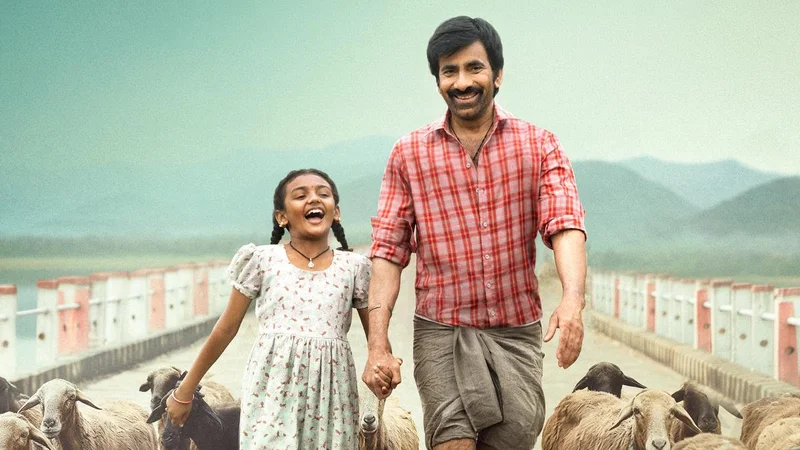
At the first sign of abuse, a character in the Telugu film Irumudi asks his daughter not to blow it up into a big issue. She wants to raise a complaint, but he states that fear is the best safety armour for a girl child. Another character empowers his daughter to be transparent and share all the happenings at school and the village without fear. These contrasting approaches of two fathers become the film’s biggest takeaway. The other significant takeaway is how Irumudi marks the return of Shiva Nirvana and Ravi Teja to form after a few middling films.
Shiva Nirvana begins to unravel the film with a sense of foreboding and maintains this mood until the very end. He sets the story in a village in Andhra Pradesh where bus connectivity is a luxury. Parents think twice before sending their children to a high school in a nearby town. The school has its own can of worms. The film opens with an incident of corporal punishment meted out to an adolescent girl. This is contrasted by how the male protagonist, Trinath (Ravi Teja), beats up a truck driver for honking loudly at the crack of dawn when his daughter is still asleep.
It’s a given that these two worlds will collide. As several characters in the village are introduced, the director, who has also written the film, drops ample hints at the danger that lurks all around.
Irumudi (Telugu)
What might have been a regular story of father-daughter bonding, threat and retaliation gets an additional layer of intrigue with the devotional fervour. Trinath is a small-time trader who takes to the bottle barring the 41-day Ayyappa deeksha, much to the annoyance of his wife Kaveri (Priya Bhavani Shankar). The spiritual fervour is also used to establish the bond between Trinath and his daughter Manemma or Manikanta (child actor Nakshatra).
Trinath reiterates that he considers every girl child in the village to be his own daughter and hence will stand up for them. Subtle humour works as an undercurrent in the portions where Ravi Teja’s action hero image is channelled into establishing him as a protective guardian for the girls in the village. His approach is starkly different from that of his family friend Guru ‘swamy’ (Sai Kumar).
At regular intervals, the narrative introduces ominous miscreants. To be frank, I watched some of these portions with a sense of unease, knowing very well how mainstream cinema, across languages, often lacks sensitivity in depicting sexual violence. Mercifully, Shiva Nirvana sidesteps some predictable tropes as the story progresses. There is danger, there is sexual assault, but thankfully the portrayal is not voyeuristic. And the perpetrators are not the usual suspects. They never are. However, anyone habituated to watching mainstream movies is likely to be suspicious of one of the key characters and will not be proved wrong.
The ramifications of abuse can still shake up viewers because of the emotionally resonant storytelling. It exposes the vulnerability of a girl child and her parents. There is heartbreak, guilt, anger and rage. There is also the underlying statement of how parents need to lend a patient ear to their children when they speak up.
The father-daughter bond forms the crux of the narrative, and both Ravi Teja and child actor Nakshatra score on this front. This is the most sincere performance from Ravi Teja in the last few years. He is mostly restrained. Even in the action sequences, he does not get to unleash one-liners or any quirks associated with mass action templates. Nakshatra’s part has been written carefully, without going overboard, and the child actor comes up with an innocent and effective portrayal. She is the soul of the film. The other adolescent students are also convincing in their parts.
Priya Bhavani Shankar might play the third character in the family drama dominated by the father and daughter, but she manages to make her presence felt with a sincere turn. We could see more of her in Telugu cinema. Sai Kumar, as always, chips in with a nuanced performance.
GV Prakash Kumar’s music adds credence to the Ayyappa deeksha portions and conveys the sense of danger as the mystery deepens. Considerable support also comes from the technical team, including cinematographer Vishnu Sharma, production designer Sahi Suresh and costume designer Rajesh Kamarsu who do what is required for the story.
A major sore thumb in the narrative is the absence of law enforcement authorities. A mysterious death here and a purported murder elsewhere, but the police are nowhere to be seen. The single-note characterisation of the sinister teacher is another drawback.
One can debate on whether the pre-climax portions rely on shock value to make an emotional connect, but the storytelling remains effective that it is hard to look away from what’s unfolding.
Despite occasional missteps, Irumudi emerges as an emotionally moving drama.
Published - August 21, 2026 02:47 pm IST