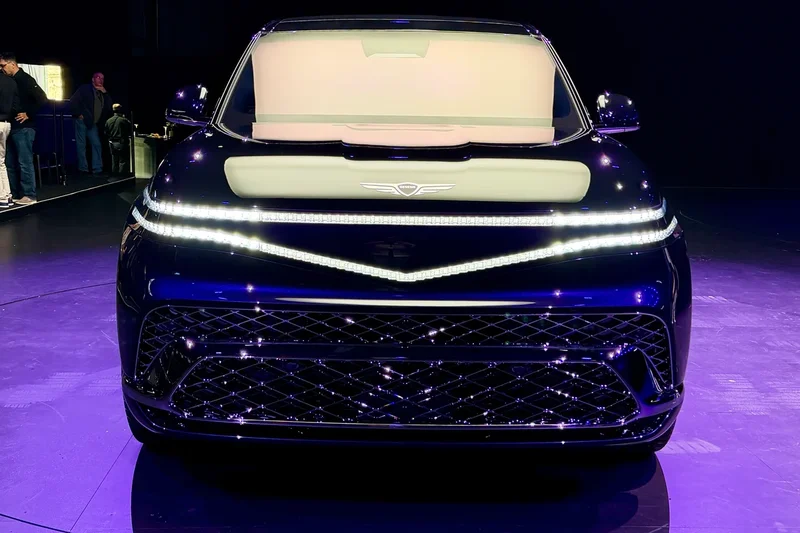
The new Genesis GV90 may be big, but the biggest news around the Korean brand’s Range Rover rival could be what comes next.
Genesis design boss Luc Donckerwolke has confirmed that the electric flagship is the first model in a new generation of cars that will reshape the whole range. And once the GV90 has shown how large Korean luxury can go, a smaller Genesis is on the way to prove that size is not everything.
Speaking to The Independent at the GV90’s unveiling in San Francisco, Donckerwolke strongly hinted that a smaller model will be revealed in the near future, possibly in New York next year.
“I do believe that luxury is not a factor of size,” he said. “I think that the near future will give you an answer to that. And we have still a lot of work to do with Genesis – we’ve just started. So, we have a lot of portfolio development to do.”
When pressed on when the next model might appear, Donckerwolke said: “It’s a couple of months too early to show the next model of the lineup.”
Genesis has a history of revealing cars in New York, with the Neolun concept, the forerunner to the new GV90, revealed in the city in 2024.
That points towards a possible reveal for a new, smaller Genesis in New York during 2027, possibly around the New York International Auto Show at the end of March, although Genesis has not confirmed the car, venue or date. The big question is whether it could revive the thinking behind the tiny Genesis Mint concept, which itself was revealed in New York back in 2019, or take the form of a more conventional small luxury car.
Either way, it will follow a very different opening act – the GV90 is Genesis’s biggest and most ambitious car yet, a full-size electric SUV with up to seven seats, a 123.5kWh battery and an estimated range of around 311 miles.
The GV90 is the first car in what Donckerwolke calls the second generation of the Genesis model range. Work on the next GV80 and G80 is already well advanced, and the technology, seats, materials and cleaner design developed for the flagship are likely to make their way into other cars.
Donckerwolke said Genesis had reached the point where it either had to step up or risk being left behind by more established luxury brands. The GV90 became the car on which it could try its boldest ideas, including those complicated ‘Neolun Arch Gate’ doors and slim lights, before using what it learned elsewhere.
However, the platform beneath the GV90 is not expected to become the basis of the smaller Genesis. Called eMP, short for Electric Mobility Prime, it has been developed specifically for the brand’s flagship electric SUV rather than as a replacement for the E-GMP platform already used by electric Genesis, Hyundai and Kia models.
The common link between the GV90 and future cars will instead be Genesis’s distinctly Korean idea of luxury. At the centre of that is son-nim, a Korean approach to hospitality that means treating a customer as an honoured guest. That explains why the GV90 focuses so heavily on entering the car, the comfort of those inside and the way its technology operates without constantly demanding attention.
Donckerwolke said the company’s use of new technologies like artificial intelligence still had to serve the person inside the car rather than simply add another item to the equipment list. “We’ll never change that; we’ll never compromise on the customer,” he said.
SangYup Lee, executive vice-president and head of the Hyundai and Genesis Global Design Centre, told The Independent that Genesis is developing around three pillars: luxury, performance and cool. The GV90 represents luxury, while performance will come from the Magma sub-brand. The first GV60 Magma is set to be followed by faster versions across the Genesis range, supported by the Magma GT and the company’s new motor racing programme.
Then there is the cool side, represented by concepts such as the 1,100bhp X Skorpio desert car and the electric Box Buggy. The latter is a compact shuttle with wheels that can turn independently, allowing it to move sideways or spin within its own length.
For now, the Box Buggy and X Skorpio remain concepts. But Donckerwolke made clear that he wants the ideas behind Genesis’s more adventurous creations to reach customers.
“I don’t want those things to be just great concepts,” he said. “They will have to come on the road and this is the big task now. So the next five years will be very busy.”
What is clear is that the GV90 is more than a new flagship. It marks the starting point for a second generation of Genesis cars built around Korean hospitality, simpler design, Magma performance and a more playful collection of smaller models.