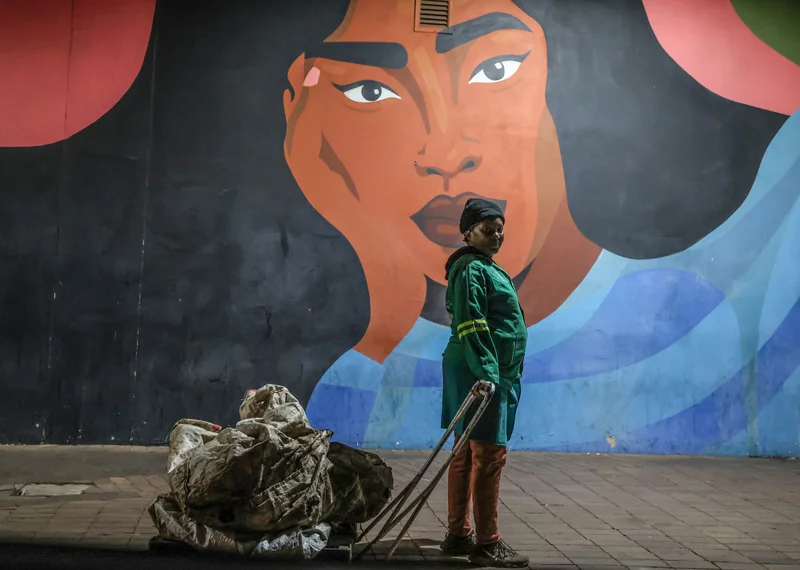
Ernestine Molhobotji wakes around 4 am.
She layers up against the Joburg winter cold, then she puts on a pair of gloves, a protective mask and clothing lined with reflective material.
The reflective material will keep her visible in the dark, for her working day starts long before the sun rises.
Finally Molhobotji gathers her primary work tool â her trolley.
Molhobotji is one of Johannesburgâs informal workers who collect, sort and sell recyclable materials like plastic, glass, cardboard and metal.
Her typical day will start with a 3km walk from Bertrams to Commissioner Street.
By the time the sun is peeking above the horizon Molhobotji is deep in her work. Her hands reach into bins in search of the everyday items that Johannesburgers have thrown away.
There are thousands of reclaimers â like Molhobotji they work Joburgâs streets and landfills pulling heavy trolleys through neighbourhoods, racing municipal truck refuse collectors.
Reclaimers play a big role in keeping the city clean and reducing landfill waste, saving the municipal entity Pikitup large sums of money.
There was a time when Molhobotji did not collect recyclable waste.
Job loss
She made African-inspired art, working mostly at a market in Rosebank. When she lost her job in 2013, her friend and housemate, who was already a recycler, helped her get into the trade.
From Commissioner Street, she works her way roughly 2km further, through Harrison and Jeppe streets, hauling out bins from local flats and going through each one by one.
When her bags are full on her trolley, Molhobotji will head to the depot on Harrison Street. By now Joburg is awake and she shares the city streets with the early morning traffic.
With her collecting for the morning over, she heads to the sorting area in the basement of the depot, where she sorts through the recyclables she has collected.
Molhobotji is the sole provider for her two children, aged 16 and 18.
âI know that when I go out to work, I will not go home with nothing⦠When I look at my trolley and see a big haul, I feel happy because I know I have made money.â
On a good day, Molhobotji makes roughly R500, an amount she says she is satisfied with.
According to The Outlierâs 2024 research, most reclaimers earn between R300 and R600 per week, although some earn higher amounts, peaking at about R7,000. Such earnings are rare.
Molhobotjiâs experience is set against broader challenges faced by reclaimers, who earn a small fraction of SAâs billion-dollar waste industry and are often disregarded, underappreciated and rarely recognised for their work. Many also face numerous health and safety risks, including exposure to potentially hazardous materials, injuries and the threat of violence on the streets of the city.
Despite working in the early hours, Molhobotji says she does not encounter the danger often associated with the cityâs streets.
âI donât have problems with robbers or people who want to harm me. I walk knowing that I am going to be safe and that I am going to work.â
There is a sense of pride in her work that allows her, as a mother, to provide for her family.
âMy life seems okay because Iâm able to get food to eat and Iâm able to pay rent as usual.â DM