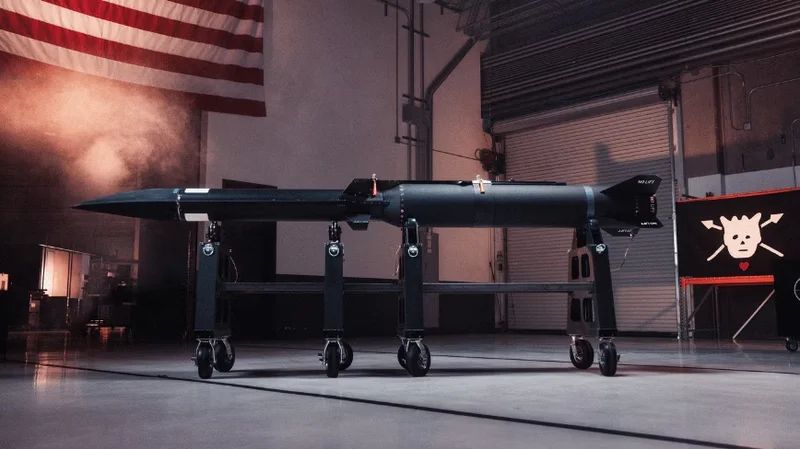
Castelion has raised $1bn at a $13bn valuation. Three SpaceX executives founded the company in 2022 to build missiles. Its first product is Blackbeard, a hypersonic strike weapon designed for quantity rather than craft.
The structure repays a close read. The round is $800m in equity plus $250m of committed financing for a revolving credit facility, the company said. A revolver is a credit line rather than a cheque. The equity figure is the one that sets the valuation.
JPMorganChase’s Strategic Investment Group co-led with Andreessen Horowitz and funds managed by Carlyle. Lightspeed, Lavrock Ventures, Altimeter, General Catalyst and Interlagos all returned. T. Rowe Price came in new, and that is the detail a banker notices. A public-markets manager has taken a position before there is a public market.
The pitch is manufacturing, not engineering
Castelion does not claim to build a better missile than Lockheed Martin or RTX. It claims it can build more of them, faster and cheaper, by running a factory the way SpaceX runs one.
Andrew Kreitz, co-founder and chief financial officer, put the problem plainly on Bloomberg Tech. Making thousands of weapons at low cost is the central challenge, he said, and his time at SpaceX shaped the approach. Bryon Hargis and Sean Pitt, the other two founders, came from the same place.
The evidence sits in New Mexico. Project Ranger is a 1,000-acre campus in Sandoval County. Castelion calls it the largest dedicated hypersonic missile manufacturing site in the country. The company has already put more than $250m of its own capital into it, and says hundreds of millions more will follow.
“Very few teams convert capital into physical capability at that ratio,” said Ravi Mhatre, co-founder of Lightspeed. His firm led the Series A before a complete system had flown.
What the Pentagon has actually paid
Castelion says it has booked more than $500m in US military contracts over 18 months. It also took Blackbeard from a blank sheet to a programme of record in under four years, with fielding targeted for 2027.
One contract is public in detail, and it is the useful number. In June the US Navy placed a $23.4m firm-fixed-price order. It covers 50 Blackbeard early operational capability pre-production prototypes and 50 storage and shipping containers. Work runs mainly out of Rio Rancho, New Mexico, and finishes in 2027.
Those are prototypes, not fielded rounds, so the figure is no unit price for a finished weapon. It remains the only public price the government has attached to this thing. Set it against the framework agreement, which targets a minimum of 500 missiles a year once testing completes. Tech Funding News notes that rate is closer to a production line than a defence workshop.
The distance between 50 prototypes and 500 a year is what $13bn buys.
Andreessen Horowitz now holds three of these
The round states a thesis a16z has built for years through its American Dynamism fund. That fund also holds Anduril and Hadrian. Hadrian builds automated factories for defence parts, and raised $1.37bn at close to $8bn a fortnight ago.
“American Dynamism has always believed that the hardest and most important problems are physical ones,” said Katherine Boyle, a general partner at the firm. She described backing Castelion when it was “a small team that wanted to build what the department of War most needed faster and cheaper than the experts thought possible”.
One fund does not make a pattern, and this is a pattern. Cambridge Aerospace raised $300m at a $3.4bn valuation this month for air defence. Smack Technologies took $61m as the Pentagon’s procurement hurry turned into a business model. In Europe the money is chasing drones, and Helsing is using Rakuten to reach Japan’s arms market.
Why Washington is paying up
The demand side is a stockpile problem. Hypersonic weapons travel above Mach 5 and manoeuvre in ways that complicate existing air defences. The American inventory has not kept pace with China’s, as TechCrunch’s Marina Temkin reported. Castelion bets the bottleneck is production capacity rather than physics.
Its investors say the same thing in different registers. Todd Combs, who runs the Strategic Investment Group at JPMorganChase, framed the deal as strengthening the defence industrial base. Carlyle’s Aaron Hurwitz called the company “a critical asset to national security”.
Hargis was blunter. “Deterrence depends on unapologetic American strength,” he said, describing weapons “produced in quantities they can’t imagine at a price taxpayers can afford”.
The claim that has to survive contact
Emma Norchet of T. Rowe Price named what distinguishes the company: “contracts in hand, a manufacturing campus built with its own capital, and unit economics that improve with scale”. That last clause is the entire investment case. It is also unproven at rate.
Defence primes have promised high-rate, low-cost production for decades and have largely not delivered. Their cost structures tend to move the other way. Low volumes and bespoke requirements are what the customer keeps ordering, so that is what the factories get built for. Castelion designs the weapon around the factory instead. That is genuinely different, and nobody has yet demonstrated it across a full production run.
A concentration question sits underneath the valuation too. Almost all the revenue comes from one customer. That exposes the company to a single budget cycle, a single set of programme reviews, and the chance that a later administration wants something else entirely.
The test has a date on it. Blackbeard should reach the field in 2027, and the framework agreement calls for 500 a year after testing. Hit that rate near the quoted price, and the manufacturing argument will have been proved in the hardest setting available. Miss it, and $13bn will have bought a factory that works about as well as the ones it was meant to replace.
Get the TNW newsletter
Get the most important tech news in your inbox each week.